Facts
The respondent instituted a commercial suit for recovery of ₹39,37,880.64, with pendente lite and future interest at 18% per annum.
Source reference: pp. 2–3; paras 3–5Summons were served on the petitioner by email on 6 December 2023 and again on 20 March 2024 at “bhaviksanghavi20@gmail.com”; the Trial Court directed the petitioner to file its written statement within the statutory period.
Source reference: pp. 2–3; paras 3–5As the petitioner failed to file the written statement within 30 days, the Trial Court closed its right to file the written statement and struck off its defence on 6 June 2024, while permitting it to seek condonation within the outer period of 120 days.
Source reference: p. 3; para 6The petitioner claimed that it first acquired knowledge of the suit on 21 August 2024 and thereafter sought recall of the service order, return or rejection of the plaint, and ultimately filed its written statement on 27 December 2024.
Source reference: pp. 4–5; paras 8–12The Trial Court rejected the petitioner’s applications under Order VIII Rule 1 read with Order V Rule 1(1), Order VII Rules 10 and 11, and Order XLVII Rule 1 read with Section 114 CPC, while permitting the respondent to place an updated plaint and related documents on record.
Source reference: p. 5; para 13The petitioner challenged the rejection of its written statement and review applications under Article 227 of the Constitution.
Source reference: p. 5; para 14Issues
1. Whether the petitioner was duly served through the email address “bhaviksanghavi20@gmail.com”, and whether the alleged defects in the mode or completeness of service invalidated service of summons.
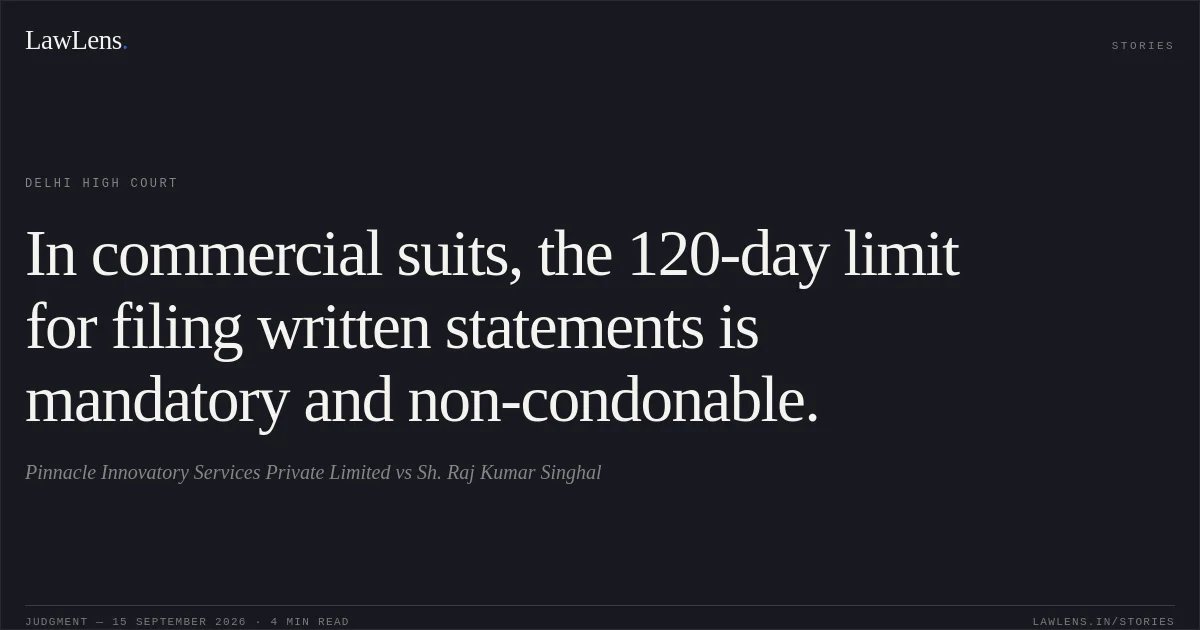
Source reference: pp. 6–8; paras 22–262. Whether the petitioner could file its written statement on 27 December 2024 after expiry of the mandatory 120-day period prescribed in commercial suits.
Source reference: pp. 8–10; paras 27–293. Whether the Trial Court’s order disclosed any ground for review under Order XLVII Rule 1 read with Section 114 CPC.
Source reference: pp. 9–10; paras 30–314. Whether the impugned order suffered from any patent illegality, jurisdictional error, or other infirmity warranting interference under Article 227 of the Constitution.
Source reference: p. 11; para 32Law Applied
The Court applied Order VIII Rule 1 CPC, as modified by the Commercial Courts Act, 2015, under which the defendant must file its written statement within 30 days of service and, in any event, within the mandatory outer limit of 120 days, after which the right is forfeited.
Source reference: p. 8; para 27It also considered Order V Rule 1(1) CPC concerning service of summons, including electronic service, and the requirement that summons be accompanied by the plaint and necessary documents.
Source reference: pp. 6–8; paras 22–26The Court relied on SCG Contracts (India) (P) Ltd. v. K.S. Chamankar Infrastructure (P) Ltd., (2019) 12 SCC 210, for the rule that the 120-day outer limit in commercial suits is mandatory and cannot be condoned.
Source reference: p. 8; para 27Review under Order XLVII Rule 1 read with Section 114 CPC is confined to discovery of new and important matter, an error apparent on the face of the record, or another sufficient reason; it cannot be used as an appeal or for re-arguing issues already decided.
Source reference: pp. 9–10; para 31The Court relied on S. Murali Sundaram v. Jothibai Kannan, (2023) 13 SCC 515, for this limited scope of review.
Source reference: pp. 9–10; para 31Reasoning
The Court held that the email address used for service was connected with the petitioner and had been disclosed by it in statutory filings before the Ministry of Corporate Affairs, including Forms CHG-1 and DPT-3. The petitioner therefore could not disown that address to avoid service of court process.
Source reference: p. 7; para 23The record also showed that service was not exclusively electronic, as process fee had been filed for registered post, and the Trial Court had found that complete summons had been served.
Source reference: pp. 7–8; paras 25–26Even assuming that service was reckoned from the later date of 20 March 2024, the 120-day period expired in July 2024. The written statement filed on 27 December 2024 was therefore irretrievably beyond the permissible period.
Source reference: p. 8; para 27The petitioner had also acquired knowledge of the proceedings by 21 August 2024 but chose to pursue other applications instead of filing its written statement and seeking condonation within the permissible period, which further undermined its claim of bona fides.
Source reference: p. 9; para 29The review application merely repeated objections already considered and disclosed neither new material nor an error apparent on the face of the record.
Source reference: pp. 9–10; paras 30–31Consequently, no jurisdictional error or patent illegality justified supervisory interference under Article 227.
Source reference: p. 11; para 32Holding
The High Court held that the petitioner was duly served, at the latest, on 20 March 2024; that the 120-day statutory period for filing the written statement had expired in July 2024; and that the written statement filed on 27 December 2024 could not be taken on record.
The Trial Court had rightly forfeited the petitioner’s right to file the written statement and had correctly dismissed the review application, since no new material or error apparent was established.
Source reference: p. 11; para 32The petition was dismissed, along with all pending applications, and no relief was granted to the petitioner.
Source reference: p. 11; para 33Acts & Sections Cited
2 provisions across 1 statute referred to in this judgment. Each provision opens on LawLens.
Code of Civil Procedure, 19082
Original Court PDF
Pinnacle Innovatory Services Private LimitedvsSh. Raj Kumar Singhal
Click to open original judgment
Original judgment, available to read, download and summarize on LawLens.in