Facts
On 17 February 2005, the deceased was travelling as a pillion rider on a motorcycle on the Rajkot–Bhavnagar Road when it collided with an unidentified vehicle; the deceased died from injuries sustained in the accident
Source reference: pp. 1, 3–4The Motor Accident Claims Tribunal, Rajkot, allowed the claim petition and made an award dated 11 March 2014.
Source reference: para. 1The insurer appealed, arguing that the Tribunal had not assessed the negligence of both vehicles and that liability should not have been imposed on the insured motorcycle’s owner and insurer when the other vehicle was unidentified.
Source reference: para. 5Issues
Whether the insurer could challenge the award on the ground that the Tribunal had not apportioned negligence between the motorcycle and the unidentified vehicle
Source reference: para. 5; p. 4Whether the claimants could recover compensation from the insured motorcycle’s owner and insurer without joining the driver or owner of the unidentified vehicle
Source reference: pp. 4–5, 8Law Applied
Section 173 of the Motor Vehicles Act, 1988, provides for an appeal against an award of a Claims Tribunal.
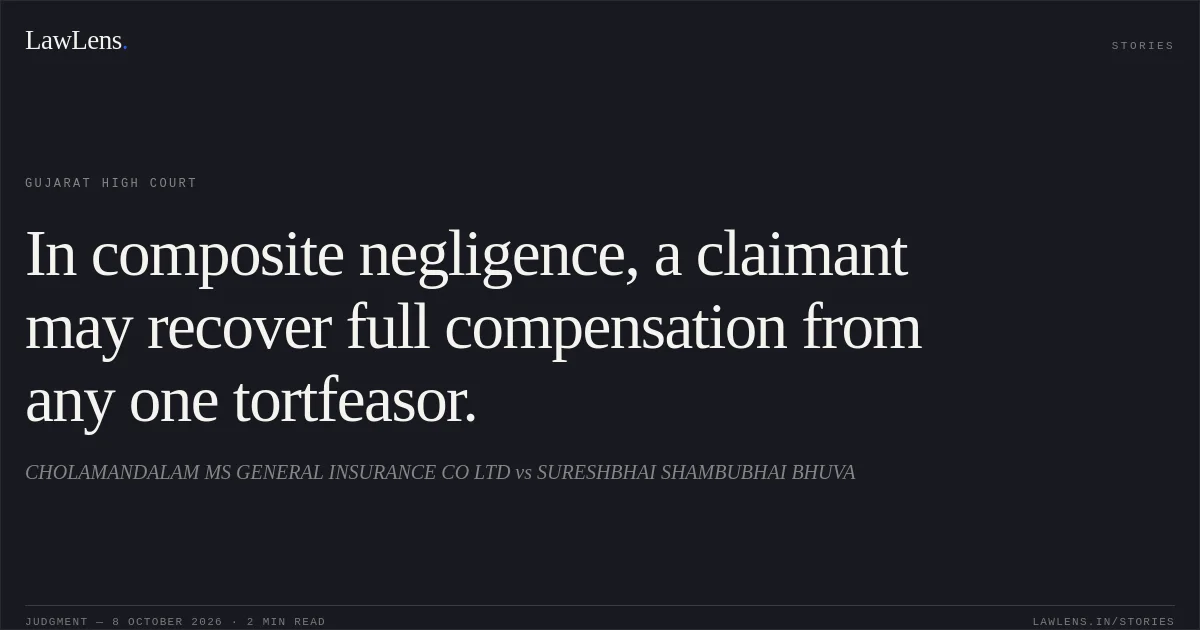
Source reference: para. 1Under the doctrine of composite negligence, a claimant may sue either or both joint tortfeasors and recover the entire compensation from any one of them; apportionment between tortfeasors is not made against the claimant. Where all tortfeasors are not joined, the Tribunal should not determine their respective shares of negligence; any claim for contribution may be pursued separately (Khenyei v. New India Assurance Co. Ltd., (2015) 9 SCC 273, para. 22, quoted at pp. 5–6).
Source reference: pp. 5–6Further, negligence of the vehicle’s driver is not imputed to an innocent passenger (Union of India v. United India Insurance Co. Ltd., (1997) 8 SCC 683, quoted in Sushma v. Nitin Ganapati Rangole, AIR 2024 SC 4627, para. 18, pp. 6–7).
Source reference: para. 18; pp. 6–7Reasoning
The deceased was a pillion passenger, and the evidence established that the motorcycle and an unidentified vehicle were involved in the fatal accident.
Source reference: pp. 3–4The Court treated the accident as a case of composite negligence and held that the claimants could seek full compensation from one tortfeasor without joining the other.
Source reference: para. 7Because the unidentified vehicle’s owner or driver was not before the Tribunal, it was not necessary to apportion negligence between the vehicles in the claimants’ proceedings.
Source reference: paras. 7–8The driver’s alleged negligence also could not be attributed to the deceased passenger.
Source reference: para. 9The Tribunal’s approach was described as mechanical, but that did not justify setting aside the award.
Source reference: para. 8Holding
The Court rejected the insurer’s challenge, holding that the claimants could recover compensation from the insured motorcycle’s owner and insurer as joint tortfeasors without an assessment of inter se negligence in the absence of the other tortfeasor.
The First Appeal was dismissed; the connected civil application was disposed of as not surviving, and the record and proceedings were ordered returned to the concerned court.
Source reference: paras. 13–14Acts & Sections Cited
1 provisions across 1 statute referred to in this judgment. Each provision opens on LawLens.
Motor Vehicles Act, 19881
Original Court PDF
CHOLAMANDALAM MS GENERAL INSURANCE CO LTDvsSURESHBHAI SHAMBUBHAI BHUVA
Click to open original judgment
Original judgment, available to read, download and summarize on LawLens.in