Facts
On 9 March 2023, Bhuvana was travelling as a passenger in a Tamil Nadu State Transport Corporation bus bearing Registration No. TN 25 N 0281 near Sammanthanur Koot Road on the Tindivanam–Tiruvannamalai Road.
Source reference: pp.2–3, paras.2–3The bus collided with a two-wheeler and capsized, causing the claimant multiple grievous injuries, including an L1 wedge-compression fracture.
Source reference: pp.2–3, paras.2–3The Corporation denied negligence, attributed the accident solely to the two-wheeler rider, and contended that the owner and insurer of the two-wheeler were necessary parties.
Source reference: p.3, para.3The Tribunal conducted a joint trial with two other connected claims and, relying on the FIR, evidence of the bus driver and police official, rough sketch, and Motor Vehicle Inspector’s reports, held that the accident resulted from composite negligence of both vehicles.
Source reference: pp.3–5, paras.4–6The Tribunal awarded ₹5,69,714 under various heads, including permanent disability, pain and suffering, medical expenses, loss of amenities, and loss of income during treatment.
Source reference: p.6, para.7The Transport Corporation challenged both the finding of negligence and the quantum of compensation under Section 173 of the Motor Vehicles Act, 1988.
Source reference: pp.1–2Issues
Whether the Tribunal was justified in holding that the accident resulted from the composite negligence of the bus and the two-wheeler, notwithstanding the police final report against the two-wheeler rider?
Source reference: pp.8–10, paras.11–14Whether the claim was liable to fail for non-joinder of the owner and insurer of the two-wheeler?
Source reference: p.10, para.14Whether the compensation of ₹5,69,714 awarded by the Tribunal was excessive or otherwise warranting appellate interference?
Source reference: pp.10–11, paras.15–16Law Applied
The Court exercised appellate jurisdiction under Section 173 of the Motor Vehicles Act, 1988, while examining the Tribunal’s findings on negligence and compensation.
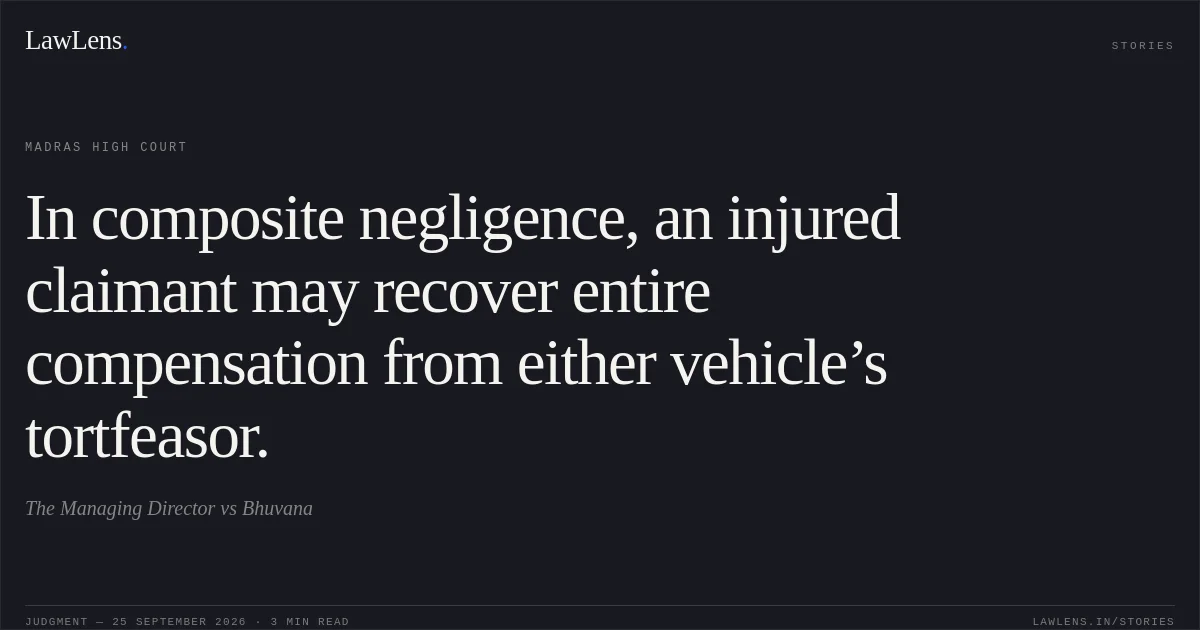
Source reference: p.1It applied the doctrine of composite negligence, under which a claimant injured by the combined negligence of two vehicles may recover the entire compensation from the owner or insurer of either vehicle, leaving issues of contribution between the tortfeasors to be resolved separately.
Source reference: pp.4–5, para.6The Court relied on APSRTC v. K. Hemalatha and Others, Order dated 28 April 2008 in SLP(C) Nos.10950–10953 of 2005, as cited by the Tribunal.
Source reference: pp.4–5, para.6For quantum, the Court accepted the percentage method for assessing non-functional permanent disability where no evidence established loss of earning capacity, and upheld reasonable awards supported by medical records and bills.
Source reference: p.10, para.15Reasoning
The Court held that the police final report against the deceased two-wheeler rider was not conclusive in the claim proceedings.
Source reference: pp.9–10, paras.13–14The bus driver’s testimony was not corroborated by any independent eyewitness or passenger, whereas the rough sketch placed the accident at the middle of the road and the Motor Vehicle Inspector’s reports showed damage to the front portions of both vehicles, consistent with a head-on collision.
Source reference: pp.9–10, paras.13–14These circumstances supported the Tribunal’s finding that both vehicles had failed to maintain their respective lanes and had contributed to the accident.
Source reference: pp.9–10, paras.13–14The Corporation’s failure to implead the owner or insurer of the two-wheeler did not defeat the claimant’s remedy against the Corporation in a composite-negligence case.
Source reference: p.10, para.14On quantum, the Court found that the Medical Board had assessed 15% permanent disability, but there was no evidence that the disability impaired the claimant’s earning capacity; accordingly, the Tribunal rightly adopted the percentage method at ₹7,000 per percentage, awarding ₹1,05,000.
Source reference: p.10, para.15The awards for pain and suffering, extra nourishment, attendant charges, medical expenses, loss of amenities, and six months’ loss of income were supported by the medical records, treatment period, medical bills, and the claimant’s occupation and income evidence.
Source reference: pp.10–11, paras.15–16No perversity or legal error warranting appellate interference was established.
Source reference: pp.10–11, paras.15–16Holding
The Court answered the issues against the Transport Corporation.
It affirmed the finding of composite negligence and held that the claimant could recover the compensation from the Corporation despite the non-joinder of the two-wheeler’s owner and insurer.
Source reference: pp.10–11, paras.15–16The compensation of ₹5,69,714 was found reasonable and was upheld.
Source reference: pp.10–11, paras.15–16The Civil Miscellaneous Appeal was dismissed, and the award dated 27 June 2025 in MCOP No.693 of 2023 was confirmed.
Source reference: p.12, para.17The Transport Corporation was directed to deposit the award amount with proportionate interest and costs, less any amount already deposited, within six weeks; the claimant was permitted to withdraw the amount in accordance with the Tribunal’s order.
Source reference: p.12, para.17No costs were awarded in the appeal, and the connected miscellaneous petition was closed.
Source reference: p.12, para.17Acts & Sections Cited
1 provisions across 1 statute referred to in this judgment. Each provision opens on LawLens.
Motor Vehicles Act, 19881
Original Court PDF
The Managing DirectorvsBhuvana
Click to open original judgment
Original judgment, available to read, download and summarize on LawLens.in