Facts
On 13 July 2017, Inkaben was travelling as a pillion rider on motorcycle No. GJ-16-BE-9447, driven by her husband, Sanjaybhai, from Kasak towards Zadeshwar. When a cow allegedly came onto the road, the motorcycle driver applied sudden brakes, following which motorcycle No. GJ-16-BD-1367 collided with it from behind. Inkaben fell onto the road, sustained serious head injuries, and died during treatment on 14 July 2017. An FIR was registered against the driver of motorcycle No. GJ-16-BD-1367
Source reference: para. 3.1, p. 2The claimants alleged that the deceased was 42 years old, operated a catering business, and earned approximately Rs. 50,000 per month; they claimed Rs. 1 crore as compensation
Source reference: para. 3.2, p. 2The Motor Accident Claims Tribunal, Bharuch, dismissed MACP No. 375 of 2017 on the ground that the deceased was a pillion rider and the accident resulted solely from the negligence of the driver of the motorcycle on which she was travelling.
Source reference: para. 2, p. 1The claimants challenged that decision under Section 173 of the Motor Vehicles Act, 1988.
Source reference: para. 2, p. 1Issues
Whether the Tribunal erred in dismissing the motor accident claim by attributing the negligence of the motorcycle driver to the deceased pillion rider.
Source reference: paras. 5–7, pp. 2–8Whether, in a case involving composite negligence of two vehicles, the Tribunal could determine the inter se negligence of the drivers so as to defeat the claim against one of the alleged tortfeasors.
Source reference: para. 5, pp. 2–3Whether the matter required remand for fresh adjudication on the claimants’ entitlement and quantum of compensation.
Source reference: paras. 8–9, p. 9Law Applied
The Court applied Sections 168 and 173 of the Motor Vehicles Act, 1988, requiring the Tribunal to determine and award just compensation and providing for an appeal to the High Court.
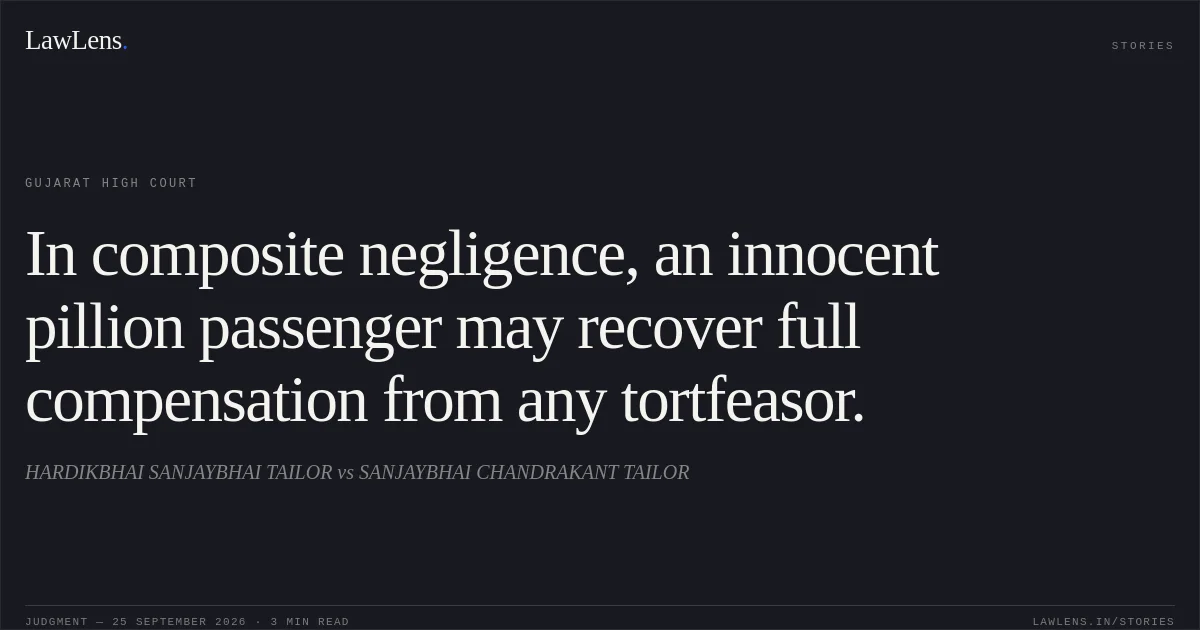
Source reference: paras. 2, 5.1, pp. 1–3Relying on Khenyei v. New India Assurance Co. Ltd., (2015) 9 SCC 273, the Court held that in cases of composite negligence, the claimant may sue any one or more joint tortfeasors and recover the entire compensation from any one of them; apportionment of negligence is not permissible against the claimant, although inter se apportionment may be determined for subsequent contribution proceedings where appropriate.
Source reference: para. 6, pp. 3–5Following Sushma v. Nitin Ganapati Rangole, AIR 2024 SC 4627, and the principle stated in Union of India v. United India Insurance Co. Ltd., (1997) 8 SCC 683, the Court held that the negligence of the driver cannot be imputed to an innocent passenger or pillion rider.
Source reference: para. 6, pp. 5–7The Court also invoked N.K.V. Bros. (P) Ltd. v. M. Karumai Ammal, (1980) 3 SCC 457, cautioning that accident claims should not be defeated by technicalities and that Tribunals must protect innocent victims and award just compensation.
Source reference: para. 7.1, pp. 8–9Reasoning
The High Court found that Inkaben, being a pillion rider, could not be treated as contributorily negligent merely because the motorcycle driver may have driven negligently; the driver’s negligence could not legally be imputed to her.
Source reference: para. 5, p. 2; para. 6, pp. 5–7The accident involved the alleged negligence of both motorcycles and therefore raised a question of composite negligence. Under Khenyei, the claimants were entitled to proceed against any one joint tortfeasor and were not required to establish or bear the consequences of an inter se apportionment of negligence between the two vehicles.
Source reference: para. 5, pp. 2–5The Tribunal therefore adopted an impermissible approach by assessing the relative negligence of the two drivers and dismissing the claim on that basis, particularly when it had itself referred to Khenyei.
Source reference: para. 7, p. 8However, the High Court expressly refrained from deciding the merits, liability, or quantum of compensation and directed a fresh adjudication by the Tribunal.
Source reference: paras. 8.1–9, p. 9Holding
The appeal was allowed.
The Tribunal’s judgment and award dated 21 December 2024 in MACP No. 375 of 2017 were quashed and set aside.
Source reference: para. 8, p. 9The claim petition was remanded to the Tribunal for fresh determination in accordance with law, without being influenced by the impugned order.
Source reference: para. 8.1, p. 9The parties were directed to appear before the Tribunal on 16 October 2026, and the Tribunal was directed to permit them to lead evidence, if desired, and decide the matter within three months from that date.
Source reference: para. 8.2, p. 9The High Court clarified that it had not adjudicated the merits of the claim.
Source reference: para. 9, p. 9Acts & Sections Cited
2 provisions across 1 statute referred to in this judgment. Each provision opens on LawLens.
Motor Vehicles Act, 19882
Original Court PDF
HARDIKBHAI SANJAYBHAI TAILORvsSANJAYBHAI CHANDRAKANT TAILOR
Click to open original judgment
Original judgment, available to read, download and summarize on LawLens.in