Facts
The appellant was issued a caste certificate in 1984 identifying him as belonging to the “Tokre Koli” Scheduled Tribe and, on its basis, secured appointment as a Junior Engineer with the Municipal Corporation of Greater Mumbai in 1994, followed by promotion in 1999
Source reference: paras. 2–3After losing the original certificate, he obtained a fresh certificate dated 21.10.2000
Source reference: para. 3In 2008, his employer referred his caste claim for verification. The Vigilance Cell relied on older family records describing his paternal ancestors as “Koli,” “Hindu Koli,” and “Hindu Suryawanshi Koli”
Source reference: para. 4Following prolonged proceedings, the Scheduled Tribe Certificate Scrutiny Committee invalidated his claim and cancelled and confiscated the certificate on 27.07.2020
Source reference: para. 5The Bombay High Court upheld that decision, finding that the pre-Constitutional records had high probative value and that the caste validity certificate of the appellant’s cousin had been obtained by misrepresentation
Source reference: paras. 6–7During the appeal, the appellant retired on 30.06.2025 after more than three decades of service and sought protection of his retiral and pensionary benefits
Source reference: paras. 10, 12Issues
Whether the Scrutiny Committee and the High Court erred in invalidating the appellant’s claim to belong to the “Tokre Koli” Scheduled Tribe on the basis of the historical documentary evidence
Source reference: paras. 6–7, 11Whether the rejection of the appellant’s request for adjournment and the alleged non-consideration of his supporting documents violated the principles of natural justice
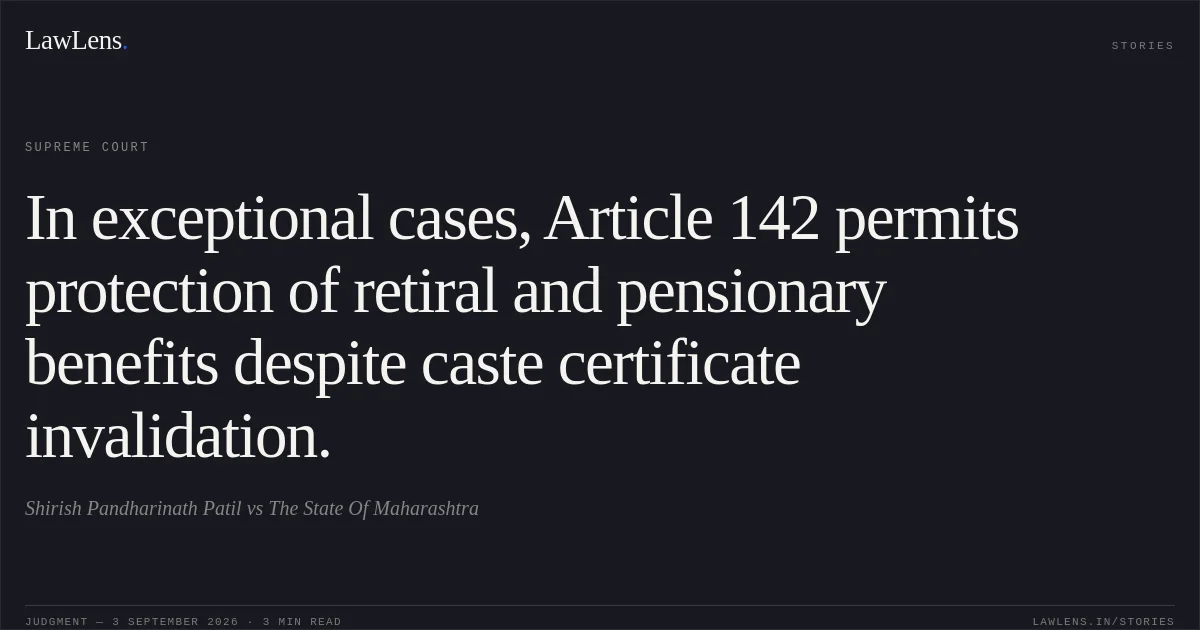
Source reference: paras. 5–7Whether, notwithstanding the invalidation of the caste certificate, the appellant’s service and retiral and pensionary benefits could be protected in exercise of the Supreme Court’s power under Article 142 of the Constitution
Source reference: paras. 10, 12–14Law Applied
Invalidation of a caste or Scheduled Tribe claim ordinarily carries legal consequences, including the potential loss of an appointment secured on the basis of the invalid certificate
Source reference: para. 13However, under Article 142 of the Constitution, the Supreme Court may, in exceptional circumstances, pass orders necessary to do complete justice, including protecting post-retirement benefits despite annulment of the caste certificate
Source reference: paras. 12–14The Court relied on Chairman and Managing Director, Food Corporation of India v. Jagdish Balaram Bahira, (2017) 8 SCC 670, recognising the exceptional Article 142 jurisdiction; R. Sundaram v. Tamil Nadu State Level Scrutiny Committee, 2023 SCC OnLine SC 287; and Surekha Baljorsingh Thakur v. Caste Scrutiny Committee, Civil Appeal No. 4586 of 2024, where post-retirement benefits were protected notwithstanding invalidation of the caste claims
Source reference: para. 13Reasoning
The Court found no error in the Scrutiny Committee’s conclusion, as affirmed by the High Court, that the appellant’s historical family records did not substantiate his claim to the “Tokre Koli” Scheduled Tribe
Source reference: para. 11It therefore declined to interfere with the invalidation of the caste certificate.
Source reference: no citationThe Court nevertheless considered the exceptional equities: the appellant had entered service in 1994, continued for more than three decades, remained in service during the appeal pursuant to an interim order, retired on superannuation on 30.06.2025, and stated by affidavit that neither he nor any family member had obtained further benefits on the basis of the certificate
Source reference: paras. 10, 12Applying the Article 142 principles recognised in the cited precedents, the Court protected the service rendered solely for computation and release of retiral and pensionary benefits, without validating the appellant’s caste claim
Source reference: paras. 13–15Holding
The appeal was allowed in part.
The invalidation of the appellant’s claim to belong to the “Tokre Koli” Scheduled Tribe and the cancellation and confiscation of his caste certificate were upheld; the High Court’s judgment was not disturbed on that issue
Source reference: paras. 14, 16Exercising Article 142, the Court directed that the appellant’s service from 21.10.1994 to 30.06.2025 be protected for the limited purpose of computing and releasing his retiral and pensionary benefits under the applicable service rules
Source reference: para. 14The benefits were directed to be processed and released within six months.
Source reference: no citationThe protection did not amount to recognition or validation of the caste claim, and neither the appellant nor his family members could claim any future benefit on the basis of the invalidated certificate
Source reference: paras. 15–16Original Court PDF
Shirish Pandharinath PatilvsThe State Of Maharashtra
Click to open original judgment
Original judgment, available to read, download and summarize on LawLens.in