Facts
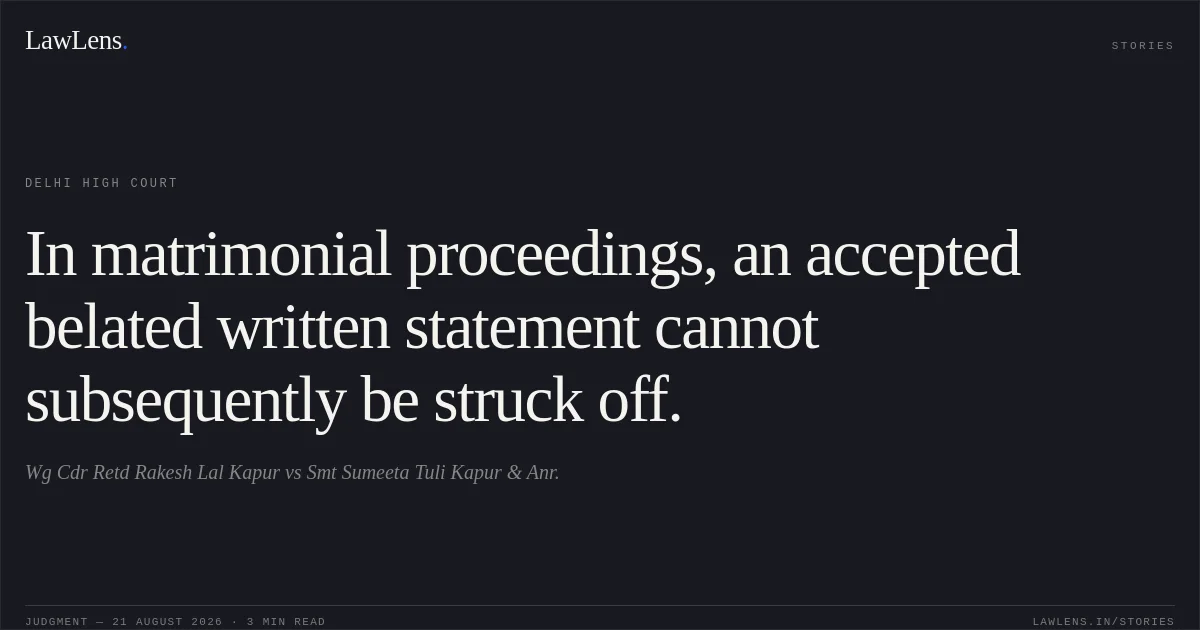
The petitioner challenged, under Article 227 of the Constitution, orders dated 2 April 2025 and 21 August 2025 passed by the Family Court-02, South District, Saket, in matrimonial proceedings under the Hindu Marriage Act.
Source reference: paras. 1; p. 1Respondent No. 1 filed her Written Statement after a delay of approximately 313 days.
Source reference: para. 2; p. 2By order dated 2 April 2025, the Family Court accepted the Written Statement on record and directed the petitioner to file replication, although it did not expressly record reasons for condoning the delay.
Source reference: paras. 2–4, 16; pp. 2–3, 7The petitioner subsequently filed an application under Order VIII Rule 1 CPC seeking closure of Respondent No. 1’s right to file the Written Statement.
Source reference: para. 17; p. 8By order dated 21 August 2025, the Family Court dismissed the application, holding that the Written Statement had already been accepted and that the direction to file replication demonstrated condonation of the delay.
Source reference: paras. 17–20; pp. 8–10Issues
1. Whether the Family Court could accept Respondent No. 1’s belated Written Statement without expressly recording reasons for condoning the delay under Order VIII Rule 1 CPC.
Source reference: paras. 2–7, 16–18; pp. 2–4, 7–92. Whether, after the Written Statement had been accepted on record and the petitioner had been directed to file replication, the Family Court could subsequently close Respondent No. 1’s right to file the Written Statement.
Source reference: paras. 17–23; pp. 8–113. Whether the impugned orders disclosed jurisdictional error, perversity or material irregularity warranting interference under Article 227 of the Constitution.
Source reference: paras. 24–27; pp. 11–12Law Applied
Section 21 of the Hindu Marriage Act, 1955 makes the CPC applicable to matrimonial proceedings “as far as may be,” meaning that CPC provisions must be applied flexibly and consistently with the nature and objectives of matrimonial adjudication.
Source reference: paras. 12–14; p. 6Order VIII Rule 1 CPC ordinarily requires filing of the Written Statement within the prescribed period and permits extension only exceptionally, for reasons recorded in writing; the timeline cannot be extended mechanically or as a matter of routine, as held in Kailash v. Nanhku and reiterated in M/s Aditya Hotels (P) Ltd. v. Bombay Swadeshi Stores Ltd.
Source reference: paras. 3, 5–6; pp. 2–4However, in matrimonial proceedings, Family Courts may adopt a comparatively liberal approach because shutting out a defence can have serious personal consequences; Komal Gupta v. Amrendra Kumar Gupta held that the Family Court should prefer substantive justice over procedural technicality, while imposing conditions where necessary to prevent delay.
Source reference: para. 15; pp. 6–7Article 227 confers supervisory, not appellate, jurisdiction and permits interference only where the subordinate court acts outside jurisdiction or commits a patent error, perversity or material irregularity.
Source reference: para. 25; p. 11Reasoning
The High Court held that although the order dated 2 April 2025 did not expressly state that the delay was condoned, the Family Court accepted the Written Statement and simultaneously directed the petitioner to file replication, thereby demonstrating that the Written Statement had been received on record.
Source reference: paras. 16–17; pp. 7–9The petitioner was represented when that order was passed and did not then object to the delay; the objection was raised only subsequently through the application seeking closure of the right.
Source reference: paras. 17–18; pp. 8–9Once the Written Statement had been filed, accepted and made part of the record, the later application effectively sought to undo the earlier procedural order and strike off an existing defence, rather than merely prevent a future filing.
Source reference: paras. 19–21; pp. 9–10Although the delay was relevant and the Family Court ought ideally to have recorded its reasons, the procedural default had to be assessed in the context of matrimonial proceedings and the prejudice that would result from extinguishing the respondent’s defence.
Source reference: paras. 22–24; pp. 10–11The Family Court’s approach was therefore neither perverse nor arbitrary, and the authorities concerning strict adherence to Order VIII Rule 1 did not require striking off the Written Statement in these circumstances.
Source reference: paras. 22–24; pp. 10–11Substitution of the High Court’s view for the Family Court’s discretionary procedural decision was impermissible under Article 227.
Source reference: para. 25; p. 11Holding
The High Court answered the issues against the petitioner.
It held that no jurisdictional error, perversity or material irregularity was established in either impugned order, and that Respondent No. 1’s Written Statement, having already been accepted on record, could not subsequently be struck off through the petitioner’s application under Order VIII Rule 1 CPC.
Source reference: paras. 26–27; p. 12The petition was dismissed, and the pending application(s), including the stay application, were disposed of accordingly.
Source reference: paras. 27–28; p. 12Acts & Sections Cited
1 provisions across 1 statute referred to in this judgment. Each provision opens on LawLens.
Hindu Marriage Act, 19551
Original Court PDF
Wg Cdr Retd Rakesh Lal KapurvsSmt Sumeeta Tuli Kapur & Anr.
Click to open original judgment
Original judgment, available to read, download and summarize on LawLens.in