01Facts
The petitioner-wife filed a transfer petition under Section 24 of the Code of Civil Procedure, 1908, seeking transfer of the divorce proceeding, Civil Suit No. A/74/2026, instituted by the respondent-husband, from the Family Court, Balodabazar-Bhatapara, to the Family Court, Mungeli.
¶ 2The parties were married in May 2019 and had two children. One child, aged approximately three years, resided with the petitioner, while the other, aged approximately six years, resided with the respondent.
¶ 3Following deterioration of the marital relationship, the petitioner left the matrimonial home and began residing with her parents at Mungeli. She asserted that she had no independent source of income and would face hardship in travelling approximately 160 kilometres round trip to attend proceedings at Balodabazar.
¶ 3Notice was served on the respondent, but he neither appeared personally nor through counsel.
¶ 102Issues
i.1. Whether the divorce proceeding pending before the Family Court, Balodabazar, should be transferred to the Family Court, Mungeli under Section 24 CPC, considering the petitioner-wife’s convenience, financial circumstances, and responsibility for a minor child?
¶ 2–7ii.2. Whether consequential directions should be issued regarding transmission and expeditious disposal of the transferred proceeding?
¶ 8–1103Law Applied
The Court applied Section 24 of the Code of Civil Procedure, 1908, which empowers the High Court to transfer proceedings where the ends of justice so require.
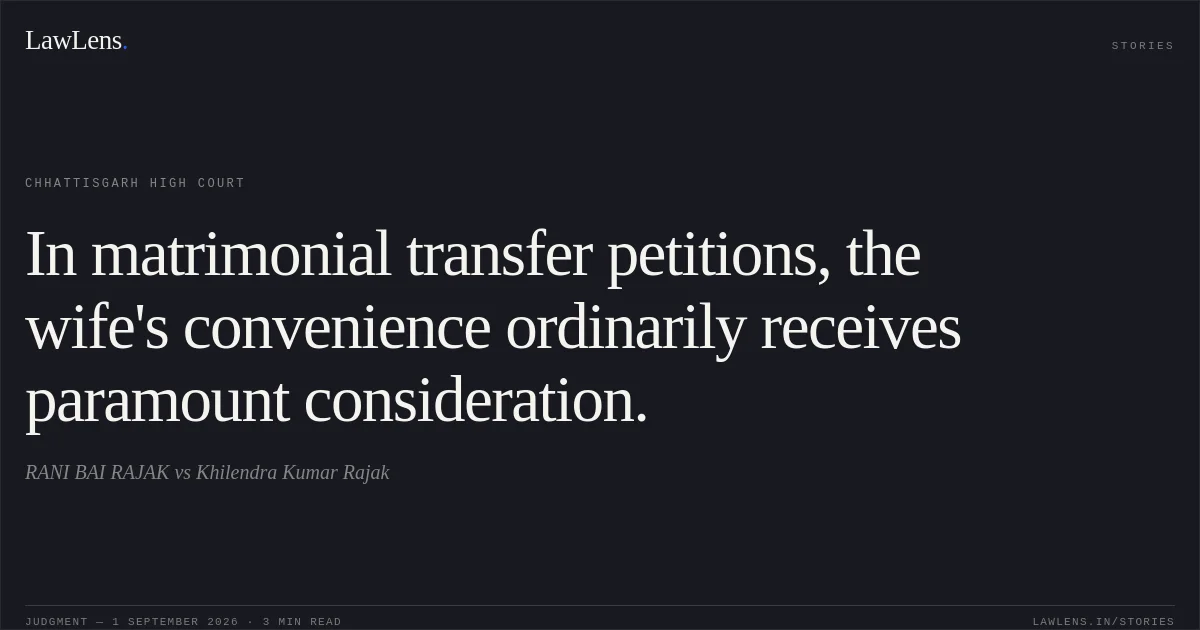
¶ 2It relied on Sumita Singh v. Kumar Sanjay, (2001) 10 SCC 41, for the principle that, where a husband institutes proceedings against his wife, the wife’s convenience must be considered.
¶ 5It further relied on Rajani Kishor Pardeshi v. Kishore Babulal Pardeshi, (2005) 12 SCC 237, which affirms that the convenience of the wife is to be preferred over that of the husband in appropriate matrimonial transfer matters.
¶ 5The Court also applied N.C.V. Aishwarya v. A.S. Saravana Karthik, 2022 SCC OnLine SC 1199, which holds that the governing consideration under Section 24 CPC is whether the ends of justice require transfer and that, in matrimonial disputes, courts should consider the parties’ economic condition, social circumstances, livelihood, standard of living, and circumstances of sustenance; generally, the wife’s convenience should receive primacy.
¶ 6Provisions in the judgment · 1 · Linked ones open on LawLens
Code of Civil Procedure, 1908 Section 24
04Reasoning
The Court found that the petitioner was residing at Mungeli with a minor child of approximately three years, had no independent income, and would have to undertake substantial travel to attend hearings at Balodabazar.
¶ 3, 7Applying the established principle that the wife’s convenience ordinarily deserves priority in matrimonial transfer proceedings, the Court concluded that requiring the petitioner to repeatedly travel to Balodabazar would cause undue hardship.
The respondent’s non-appearance despite service of notice left the petitioner’s grounds uncontested.
¶ 1In these circumstances, transfer to Mungeli was considered necessary to advance the ends of justice and facilitate the petitioner’s effective participation in the proceedings.
¶ 705Holding
The transfer petition was allowed.
Civil Suit No. A/74/2026, Khilendra Kumar Rajak v. Rani Bai Rajak, was transferred from the Family Court, Balodabazar-Bhatapara, to the Family Court, Mungeli, for trial and disposal in accordance with law.
¶ 8The transferor court was directed to transmit the record within fifteen days of receiving or communicating the order.
¶ 9The transferee court was directed to conclude the proceedings expeditiously, preferably within four months of receiving the record, with both parties directed to cooperate.
¶ 10The respondent-husband was permitted to participate through video conferencing on dates when his personal appearance was not specifically required.
¶ 11Any pending interim applications were disposed of.
¶ 12Original Court PDF
RANI BAI RAJAKvsKhilendra Kumar Rajak
Click to open original judgment
Original judgment, available to read, download and summarize on LawLens.in