01Facts
The appellant was appointed as a Medical Officer in the Department of Health and Family Welfare, Punjab, on 4 March 1991.
¶ 3An FIR (No. 268, dated 4 September 2006) was registered against the appellant, and he was arrested on 8 October 2006. He remained in custody until bail was granted on 23 May 2009.
¶ 3He was hospitalised from 25 May 2009 and gave a joining report on 22 June 2009, which was not accepted.
¶ 3A second FIR (No. 13, dated 18 August 2009) was registered, and the appellant was arrested on 10 October 2009 and remained in custody until 16 December 2009.
¶ 3A charge sheet dated 7 October 2009 alleged unauthorised absence from duty without intimation.
¶ 4The appellant replied that his absence was a forced non-performance of duty due to incarceration.
¶ 5A departmental inquiry upheld the charge, and the appellant was dismissed from service by order dated 14 September 2012.
¶ 5His departmental appeal was rejected on 14 November 2013.
¶ 6The writ petition (CWP-4116-2014) was dismissed by the learned Single Judge on 14 January 2019, who held that non-intimation of arrest made the absence a misconduct.
¶ 7The appellant was acquitted in both criminal cases.
¶ 9 · ¶ 20The State contended that the absence exceeded three years and that the department was never informed of the incarceration.
¶ 11The appellant had made representations from prison in 2007 and disclosed his custody in his reply to the charge sheet (Annexure P-7).
¶ 1902Issues
i.1. Whether the period of the appellant's incarceration pursuant to criminal proceedings, during which he could not attend duty, can be treated as voluntary absence from duty constituting misconduct.
¶ 14 · ¶ 15 · ¶ 16ii.2. Whether the departmental charge of voluntary absence was proved, given that the department's only stated ground was the absence of intimation of the criminal proceedings.
¶ 18 · ¶ 19iii.3. Whether, in view of the acquittal and the appellant's prior disclosure, the penalty of dismissal should be sustained or modified.
¶ 20 · ¶ 21 · ¶ 2203Law Applied
An employee detained for 48 hours or more is deemed to be under automatic suspension, and a suspended employee is not required to attend duty, so such a period cannot be treated as absence.
¶ 17A conceded incarceration in connection with a criminal case cannot ordinarily be characterised as voluntary absence and therefore cannot constitute misconduct.
¶ 16The department's knowledge of the custody, shown through representations and the charge-sheet reply, defeats the claim that the department was uninformed.
¶ 19A dismissal may be modified to compulsory retirement where the charge is not established, relying on the appellant's counsel's concession and the nature of the facts.
¶ 21 · ¶ 2204Reasoning
The court accepted as conceded that the appellant was in custody for the periods from October 2006 to May 2009 and from October 2009 to December 2009.
¶ 13 · ¶ 15The court held that absence caused by such custody is not voluntary, so the charge of voluntary absence could not be sustained for those periods.
¶ 16Applying the deemed-suspension principle, the court found that the appellant was under suspension during detention and therefore was not required to perform duty during that time.
¶ 17The court addressed the department's sole stated ground, namely non-intimation of the criminal proceedings. It found that the appellant had made representations in 2007 and had disclosed his judicial custody in his reply to the charge sheet, so the department had knowledge of the incarceration.
¶ 19The learned Single Judge had missed this, and the court held that the charge was not made out even on its face.
¶ 19 · ¶ 20The acquittal in both criminal cases further weakened the basis for the penalty.
¶ 20Because the charge of voluntary absence failed, but the detention itself was a fact, the court considered it appropriate to modify the dismissal to compulsory retirement rather than uphold or fully set aside the penalty. This allowed the appellant to receive pensionary benefits for service from 4 March 1991 to 14 September 2012.
¶ 22 · ¶ 21 · ¶ 2505Holding
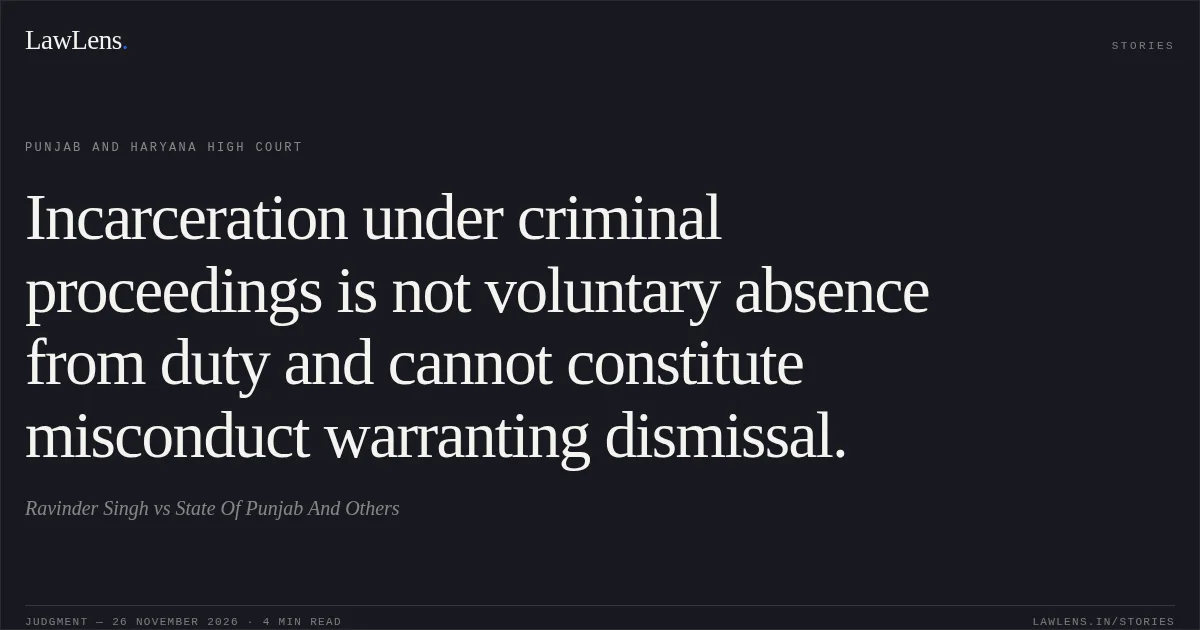
The period of incarceration pursuant to criminal proceedings cannot be treated as voluntary absence constituting misconduct, and the charge was not proved.
¶ 16 · ¶ 20 · ¶ 22The appeal is allowed. The order of dismissal dated 14 September 2012 is modified to compulsory retirement, effective from 14 September 2012. The order of the learned Single Judge dated 14 January 2019 and the appellate rejection order are set aside.
¶ 22 · ¶ 24 · ¶ 26The respondents must compute pensionary benefits for service from 4 March 1991 to 14 September 2012, and pay arrears and regular pension from 15 September 2012, within eight weeks of receipt of the order. Pending applications, if any, are disposed of.
¶ 25 · ¶ 30Original Court PDF
Ravinder SinghvsState Of Punjab And Others
Click to open original judgment
Original judgment, available to read, download and summarize on LawLens.in