Facts
The petitioner, a manufacturer of electrical equipment, was covered under the EPF Act from July 2005. Following an inspection, the respondent authorities preponed the coverage to January 1997
Source reference: p. 2Based on an Enforcement Officer's report, proceedings under Section 7A were initiated, alleging failure to remit contributions for temporary/contract workers and non-payment on "Incentive" and "Production Bonus" components
Source reference: p. 5-7The authorities passed an order on 03.08.2007 assessing dues of Rs. 24,85,652 under Section 7A and Rs. 17,22,047 under Section 7Q
Source reference: p. 4The petitioner's review application under Section 7B was rejected on 03.05.2011
Source reference: p. 1, 20The petitioner challenged these orders, contending that incentives/overtime are not "basic wages" and that the authorities failed to identify the specific contract employees for whom dues were claimed
Source reference: p. 4-5Issues
1. Whether "Incentive" and "Production Bonus" are to be treated as "basic wages" attracting Provident Fund liability under the EPF Act.
Source reference: p. 9 / para. 172. Whether an assessment order under Section 7A is valid if it fails to identify specific employees and provide a transparent basis for computation.
Source reference: p. 18 / para. 243. Whether the reduction of contributions on certain components (previously paid by mistake) violates Section 12 of the EPF Act.
Source reference: p. 9 / para. 16Law Applied
The Court primarily applied Section 2(b) and Section 6 of the Employees' Provident Funds and Miscellaneous Provisions Act, 1952, regarding the definition of "basic wages"
Source reference: p. 11-12It relied heavily on the Supreme Court precedent in Regional Provident Fund Commissioner (II) v. Vivekananda Vidyamandir, which established that "basic wage" excludes variable earnings like special incentives or production bonuses that are not universally paid across the board to all employees
Source reference: p. 11, 15The Court also applied the principle from Gurbir Kaur v. RPFC, which mandates that Section 7A orders must be reasoned and must disclose details of employees and salary structures to avoid being deemed arbitrary or based on conjecture
Source reference: p. 18Reasoning
The Court found that the respondent authorities erred in treating incentive and production bonuses as part of basic wages. Applying the Vivekananda Vidyamandir test, the Court noted that any variable earning linked to individual efficiency or extra output falls outside the purview of "basic wages"
Source reference: para. 22, 29The mere fact that the petitioner had briefly contributed on these components in 2005 did not create a liability in perpetuity, and rectifying such a mistake does not attract the mischief of Section 12
Source reference: para. 16, 30Furthermore, regarding the dues claimed for contract/temporary staff, the Court observed that neither the Enforcement Officer's report nor the Section 7A order identified the specific employees or the basis for the lump-sum computation
Source reference: para. 32Following Gurbir Kaur, the Court reasoned that the authorities cannot shirk the responsibility of disclosing these particulars, as non-disclosure renders the order a "non-speaking order" based on surmise
Source reference: para. 23, 33Holding
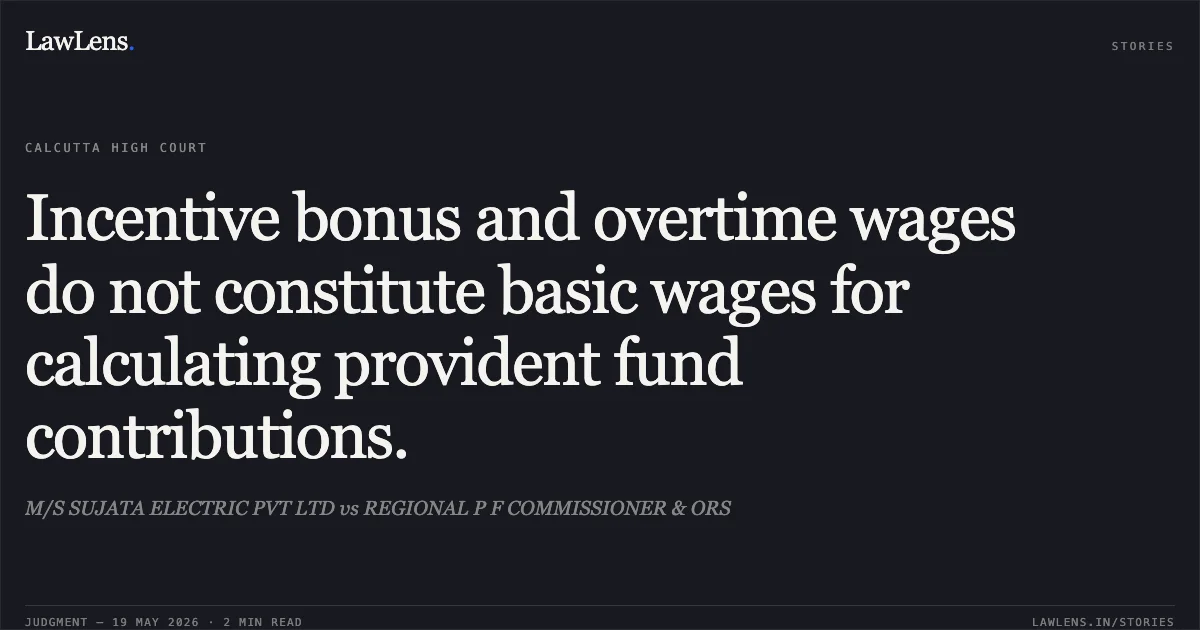
The Court answered the issues in favor of the petitioner, holding that incentive and production bonuses do not attract PF liability and that the 7A assessment was vague and legally unsustainable
The Court set aside the impugned orders dated 03.08.2007 (Section 7A), 03.05.2011 (Section 7B), and the prohibitory order dated 14.06.2011. WPA 10361 of 2011 was allowed
Source reference: para. 1, 34, 35Acts & Sections Cited
1 provisions across 1 statute referred to in this judgment. Each provision opens on LawLens.
Code of Civil Procedure, 19081
Original Court PDF
M/S SUJATA ELECTRIC PVT LTDvsREGIONAL P F COMMISSIONER & ORS
Click to open original judgment
Original judgment, available to read, download and summarize on LawLens.in


![Authorities must decide pensionary and retiral-benefit claims through a reasoned order within eight weeks.. Habibullah khan vs HOME DEPARTMENT. CAT - ['Srinagar']. LawLens](/stories/thumbnails/authorities-must-decide-pensionary-and-retiral-benefit-claims-through-a-reasoned-order-wit-d0cbe8a8119c48fbabe7df9f2d353488.webp)