Facts
The deceased was the husband of A2–Indhumathi. The prosecution alleged that A1–Sridhar and A2 had an illicit relationship, which was opposed by the deceased, and that they consequently conspired to murder him on 9 July 2020, placed his body in a gunny bag and abandoned it nearby.
Source reference: para. 2; pp.2–6The deceased’s parents lodged the complaint after the body was discovered, and the police registered a case under Section 302 IPC.
Source reference: para. 2.1; pp.2–4The post-mortem disclosed multiple injuries and opined that the deceased died from asphyxia due to strangulation associated with multiple injuries.
Source reference: para. 2.1; pp.3–5The prosecution principally relied on: the alleged illicit relationship; evidence that the accused and deceased were together in A2’s house; evidence that A1 and A2 were seen carrying a gunny bag; and the alleged recovery of bloodstained material from A2’s house pursuant to their disclosure statements.
Source reference: para. 6; p.9The trial Court rejected the charge under Section 120B IPC but convicted both accused under Sections 302 and 201 IPC, sentencing each to life imprisonment for murder and two years’ rigorous imprisonment for causing disappearance of evidence.
Source reference: para. 2.6; pp.7–8The accused challenged the conviction under Section 374(2) Cr.P.C.
Source reference: p.1Issues
Whether the prosecution established, beyond reasonable doubt, a complete and unbroken chain of circumstantial evidence proving that A1 and A2 caused the deceased’s murder under Section 302 IPC?
Source reference: paras. 6–7, 14; pp.9, 14–15Whether the alleged motive of an illicit relationship between A1 and A2 was proved by reliable evidence?
Source reference: para. 8; pp.10–11Whether the evidence that the accused and deceased were last seen together, and that A1 and A2 were later seen carrying the gunny bag containing the body, was credible and sufficient to connect them with the offence?
Source reference: paras. 9–11; pp.11–13Whether the alleged arrest, disclosure statements and recovery of bloodstained material from A2’s house were legally reliable and capable of sustaining the convictions under Sections 302 and 201 IPC?
Source reference: paras. 12–13; pp.13–14Law Applied
The Court applied Sections 302 and 201 IPC, concerning murder and causing disappearance of evidence, respectively, and considered the appellate jurisdiction under Section 374(2) Cr.P.C.
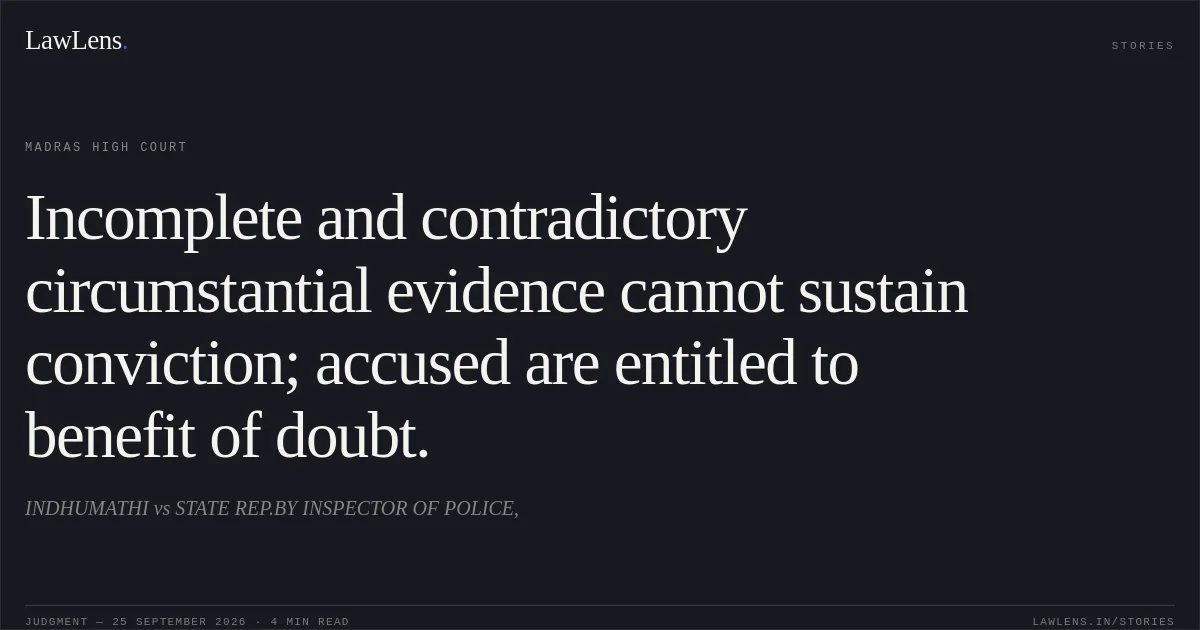
Source reference: paras. 1–2, 15; pp.1–2, 15Since the case rested entirely on circumstantial evidence, the prosecution was required to establish every incriminating circumstance firmly and prove a complete chain leading only to the guilt of the accused; suspicion, however strong, could not substitute proof, and any reasonable doubt had to benefit the accused.
Source reference: para. 7; p.10The Court also assessed the alleged disclosure-based recoveries and the credibility of the surrounding and scientific evidence in determining whether the prosecution had proved the accused’s exclusive connection with the murder and disposal of the body.
Source reference: paras. 12–13; pp.13–14Reasoning
The Court found that the alleged illicit relationship was not proved: the relevant witnesses merely stated that A1 and A2 travelled or were seen together and did not establish an illicit connection.
Source reference: para. 8; pp.10–11The evidence of PW6 and PW7, who claimed to have seen the accused and deceased together in A2’s house, was considered unnatural because they did not disclose the fact to anyone and because the physical layout of the house made their claimed observation doubtful.
Source reference: para. 9; pp.11–12The evidence of PW18 regarding the accused carrying a gunny bag was also treated as unreliable, particularly because he did not report the matter contemporaneously and his evidence conflicted with the prosecution evidence that A2 was with the deceased’s family searching for the deceased at the relevant time.
Source reference: paras. 10–11; pp.12–13Although the Investigating Officer claimed that the accused were arrested on 11 July 2020 and that recoveries followed their disclosure statements, the evidence of the deceased’s family and the arrest witness indicated that A2 had already been taken to the police station and kept in custody on 10 July 2020.
Source reference: para. 12; p.13Consequently, the subsequent arrest and recovery proceedings were considered unreliable.
Source reference: para. 12; p.13The bloodstained material recovered from A2’s house did not cure these defects because the circumstances of its seizure were doubtful, the photographs showed only limited bloodstaining despite the extensive injuries, and the possibility that the material had been obtained from the body or otherwise planted could not be excluded.
Source reference: para. 13; pp.13–14The evidence concerning the alleged conversation to “finish” the deceased was also found artificial and inconsistent with the other prosecution evidence.
Source reference: para. 14; p.14The prosecution therefore failed to establish a complete chain of circumstances proving guilt beyond reasonable doubt.
Source reference: paras. 7, 14; pp.10, 14–15Holding
The Court held that the prosecution failed to prove the alleged motive, last-seen circumstance, transportation of the body, arrest and recovery proceedings, or any other circumstance forming a complete chain of proof against the accused.
The appeals were allowed, the trial Court’s judgment dated 10 July 2024 was set aside, and A1–Sridhar and A2–Indhumathi were acquitted of all charges under Sections 302 and 201 IPC.
Source reference: para. 15; p.15Any fine paid was directed to be refunded, the bail bonds were discharged, and the connected miscellaneous petitions for suspension of sentence were closed.
Source reference: para. 15; p.15Acts & Sections Cited
4 provisions across 2 statutes referred to in this judgment. Each provision opens on LawLens.
Indian Penal Code, 18602
Code of Criminal Procedure, 19732
Original Court PDF
INDHUMATHIvsSTATE REP.BY INSPECTOR OF POLICE,
Click to open original judgment
Original judgment, available to read, download and summarize on LawLens.in