Facts
Sharada, who had left her husband, was living with the appellant in a hut. She was found dead there on the morning of 4 December 2017; the prosecution alleged that the appellant had killed her during the preceding night.
Source reference: para. 2, 4The Sessions Court convicted him under Section 302 IPC and sentenced him to life imprisonment and a fine.
Source reference: para. 6The appellant maintained that he had gone hunting, as was customary, and returned the next morning; he also relied on evidence of the deceased’s alcohol use and her husband’s prior quarrels with her.
Source reference: para. 10, 13, 20Issues
Whether the circumstantial evidence established beyond reasonable doubt that the appellant committed Sharada’s murder.
Source reference: para. 9, 25Whether the alleged recovery of bloodstained clothes and a sickle, together with the other circumstances, sufficiently connected the appellant to the offence.
Source reference: para. 21–25Law Applied
The appellant’s conviction was under Section 302 of the Indian Penal Code, and the appeal was brought under Section 374(2) of the Code of Criminal Procedure.
Source reference: para. 1–3The case rested entirely on circumstantial evidence; the prosecution therefore had to establish the circumstances relied upon beyond reasonable doubt before guilt could be sustained.
Source reference: para. 6, 20, 25The appellant’s explanation was given in his statement under Section 313 CrPC. The judgment cites no precedent or additional statutory doctrine.
Source reference: para. 1–3, 6, 20, 25Reasoning
The Court found that the prosecution had not established a complete and reliable chain of circumstances.
Source reference: para. 25Witnesses supported the appellant’s account that he routinely went hunting at night and returned the following morning; they also described the couple’s relationship as cordial and the deceased’s regular alcohol use.
Source reference: para. 15–24The deceased’s husband had previously quarrelled with her and was said to have threatened the couple.
Source reference: para. 15–24The recovery evidence was weakened because both panch witnesses turned hostile, while the Investigating Officer’s evidence did not show that the appellant’s voluntary statement had been recorded in the panchas’ presence.
Source reference: para. 15–24Although the clothes and sickle bore ‘A’ group human blood, the forensic witness could not identify whose blood it was.
Source reference: para. 15–24The post-mortem opinion attributed death to a head injury under the influence of alcohol, but this was not clarified by the prosecution.
Source reference: para. 15–24Holding
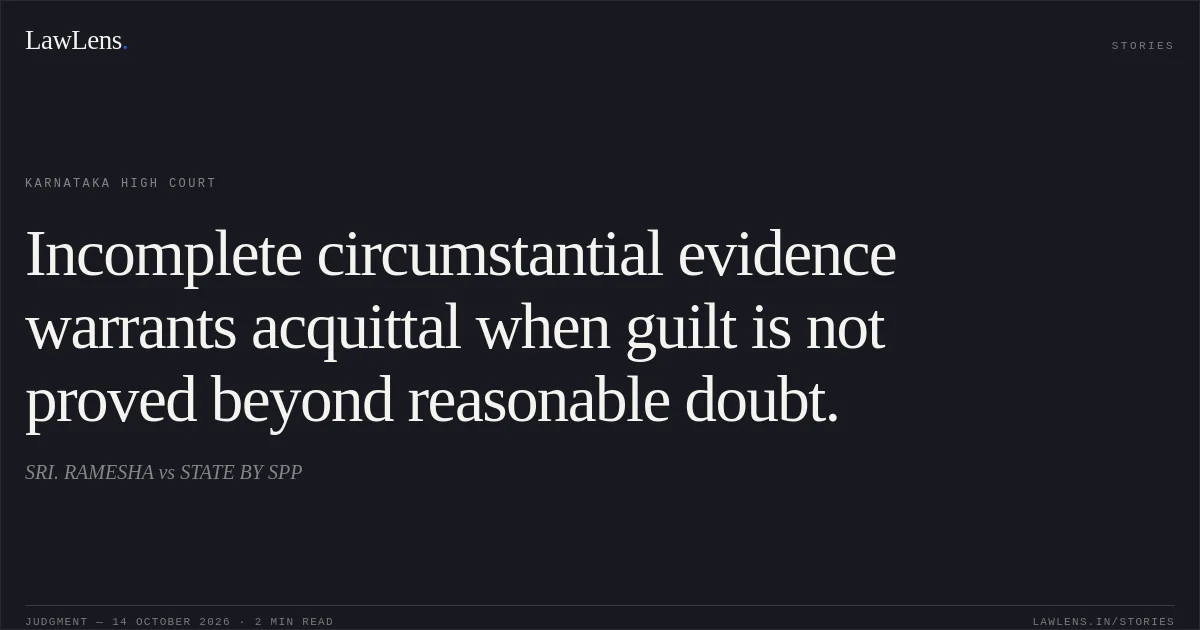
The Court held that the prosecution had failed to prove the circumstances beyond reasonable doubt and extended the benefit of doubt to the appellant.
It allowed the appeal, set aside the conviction and sentence under Section 302 IPC, acquitted the appellant, and directed that he be released forthwith unless required in another case.
Source reference: para. 25–26Acts & Sections Cited
3 provisions across 2 statutes referred to in this judgment. Each provision opens on LawLens.
Code of Criminal Procedure, 19732
Indian Penal Code, 18601
Original Court PDF
SRI. RAMESHAvsSTATE BY SPP
Click to open original judgment
Original judgment, available to read, download and summarize on LawLens.in


