Facts
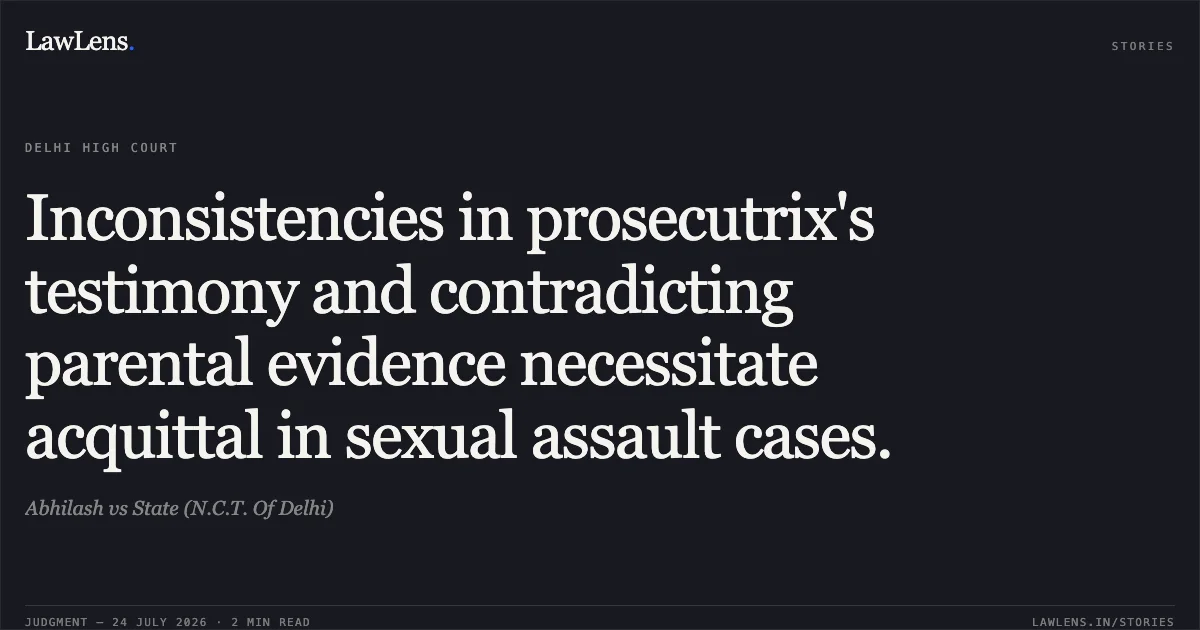
The appellant was convicted by a Special POCSO Court for rape and penetrative sexual assault under Section 376 of the IPC and Section 4 of the POCSO Act.
Source reference: p. 1-2The prosecution alleged that in late 2015, the appellant twice administered an intoxicant in a cold drink to the prosecutrix (PW1), then aged approximately 16, and committed sexual assault while she was unconscious.
Source reference: p. 2The appellant maintained his innocence, claiming the charges were a result of a family feud following his family's refusal to approve a marriage between him and PW1.
Source reference: p. 4Procedurally, the appellant challenged the trial court's judgment of conviction dated 26.11.2022 and the subsequent sentencing order.
Source reference: p. 1, 5Issues
1. Whether there were material inconsistencies and embellishments in the testimony of the prosecutrix that rendered her evidence unreliable.
Source reference: p. 5, 152. Whether the medical evidence (MLC) was sufficient to sustain a conviction in the absence of credible ocular testimony.
Source reference: p. 6, 193. Whether the prosecution established the age of the victim and the commission of the offense beyond a reasonable doubt.
Source reference: p. 14-16Law Applied
The court applied Section 376 of the Indian Penal Code regarding rape and Section 4 of the POCSO Act concerning penetrative sexual assault.
Source reference: p. 2It also referenced Section 42 of the POCSO Act, which mandates that where an act constitutes an offense under both the IPC and POCSO, the offender shall be punished under the law that provides for the greater degree of punishment.
Source reference: p. 5The judgment relied on the evidentiary principle that while a conviction can be based on the sole testimony of a prosecutrix, such testimony must be consistent, credible, and inspire confidence; where material contradictions exist, the benefit of doubt must be extended to the accused.
Source reference: p. 20-21Reasoning
The High Court found significant discrepancies between the prosecutrix’s FIR, her Section 164 statement, and her court testimony regarding the location of the incidents and the identity of the person who provided the drugged drink.
Source reference: p. 16-17Specifically, the witness shifted her account from the "mausi’s house" to a "bua’s house" and eventually claimed a third party ("fufa") provided the drink, creating confusion regarding the accused's role.
Source reference: p. 17-18The Court further noted a conflict between PW1 and her mother (PW11) regarding the timeline of reporting to the police.
Source reference: p. 18-19Regarding the medical evidence, the Court determined that the findings of a torn hymen were not conclusive proof of sexual assault in the absence of reliable ocular evidence.
Source reference: p. 19The Court observed the "strange" conduct of the victim in voluntarily returning to the accused and consuming a drink a second time after allegedly being drugged and raped previously.
Source reference: p. 19-20Holding
The Court held that the prosecution failed to establish the charges beyond a reasonable doubt due to the inherent improbabilities and inconsistencies in the evidence.
The Court allowed the appeal, setting aside the judgment of conviction and the order of sentence. The appellant was acquitted of all charges and ordered to be set at liberty.
Source reference: p. 21Acts & Sections Cited
3 provisions across 3 statutes referred to in this judgment. Linked provisions open on LawLens.
Code of Criminal Procedure, 19731
Indian Penal Code, 18601
Protection of Children from Sexual Offences Act, 20121
Original Court PDF
AbhilashvsState (N.C.T. Of Delhi)
Click to open original judgment
Original judgment, available to read, download and summarize on LawLens.in