Facts
The Three appellants (A1, A2, A3) were convicted by the Trial Court under Section 376D (Gang Rape) of the IPC and sentenced to 20 years RI.
Source reference: p. 6-7The prosecution alleged that on May 31, 2013, A1 abducted the victim (PW11) in a Santro car while A2 and A3 restrained her, subsequently committing gang rape in a godown.
Source reference: p. 3-4During the trial, the victim's testimony underwent several shifts: in her examination-in-chief, she supported the prosecution.
Source reference: p. 10In cross-examination, she admitted to a consensual friendship with A1 and stated the complaint was filed due to her father's fear.
Source reference: p. 13In re-examination, she reverted to the rape allegation citing threats from the accused.
Source reference: p. 15In final cross-examination, she admitted her re-examination testimony was false and given under pressure from her father.
Source reference: p. 17-18The Trial Court acquitted them of abduction (Sec 366) but convicted them of rape based on the initial testimony and a DNA report.
Source reference: p. 18, 37Issues
1. Whether the conviction for gang rape under Section 376D IPC can be sustained given the victim's repeatedly conflicting versions and admissions of consent during trial.
Source reference: p. 7 / para. 112. Whether expert DNA evidence can form the sole basis for conviction when the ocular testimony regarding consent is unreliable.
Source reference: p. 32 / para. 25Law Applied
The Court applied Section 376D of the IPC regarding gang rape and Section 374 of the Cr.P.C. for the appellate challenge.
Source reference: p. 3It relied on *Kartar Singh v. State of Punjab* and *Jayendra Vishnu Thakur v. State of Maharashtra* to establish that cross-examination is the "acid test" of truth and a statutory right.
Source reference: p. 25, 26Regarding expert evidence, it cited *Ishwari Prasad Misra v. Mohammad Isa* and *Murari Lal v. State of M.P.*, holding that expert opinions are not conclusive and must be received with caution as human judgment is fallible.
Source reference: p. 33-35It further clarified that statements under Section 161 and 164 Cr.P.C. are not substantive evidence and can only be used for corroboration or contradiction, not as a replacement for trial testimony.
Source reference: p. 23-24Reasoning
The High Court found that the Trial Court erred by treating the victim's inconsistencies as "minor".
Source reference: p. 37The Court noted that the victim's testimony was not of "sterling quality" because she admitted her allegations were made under her father's influence to protect the "family's honour".
Source reference: p. 17, 37Since the Trial Court had already doubted the abduction (Sec 366), the burden to prove lack of consent for the sexual acts became heavier.
Source reference: p. 18The High Court rejected the prosecution's reliance on *Vinod Kumar v. State of Punjab* and *Harvinder v. State*, distinguishing them on the basis that in those cases, the witnesses remained overall consistent, whereas here, the victim explicitly admitted to lying in her re-examination.
Source reference: p. 22, 30Regarding the DNA report (Ex. PW18/PX1), the Court held that while it proved sexual contact, it could not prove a lack of consent, especially when the medical report showed no internal or external injuries consistent with a struggle.
Source reference: p. 31, 36Holding
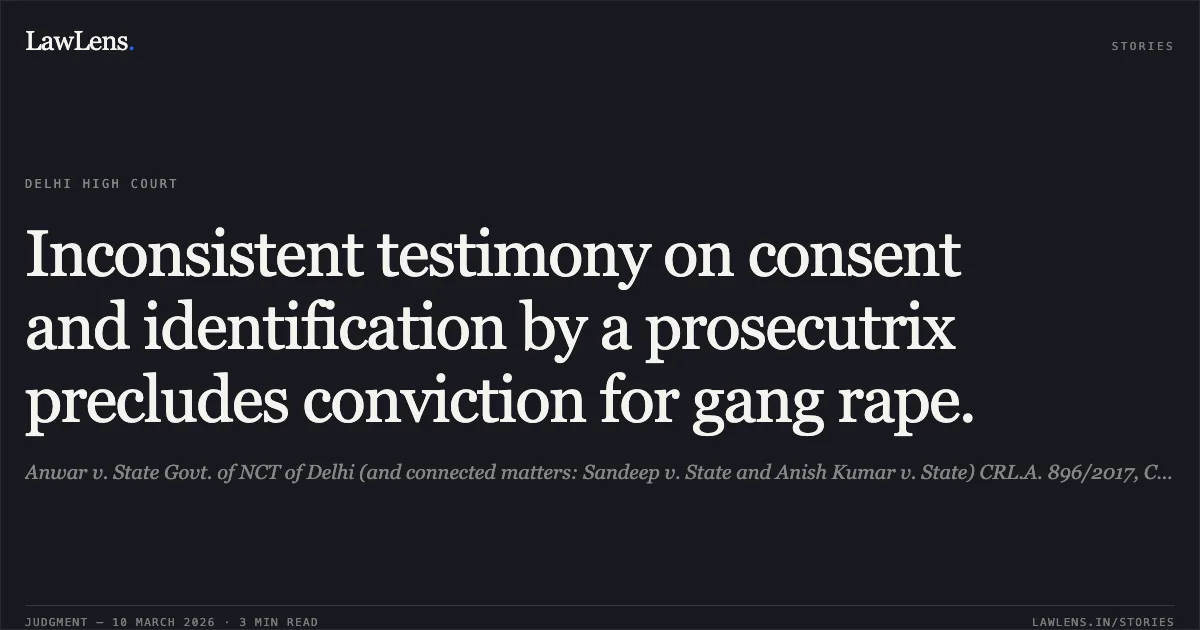
The Court answered the issues in the negative, holding that the prosecution failed to prove the absence of consent beyond a reasonable doubt.
The Court held that when two views are possible, the one favouring the accused must be adopted.
Source reference: p. 37Consequently, the High Court allowed the appeals, set aside the judgment of conviction and order of sentence dated 18.07.2017, and acquitted all three appellants of the charge under Section 376D IPC.
Source reference: p. 38Acts & Sections Cited
13 provisions across 2 statutes referred to in this judgment. Each provision opens on LawLens.
Indian Penal Code, 18603
Code of Criminal Procedure, 1973
Original Court PDF
Anwar v. State Govt. of NCT of Delhi (and connected matters: Sandeep v. State and Anish Kumar v. State) CRL.A. 896/2017, CRL.A. 1051/2017, and CRL.A. 985/2017.
Click to open original judgment
Original judgment, available to read, download and summarize on LawLens.in


![Subsequent exoneration does not retrospectively invalidate a finalized promotion select list.. UNNIKRISHNAN M vs M/o Environment And Forests. CAT - ['Ernakulam']. LawLens](/stories/thumbnails/subsequent-exoneration-does-not-retrospectively-invalidate-a-finalized-promotion-select-li-ce80a0e84f2f4887857271e8b4341c42.webp)