Facts
The petitioner, S. Indushekhar, is the son of late Sanna Sharanappa. He claimed that a common ancestor, S.B. Veeranagouda, had partitioned properties between his two sons, Sanna Sharanappa and Dodda Sharanappa, leading to a complete severance of status between the two branches
Source reference: p. 5, 31Respondent No. 1 (from the other branch) filed O.S. No. 39/2008 for partition
Source reference: p. 7Although Defendant No. 1 in that suit specifically pleaded that certain properties (e.g., Survey No. 166A) belonged to the petitioner, the petitioner was not impleaded.
Source reference: p. 8, 30Following a remand from the High Court, the parties to the suit entered into a compromise decree on July 3, 2018, which included properties the petitioner claimed as his own, as well as new properties not in the original plaint
Source reference: p. 10, 32The petitioner filed an application under Order XXIII Rule 3 r/w Section 151 CPC to recall the decree
Source reference: p. 11The Trial Court rejected it on November 25, 2022, holding that as a "stranger" to the suit, his only remedy was an independent suit
Source reference: p. 12Issues
1. Whether the Trial Court was justified in relegating a non-party to an independent suit when that person’s proprietary rights were directly affected by a compromise decree
Source reference: p. 17 / para. 20(i)2. Whether a person asserting independent title affected by a compromise can invoke Order XXIII Rule 3 r/w Section 151 CPC before the same Court that recorded the compromise
Source reference: p. 17 / para. 20(ii)Law Applied
The court applied Order XXIII Rule 3 and Rule 3A of the CPC, which bars a separate suit to set aside a decree on the ground that the compromise was not "lawful"
Source reference: p. 18The Court relied on Banwari Lal v. Chando Devi, establishing that the court recording a compromise retains jurisdiction to examine its legality
Source reference: p. 19The Court relied on Pushpa Devi Bhagat v. Rajinder Singh, which clarified that the exclusive remedy for an aggrieved person is the court that recorded the compromise
Source reference: p. 19It applied Triloki Nath Singh v. Anirudh Singh, distinguishing between a "derivative stranger" (who must move the original court) and an "independent stranger" (who may file a new suit if not seeking to impeach the compromise itself)
Source reference: p. 20, 26Reasoning
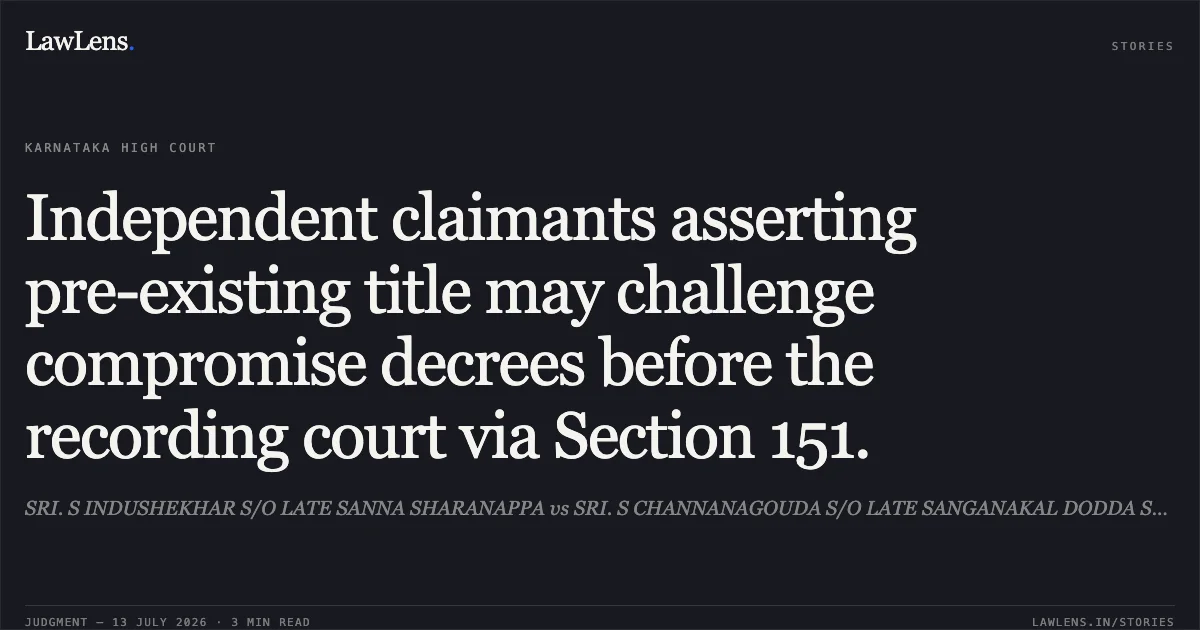
The High Court found the Trial Court’s "stranger" vs. "party" distinction too simplistic. It held that the true test is the nature of the right: if the claim is derivative (tracing title through a party), Rule 3A bars an independent suit; if the title is independent and pre-existing, a separate suit is generally permissible
Source reference: p. 23-28In this specific case, the Court observed that the compromise decree dealt with properties specifically admitted in the original pleadings to belong to the petitioner. Furthermore, the parties had expanded the suit's scope during the compromise to include properties not originally litigated
Source reference: p. 30, 32, 34, 40The Court reasoned that as long as the 2018 compromise decree subsisted, any independent suit by the petitioner for declaration of title would face "conflicting adjudications"
Source reference: p. 36, 45Therefore, because the issues of prior severance, self-acquisition, and non-joinder was "inextricably intertwined" with the legality of the compromise decree, the ends of justice required the decree to be reopened by the Court that passed it to avoid multiplicity of proceedings
Source reference: p. 38, 43Holding
The Court answered Point (i) in the Negative and Point (ii) in the Affirmative
It allowed the writ petition, set aside the order dated November 25, 2022, and recalled the compromise decree dated July 3, 2018. The Court ordered the restoration of O.S. No. 39/2008, directed that the petitioner be impleaded as a party, and instructed the Trial Court to conduct a fresh adjudication on the merits, including the issues of prior severance and the character of the properties, within nine months
Source reference: p. 45, 46-47Acts & Sections Cited
4 provisions across 1 statute referred to in this judgment. Each provision opens on LawLens.
Code of Civil Procedure, 19084
Original Court PDF
SRI. S INDUSHEKHAR S/O LATE SANNA SHARANAPPAvsSRI. S CHANNANAGOUDA S/O LATE SANGANAKAL DODDA SHARANAPPA
Click to open original judgment
Original judgment, available to read, download and summarize on LawLens.in


![Subsequent exoneration does not retrospectively invalidate a finalized promotion select list.. UNNIKRISHNAN M vs M/o Environment And Forests. CAT - ['Ernakulam']. LawLens](/stories/thumbnails/subsequent-exoneration-does-not-retrospectively-invalidate-a-finalized-promotion-select-li-ce80a0e84f2f4887857271e8b4341c42.webp)