Facts
On 9 November 2012, Uday Singh and members of his family and group went to a temple for worship. The prosecution alleged that Vijay Singh Chauhan and the other accused objected to their presence, claimed ownership over the temple, and opened indiscriminate fire. Vijay Singh allegedly fired at Uday Singh, who sustained a fatal firearm injury and died shortly thereafter. Several prosecution witnesses claimed to have witnessed the incident, although none sustained firearm injuries.
Source reference: paras. 2–5A Dehati Nalishi was lodged by Hariom Singh, naming the accused and identifying Lokendra Singh and Mahesh Chauhan as eyewitnesses.
Source reference: paras. 13, 25The post-mortem disclosed an entry wound on the left abdomen and an exit wound near the lumbar region; the medical opinion was that the firearm injury was sufficient in the ordinary course of nature to cause death.
Source reference: paras. 7–8The Sessions Court convicted Vijay Singh under Section 302 IPC and the other convicted accused under Sections 302/149 and 148 IPC, sentencing them to life imprisonment and additional imprisonment for rioting with deadly weapons. It acquitted Devendra Singh Chauhan, Kalla alias Ramkishore Chauhan and Amreshi Singh Chauhan. The convicted accused appealed, while the State appealed against the acquittal.
Source reference: para. 1During the pendency of the appeal, Shankar Singh died and the appeal abated as against him.
Source reference: para. 2Issues
Whether the ocular testimony of the prosecution witnesses was reliable despite the absence of injuries to the eyewitnesses and the alleged discrepancies between the ocular and medical evidence?
Source reference: paras. 7–18Whether the medical evidence concerning the downward trajectory of the bullet contradicted the prosecution version regarding the firing and the assailants’ positions?
Source reference: paras. 9–15Whether the convicted accused constituted an unlawful assembly sharing the common object of committing Uday Singh’s murder, thereby attracting Sections 148 and 302/149 IPC?
Source reference: paras. 13–18, 30Whether the plea of alibi raised by Megh Singh was established by credible and independent evidence?
Source reference: para. 29Whether the acquittal of Devendra Singh Chauhan, Kalla alias Ramkishore Chauhan and Amreshi Singh Chauhan was liable to be reversed in the State’s appeal?
Source reference: paras. 31–37Law Applied
The Court applied Sections 148, 149 and 302 of the Indian Penal Code: Section 148 concerns rioting while armed with a deadly weapon; Section 302 punishes murder; and Section 149 fixes constructive liability on every member of an unlawful assembly for an offence committed in prosecution of its common object.
Source reference: no citationThe Court reiterated that minor discrepancies which do not affect the core of an otherwise reliable testimony are not sufficient to reject it, relying on State (Delhi Administration) v. Laxman Kumar, (1985) 4 SCC 476, and Wilson Fernandes v. Nitin Pandurang, (2004) 2 MWN (Cri) DCC 32 (Bom).
Source reference: para. 12It further applied the principle that the absence of injury to an eyewitness does not, by itself, establish that the witness was not present or did not see the occurrence.
Source reference: paras. 17–18In an appeal against acquittal, interference is justified only where the acquittal is perverse, manifestly erroneous, or results in a miscarriage of justice; substantial and compelling reasons are required, as stated in Shivajirao Sahabrao Bobade v. State of Maharashtra, 1973 SCC (Cri) 1033.
Source reference: para. 36The Court also held that an alibi must be proved through cogent, preferably independent, ocular or documentary evidence and cannot ordinarily rest solely on the accused’s uncorroborated testimony.
Source reference: para. 29Reasoning
The Court found that the eyewitnesses’ presence was supported by the prompt Dehati Nalishi, the consistent account of firing, the recovery of blood-stained soil and numerous empty cartridges, and bullet marks on the temple structure.
Source reference: paras. 17–18, 25Their failure to sustain injuries was attributed to their alertness in taking shelter inside the temple and was not treated as inconsistent with indiscriminate firing.
Source reference: para. 18The difference between the initial version and subsequent testimony regarding whether Vijay Singh fired from the ground floor or the temple roof was considered a minor discrepancy arising from the confused circumstances of sustained firing.
Source reference: paras. 11, 14The Court accepted that the bullet could have deflected after striking the spine, thereby explaining the downward exit trajectory without discrediting the prosecution case.
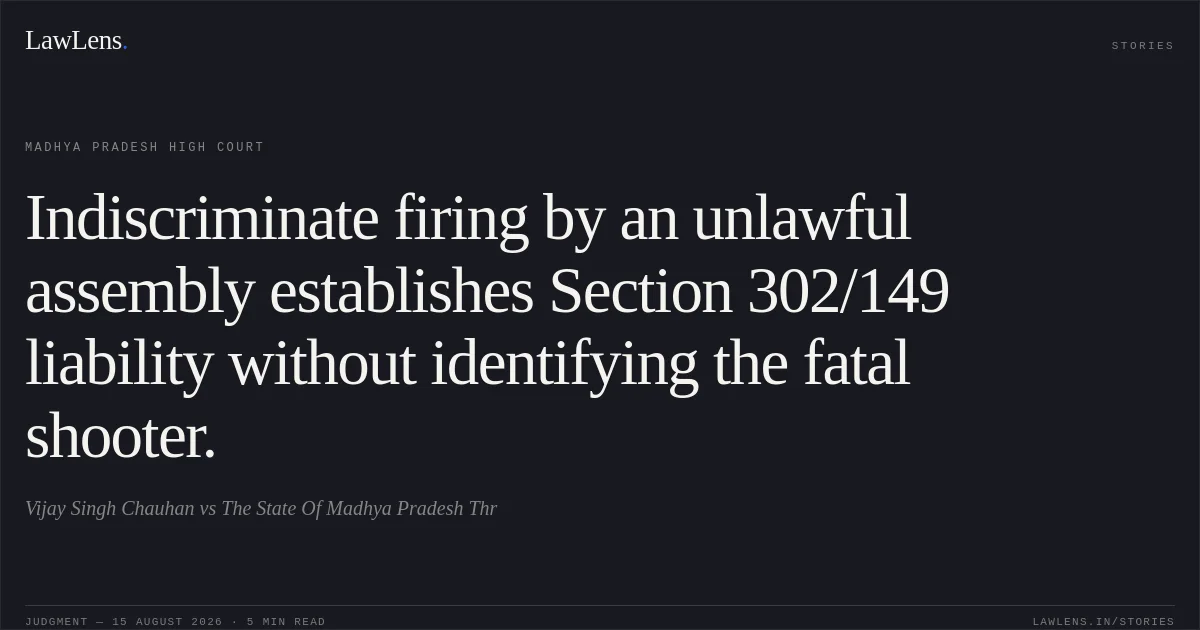
Source reference: paras. 8–10Because all the convicted accused were armed and firing pursuant to a common plan, the Court held that the fatal shot could not be attributed with certainty to any individual accused.
Source reference: para. 15Consequently, Vijay Singh’s individual conviction under Section 302 IPC was modified to one under Section 302/149 IPC, while the finding of common object and the convictions under Sections 302/149 and 148 IPC were otherwise sustained.
Source reference: para. 30Megh Singh’s alibi failed because it was unsupported by his sister, brother-in-law, or any documentary evidence and his own testimony was found unreliable.
Source reference: para. 29Conversely, the evidence against the acquitted respondents did not establish their specific participation, use of weapons, exhortation, or membership of the unlawful assembly. The material contradictions and absence of proof of any overt or legally attributable role justified applying the heightened standard applicable to an appeal against acquittal.
Source reference: paras. 33–37Holding
The appeals against conviction were disposed of with a limited modification: Vijay Singh Chauhan’s conviction was altered from Section 302 IPC to Section 302/149 IPC because the fatal shot could not be exclusively attributed to him.
The convictions and sentences of the remaining convicted appellants under Sections 148 and 302/149 IPC were upheld.
Source reference: paras. 30, 38, 42Criminal Appeal No. 547/2016 abated to the extent of deceased appellant Shankar Singh.
Source reference: paras. 2, 39The State’s appeal against the acquittal of Devendra Singh Chauhan, Kalla alias Ramkishore Chauhan and Amreshi Singh Chauhan was dismissed.
Source reference: para. 37The appellants remaining on bail were directed to surrender before the trial Court by 31 August 2026, failing which coercive measures could be taken; upon surrender or arrest, they were to be committed to custody to undergo the remaining sentence.
Source reference: para. 40Acts & Sections Cited
6 provisions across 2 statutes referred to in this judgment. Each provision opens on LawLens.
Indian Penal Code, 18605
Code of Criminal Procedure, 19731
Original Court PDF
Vijay Singh ChauhanvsThe State Of Madhya Pradesh Thr
Click to open original judgment
Original judgment, available to read, download and summarize on LawLens.in