Facts
The M.P. State Mining Corporation Limited held a quarry lease for rock-phosphate mining at Survey No. 1259, Village Tigora, District Sagar.
Source reference: no citationThe prosecution alleged that mining operations were conducted without the requisite environmental clearance and other statutory consents.
Source reference: no citationThe Pollution Control Board instituted a complaint under Sections 15 and 17 of the Environment (Protection) Act, 1986, and cognizance was taken on 21 January 2021.
Source reference: para. 3The petitioner, an officer of the Mining Corporation, was arrayed as an accused.
Source reference: no citationThe JMFC, Sagar framed charges against him under Sections 15 and 17 of the Act on 23 January 2024.
Source reference: paras. 1, 3–4His criminal revision was dismissed by the First Additional Sessions Judge, Sagar, on 14 February 2025.
Source reference: paras. 1, 3–4Issues
Whether the material placed before the Trial Court disclosed the statutory ingredients necessary to prosecute the petitioner individually under Sections 15 read with 17(2) of the Environment (Protection) Act, 1986?
Source reference: paras. 22–25, 45–47Whether the petitioner’s official designation, alleged control over the mine, and correspondence with the Pollution Control Board established consent, connivance or neglect under Section 17(2)?
Source reference: paras. 30–37Whether the complaint was instituted by a competent person under Section 19 of the Environment (Protection) Act, 1986?
Source reference: paras. 40–42Whether continuation of the criminal proceedings against the petitioner amounted to an abuse of the process of law warranting interference under Section 482 Cr.P.C.?
Source reference: paras. 1, 7–8, 47–49Law Applied
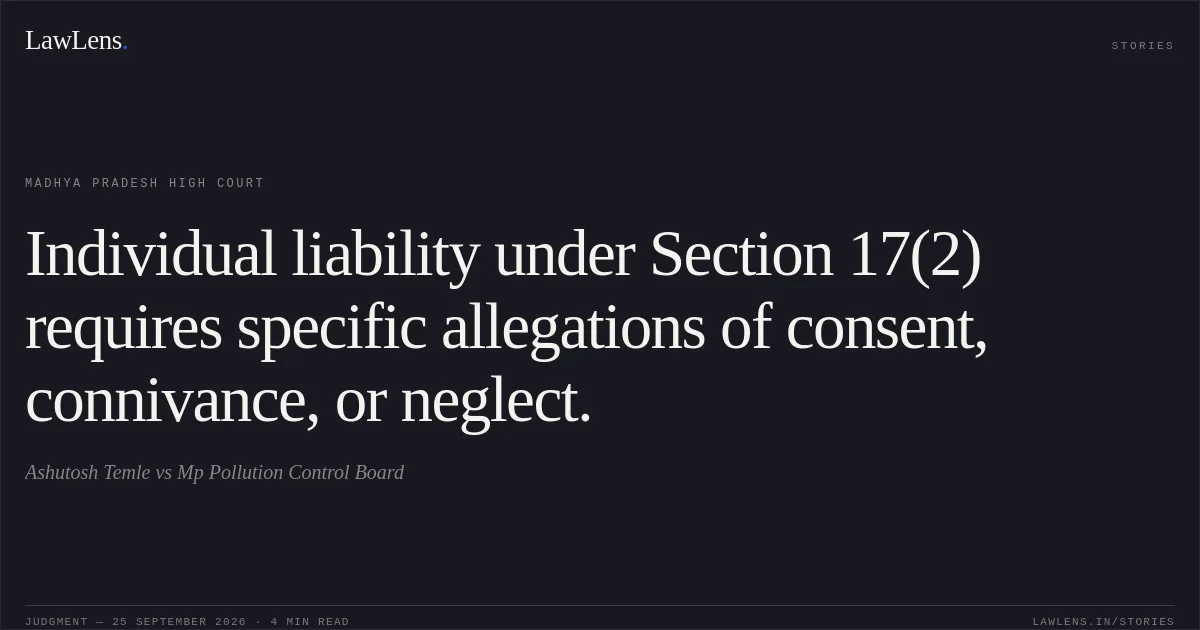
The Court applied Sections 15 and 17 of the Environment (Protection) Act, 1986, holding that while Section 15 prescribes punishment for contravention of the Act, Section 17(2) requires a specific factual foundation before an officer other than the Head of a Department can be deemed guilty—namely, that the offence was committed with the officer’s consent or connivance or was attributable to his neglect.
Source reference: paras. 25, 32–34Mere official designation, association with an establishment, or supervision of an activity does not automatically create individual criminal liability.
Source reference: paras. 32–34Section 19 concerns the competence of the person instituting the complaint and does not dispense with the requirement of proving the substantive ingredients of Section 17(2).
Source reference: paras. 40–42The Court also applied the principle that a prosecution cannot subsequently improve its foundational case by producing disputed material for the first time before the High Court, relying on Rekha Sharad Ushir v. Saptashrungi Mahila Nagari Sahakari Patsanstha Ltd., 2025 INSC 399.
Source reference: paras. 28–30The principles concerning vicarious liability and the need for specific allegations were also considered with reference to Ajoy Kumar Ghose v. State of Jharkhand, (2009) 14 SCC 115; Standard Chartered Bank v. Directorate of Enforcement, (2005) 4 SCC 530; Manu Anand, Managing Director v. M.P. Pollution Control Board, I.L.R. (2016) M.P. 3180; and Girdhari Lal Gupta v. D.H. Mehta, AIR 1971 SC 2162.
Source reference: paras. 9, 20The Court exercised its inherent jurisdiction under Section 482 Cr.P.C. to prevent abuse of process.
Source reference: paras. 1, 47–49Reasoning
The Court accepted that the material prima facie indicated a statutory violation by the Mining Corporation, including mining without environmental clearance, but held that the Corporation’s alleged violation did not automatically establish the petitioner’s individual criminal liability.
Source reference: paras. 23–24, 36, 45The complaint and material before the Trial Court did not identify any particular act demonstrating that the petitioner consented to or connived in the offence, or that the offence was attributable to his neglect.
Source reference: paras. 32–35His designation as Senior Deputy General Manager (Mines), alleged responsibility for the mine, and correspondence with the Board established, at most, his official association with the subject matter; they did not satisfy Section 17(2).
Source reference: paras. 30–35The Court further held that additional documents produced before it could not be used to retrospectively supply the missing statutory foundation, particularly where those documents involved disputed factual assertions regarding control and responsibility.
Source reference: paras. 26–30, 46The Court rejected the broad challenge to the complainant’s competence under Section 19 because the notifications and authorisation documents indicated that the concerned Regional Officer was competent to institute the complaint.
Source reference: paras. 40–42However, that finding only established the maintainability of the complaint and could not cure the absence of material satisfying Section 17(2) against the petitioner.
Source reference: para. 42The Court therefore distinguished the Corporation’s liability from the petitioner’s independent individual liability.
Source reference: paras. 39, 45–47Holding
The Court held that, although there was prima facie material regarding the Corporation’s alleged environmental violation, the prosecution failed to establish the foundational ingredients required to proceed against the petitioner under Section 17(2) of the Environment (Protection) Act, 1986.
The challenge to the complainant’s authority under Section 19 was rejected, but the absence of specific material showing the petitioner’s consent, connivance or neglect rendered the proceedings against him unsustainable.
Source reference: paras. 41–47Accordingly, the order framing charges dated 23 January 2024 and the revisional order dated 14 February 2025 were set aside insofar as they related to the petitioner.
Source reference: para. 48The proceedings arising from RCT No. 5576/2013 were quashed against him, without affecting the prosecution of the Mining Corporation or any other accused.
Source reference: para. 48The petition was allowed.
Source reference: para. 49Acts & Sections Cited
5 provisions across 2 statutes referred to in this judgment. Each provision opens on LawLens.
Code of Criminal Procedure, 19732
Environment (Protection) Act, 19863
Original Court PDF
Ashutosh TemlevsMp Pollution Control Board
Click to open original judgment
Original judgment, available to read, download and summarize on LawLens.in