Facts
The employee challenged his transfer from Midnapore to Jamnagar, ordered on 29 July 2024, alleging it was mala fide and followed pressure on him to resign.
Source reference: para. 24, 35–37His appointment terms permitted transfer anywhere in India.
Source reference: para. 24, 35–37He initiated proceedings under Section 10(1B)(d) of the Industrial Disputes Act, 1947, after obtaining a certificate of pendency from the Conciliation Officer.
Source reference: para. 4–5, 41The First Industrial Tribunal rejected the employer’s maintainability application, reasoning that an individual could challenge a mala fide transfer under Item 7 of the Fifth Schedule.
Source reference: para. 42, 50Issues
1. Whether an individual workman may pursue a dispute challenging a transfer under Section 10(1B)(d) of the Industrial Disputes Act, 1947, without the dispute being espoused collectively under Section 2(k).
Source reference: para. 38, 45, 48–532. Whether the Tribunal could treat the transfer as prima facie mala fide before resolving the objection to the maintainability of the individual dispute.
Source reference: para. 54–57Law Applied
Section 2(k) of the Industrial Disputes Act defines an “industrial dispute” as a dispute or difference between employers and employers, employers and workmen, or workmen and workmen, connected with employment or its terms or conditions.
Source reference: para. 46Under Workmen of Dimakuchi Tea Estate v. Management of Dimakuchi Tea Estate, an individual dispute not espoused by others of the relevant class is generally not an industrial dispute under Section 2(k); the dispute must have a collective character, demonstrated by the class’s direct or substantial interest.
Source reference: para. 46Section 2A deems a dispute concerning an individual workman’s termination to be an industrial dispute. The Court construed Section 10(1B) as providing an individual route for disputes of that kind, not for an individual challenge to a transfer.
Source reference: para. 48–53Although Item 7 of the Fifth Schedule identifies mala fide transfer under the guise of management policy as an unfair labour practice, the Court held that it did not remove the requirement that a transfer dispute be raised collectively under Section 2(k).
Source reference: para. 28, 49–53Reasoning
The Court held that the Tribunal misconstrued Section 2(k) by treating the employee’s allegation of mala fide transfer as sufficient, by itself, to make the dispute maintainable under Section 10(1B)(d).
Source reference: para. 47–53The provision, in the Court’s view, did not extend the individual-dispute procedure beyond termination disputes covered by Section 2A; a transfer dispute therefore had to satisfy Section 2(k)’s collective requirement.
Source reference: para. 47–53The Conciliation Officer’s certificate did not cure that defect.
Source reference: para. 50The Court also found no material before the Tribunal to support a prima facie finding of unfair labour practice or mala fides. It noted the contractual transfer clause and the absence of supporting incidents beyond the employee’s allegations.
Source reference: para. 43, 54–57Holding
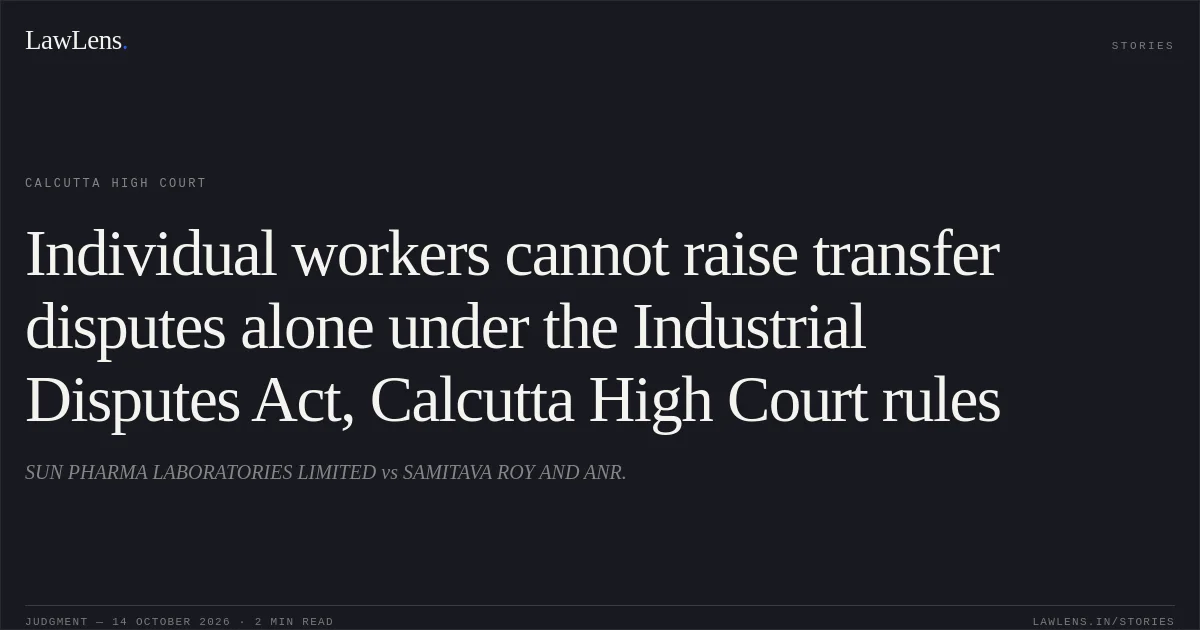
The Court held that the individual transfer dispute was not maintainable under Section 10(1B)(d) and set aside the Tribunal’s order dated 2 January 2026.
The writ petition was allowed.
Source reference: para. 61–62The employee was held entitled to any dues up to 31 July 2024, payable within three months.
Source reference: para. 61–62Acts & Sections Cited
1 provisions across 1 statute referred to in this judgment. Each provision opens on LawLens.
Industrial Relations Code, 20201
Original Court PDF
SUN PHARMA LABORATORIES LIMITEDvsSAMITAVA ROY AND ANR.
Click to open original judgment
Original judgment, available to read, download and summarize on LawLens.in


