Facts
The petitioner-employer operated a glass-container manufacturing factory at Mahalaxmi, Mumbai, employing approximately 512 persons, including 471 workmen.
Source reference: paras. 2–3It applied under Section 25-O(1) of the Industrial Disputes Act, 1947 (“ID Act”) for permission to close the undertaking, citing losses, high fuel costs, inadequate natural-gas supply, labour costs, declining demand and the condition of its furnace.
Source reference: paras. 2–3The Labour Commissioner granted permission for closure on 29 July 2006.
Source reference: para. 4The recognised union initially sought review under Section 25-O(5), but later withdrew its application. Individual workmen nevertheless continued the challenge, resulting in a reference to the Industrial Tribunal.
Source reference: paras. 4, 17–18By its award dated 31 October 2017, the Tribunal set aside the closure permission, rejected the petitioner’s closure application and directed that the affected workmen be treated as continuing in employment with consequential benefits.
Source reference: para. 5Issues
Whether individual workmen could prosecute the proceedings challenging the closure permission despite the existence of a recognised union, having regard to Section 36 of the ID Act and its Maharashtra proviso?
Source reference: paras. 19–31Whether the petitioner had established genuine and adequate grounds warranting closure under Section 25-O of the ID Act, and whether the Industrial Tribunal’s findings rejecting the closure were perverse or legally unsustainable?
Source reference: paras. 32–54Whether the Industrial Tribunal’s failure to decide the reference within the thirty-day period prescribed by the proviso to Section 25-O(5) rendered its award void or without jurisdiction?
Source reference: para. 52Whether, in view of the prolonged closure and subsequent circumstances, the relief of reinstatement and consequential service benefits required modification?
Source reference: paras. 51–56Law Applied
The Court applied Section 25-O of the ID Act, under which an employer covered by Chapter V-B must obtain prior permission to close an undertaking, and the appropriate Government must assess the genuineness and adequacy of the stated reasons, the interests of the general public and other relevant factors.
Source reference: paras. 16, 25Under Section 25-O(5), an employer or any workman may seek review or reference of the closure decision; the statutory scheme does not restrict the remedy exclusively to a recognised union.
Source reference: paras. 24–27The Court also considered Section 36(1) of the ID Act and its Maharashtra proviso, which ordinarily requires workmen in an undertaking having a recognised union to be represented through that union, except in proceedings concerning dismissal, discharge, removal, retrenchment, termination or suspension; however, the Court held that the specific scheme of Section 25-O permits an individual workman to challenge closure.
Source reference: paras. 19–27The Court relied on Asian Paints India Ltd. v. Mazdoor Kranti Union, M/s. Godrej & Boyce Manufacturing Co. Pvt. Ltd. v. Association of Engineering Workers, Hind Kamgar Sanghatana v. Dai-Ichi Karkaria Ltd., Britania Industries Ltd. v. Maharashtra General Kamgar Union, Orissa Textile & Steel Ltd. v. State of Orissa and Voltas Employees Union, Mumbai v. Voltas Ltd. for the distinction between collective industrial disputes and closure proceedings, the scope of review into the genuineness of closure reasons, and the relevance of public interest.
Source reference: paras. 6–13, 29–30, 53The thirty-day period under Section 25-O(5) was treated as directory, and expiry of that period did not render the Tribunal functus officio or nullify its award.
Source reference: para. 52Reasoning
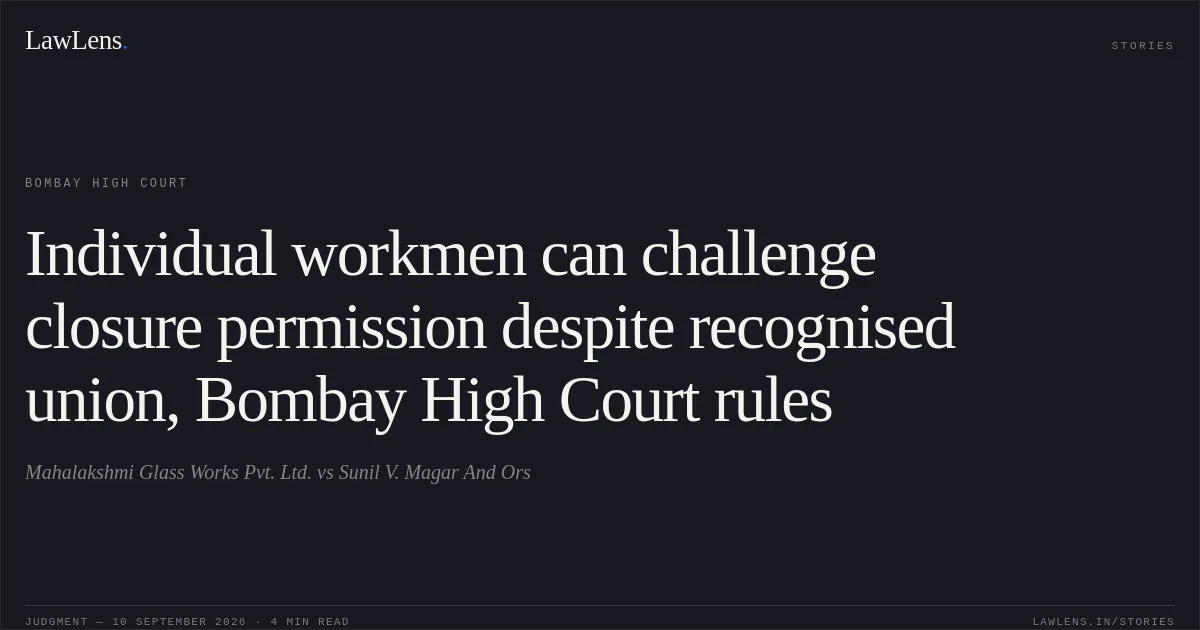
The Court rejected the employer’s objection to the locus of the individual workmen. It held that Section 25-O expressly permits “any workman” to oppose closure or seek review, and that the Maharashtra amendment likewise permits an affected workman to appeal against a closure order; therefore, the recognised union’s withdrawal did not terminate the workmen’s statutory right to pursue the proceedings.
Source reference: paras. 24–31On the merits, the Court held that the petitioner bore the burden of proving circumstances justifying closure.
Source reference: para. 32The financial material showed losses in only two of the three relevant years and a profit of approximately Rs.1.05 crore in 2004–05; the alleged losses were also lower than the amount projected in the closure application.
Source reference: paras. 34, 38–40The Tribunal was justified in considering that the petitioner had not adequately demonstrated the alleged fuel-cost burden, declining demand or the impossibility of using natural gas.
Source reference: paras. 43–47Although the Court acknowledged that the gas supplier’s offer was limited and conditional, it found that the petitioner had proceeded to seek closure shortly thereafter without sufficiently exploring continued operations or alternative measures.
Source reference: paras. 43–47The Court nevertheless recognised mitigating circumstances: the factory had remained closed for nearly twenty years, there was no evidence that manufacturing had continued elsewhere or through substitute workers, and recommencement in the Mahalaxmi premises was no longer realistically feasible, particularly in light of environmental and land-use considerations.
Source reference: paras. 48–51, 54Accordingly, while the Tribunal was correct that closure permission ought not to have been granted on the evidence then available, reinstatement with full consequential benefits was no longer an appropriate remedy.
Source reference: paras. 51–54Holding
The Court held that individual workmen were competent to prosecute the Section 25-O proceedings despite the existence and subsequent withdrawal of the recognised union’s application for review.
It further held that the petitioner had not established sufficient and genuine grounds for closure and that the Tribunal’s substantive conclusion was not perverse.
Source reference: paras. 32–54The Court rejected the argument that the Tribunal’s delay beyond thirty days invalidated the award.
Source reference: para. 52However, considering the twenty-year closure and the practical impossibility of restarting manufacturing operations, the Tribunal’s award was modified.
Source reference: para. 56The petitioner was directed to pay lump-sum compensation of Rs.2,00,000 to each of 472 workmen or their legal heirs within four months, over and above amounts already paid; upon such payment, the workmen would not be entitled to further service-related benefits or payments.
Source reference: para. 56The writ petition was therefore partly allowed, the rule was partly made absolute, and the interim application was disposed of.
Source reference: para. 57Acts & Sections Cited
5 provisions across 1 statute referred to in this judgment. Linked provisions open on LawLens.
Industrial Disputes Act, 19475
Original Court PDF
Mahalakshmi Glass Works Pvt. Ltd.vsSunil V. Magar And Ors
Click to open original judgment
Original judgment, available to read, download and summarize on LawLens.in