Facts
The petitioners are accused in a trial for murder under Section 302 of the IPC (Sessions Case No. 47 of 2023).
Source reference: p. 3During the cross-examination of Prosecution Witness No. 22 (Pethabhai Sakhara), an alleged eyewitness, the defense attempted to pose a question regarding a scene-of-offence panchnama (Exh. 35).
Source reference: p. 3The panchnama recorded that the witness had told the Investigating Officer that a recovered jacket belonged to the deceased and that its cut marks were caused by an assault by unknown persons.
Source reference: p. 3In his deposition (Exh. 152), the witness identified the jacket but remained silent on the cause of the cut marks.
Source reference: p. 4The Prosecution objected to the question on the ground that a panchnama is not a statement under Section 162 of the Cr.P.C. and cannot be used for contradiction.
Source reference: p. 2-3The Sessions Court upheld this objection on June 30, 2026, disallowing the question.
Source reference: p. 2-3Issues
1. Whether the information provided by a witness and recorded in a scene-of-offence panchnama constitutes a "previous statement in writing" for the purpose of cross-examination and contradiction under the Evidence Act.
Source reference: p. 4-52. Whether the trial court erred in disallowing the defense from pointing out contradictions between the witness's oral testimony and the contents of the panchnama.
Source reference: p. 5Law Applied
Section 145 of the Indian Evidence Act, which permits a witness to be cross-examined regarding previous statements made by him in writing or reduced into writing and relevant to matters in question, provided his attention is called to the parts used for contradiction.
Source reference: p. 4-5Section 162 of the Code of Criminal Procedure regarding statements made to the police during investigations.
Source reference: p. 3Reasoning
The Court observed that the witness (P.W. 22) was present during the drawing of the panchnama and had provided specific information to the police regarding the ownership and condition of the deceased's jacket.
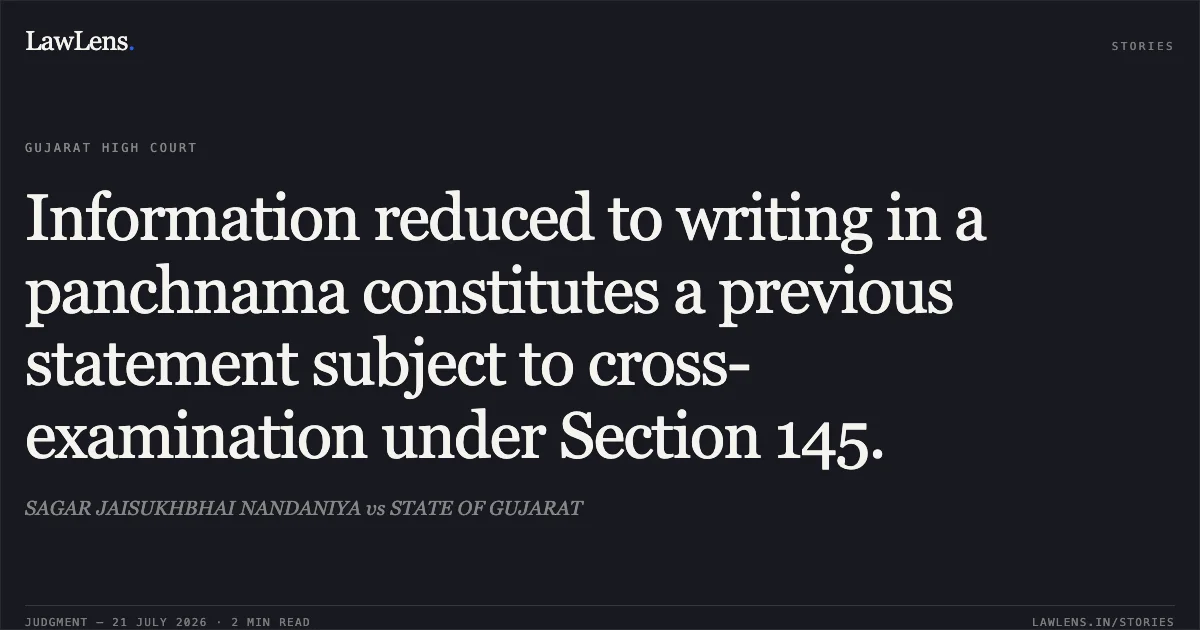
Source reference: p. 4The Court reasoned that any information provided by a witness to the police that is "reduced into writing"—as it was in the panchnama—qualifies as a "previous statement" under Section 145 of the Evidence Act.
Source reference: p. 5The defense is entitled to use such writing to contradict the witness if his oral testimony deviates from those recorded facts.
Source reference: p. 5The High Court rejected the Sessions Court's reasoning that the question was inadmissible because the panchnama was not a Section 162 statement or because the defense had failed to question the Panch witnesses on the matter; such factors go to the weight of evidence at the end of the trial, not the initial right to cross-examine.
Source reference: p. 5Holding
The information in the panchnama constituted a statement reduced to writing, and therefore, the petitioners must be permitted to put the disputed question to P.W. 22 to bring contradictions on record in the interest of a fair trial.
The High Court allowed the petition and quashed the impugned order dated June 30, 2026. Rule was made absolute.
Source reference: p. 5Acts & Sections Cited
2 provisions across 2 statutes referred to in this judgment. Each provision opens on LawLens.
Indian Penal Code, 18601
Code of Criminal Procedure, 19731
Original Court PDF
SAGAR JAISUKHBHAI NANDANIYAvsSTATE OF GUJARAT
Click to open original judgment
Original judgment, available to read, download and summarize on LawLens.in