Facts
Respondent No. 1 filed a complaint under Section 138 of the Negotiable Instruments Act, 1881 against the petitioner before the learned JMFC, NI Act, North District, Rohini Courts.
Source reference: pp. 1–2, paras. 1–2During the complainant’s evidence, Respondent No. 1 moved an application under Section 311 of the Code of Criminal Procedure, 1973, seeking permission to examine two additional witnesses and produce documents.
Source reference: pp. 1–2, paras. 1–2The Trial Court allowed the application on 24 February 2025.
Source reference: pp. 1–2, paras. 1–2The petitioner’s revision petition under Section 397 CrPC was dismissed by the learned Additional Sessions Judge on 29 October 2025, affirming the Trial Court’s order.
Source reference: pp. 1–2, paras. 1–2The petitioner thereafter invoked the High Court’s jurisdiction under Section 528 of the Bharatiya Nagarik Suraksha Sanhita, 2023/Section 482 CrPC, challenging the Revisional Court’s order and contending that the proposed evidence sought to introduce a new case without foundational facts, particularly in a summary proceeding under the NI Act.
Source reference: p. 3, paras. 5–7Issues
Whether a petition under Section 528 BNSS/Section 482 CrPC is maintainable against an order passed by the Revisional Court under Section 397 CrPC, particularly when it effectively seeks appellate reconsideration of the Revisional Court’s decision?
Source reference: pp. 2–4, paras. 3, 7–10Whether the High Court should exercise its inherent jurisdiction in the absence of an allegation of abuse of process, miscarriage of justice, non-compliance with a mandatory legal provision, or a similar exceptional circumstance?
Source reference: pp. 4–5, paras. 10–14Whether the Trial Court and Revisional Court erred in permitting the complainant to examine additional witnesses and produce documents under Section 311 CrPC?
Source reference: pp. 5–7, paras. 15–17Law Applied
The Court applied Section 397 CrPC, including the statutory bar on a second revision under Section 397(3), and the corresponding provisions of Sections 438(3) and 440(3) BNSS.
Source reference: pp. 3–4, paras. 8–9It distinguished the revisional remedy from an appeal under Section 372 CrPC/Section 413 BNSS and from the inherent jurisdiction under Section 482 CrPC/Section 528 BNSS.
Source reference: pp. 3–4, paras. 8–9Relying on Amar Nath v. State of Haryana, (1977) 4 SCC 137, the Court held that inherent powers ordinarily cannot be invoked where the statute expressly bars a particular remedy.
Source reference: p. 4, para. 11Under Madhu Limaye v. State of Maharashtra, (1977) 4 SCC 551, inherent powers must not be used where a specific statutory remedy exists, must be exercised sparingly to prevent abuse of process or secure the ends of justice, and cannot be exercised against an express statutory bar.
Source reference: pp. 4–5, para. 12The Court further relied on Vijay Kumar v. State of Uttar Pradesh, (2011) 8 SCC 136, and Swapan Kumar Chatterjee v. CBI, (2019) 14 SCC 328, for the principle that Section 311 CrPC confers wide discretionary power to summon or examine witnesses at any stage where their evidence is considered essential for a just decision.
Source reference: p. 6, para. 16Reasoning
The Court found that the present petition was, in substance, an appeal against the Revisional Court’s order and an attempt to obtain a second revision through the guise of proceedings under Section 482 CrPC/Section 528 BNSS.
Source reference: pp. 3–4, paras. 7–10Although inherent jurisdiction remains available in exceptional cases, the petitioner neither pleaded nor demonstrated abuse of process, miscarriage of justice, violation of a mandatory provision, or any comparable ground warranting interference with the Revisional Court’s exercise of jurisdiction.
Source reference: p. 5, para. 14On merits, the Revisional Court had correctly held that the proposed witness could testify regarding the issuance of the cheques in his presence and that the Axis Bank witness could establish the parties’ regular business dealings.
Source reference: pp. 5–6, para. 15The petitioner’s objections concerning the absence of these facts from the complaint or affidavit, and the proposed witness’s lack of custody of the complainant’s books of account, were matters for assessment after examination and cross-examination, not grounds to prevent the evidence at the threshold.
Source reference: pp. 5–6, para. 15In light of the broad scope of Section 311 CrPC and the statutory bar against a second revision, no exceptional circumstance justified the exercise of inherent powers.
Source reference: pp. 6–7, paras. 16–17Holding
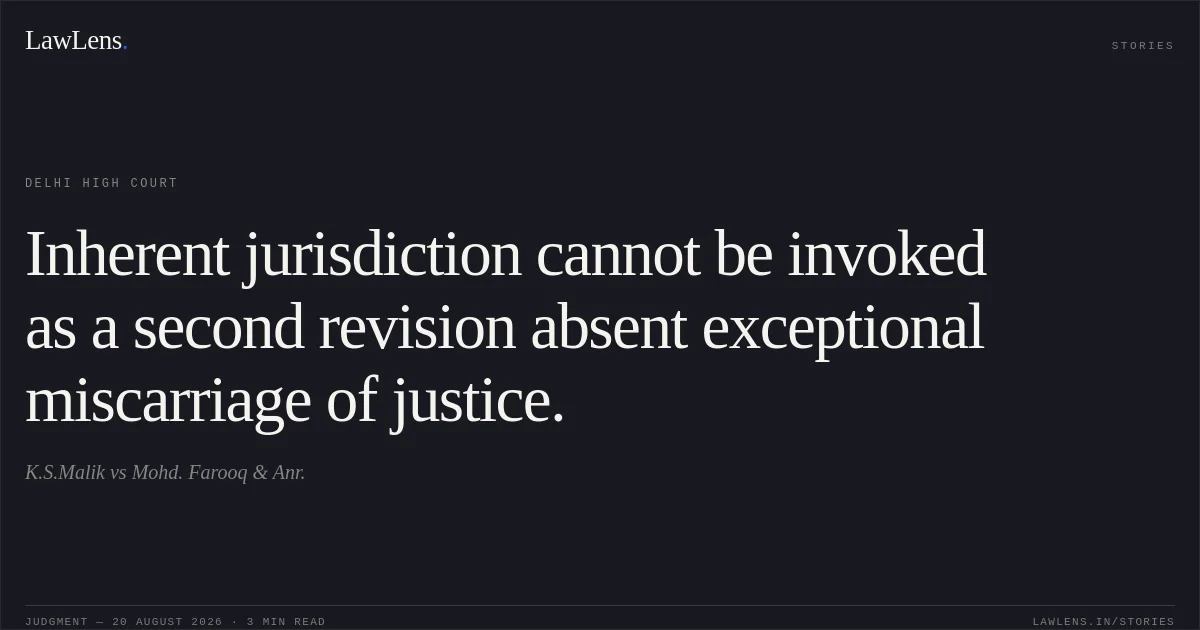
The High Court held that the petition under Section 528 BNSS/Section 482 CrPC was not maintainable because it sought to circumvent the statutory bar on a second revision and effectively challenged the Revisional Court’s order as an appeal.
The Court also found no exceptional ground for exercising inherent jurisdiction and upheld the orders permitting the complainant to examine the additional witnesses and produce the relevant documents under Section 311 CrPC.
Source reference: p. 7, para. 18The petition, along with the pending applications, was accordingly dismissed in limine.
Source reference: p. 7, para. 18Acts & Sections Cited
11 provisions across 3 statutes referred to in this judgment. Each provision opens on LawLens.
Negotiable Instruments Act, 18811
Code of Criminal Procedure, 19735
Bharatiya Nagarik Suraksha Sanhita, 20235
Original Court PDF
K.S.MalikvsMohd. Farooq & Anr.
Click to open original judgment
Original judgment, available to read, download and summarize on LawLens.in