Facts
Respondent No. 2 alleged that his cheque leaves had been lost or stolen and that, despite informing the State Bank of India on 23 March 2020, the cheques were later misused by co-accused Harish @ Vicky Manani.
Source reference: para. 2Crime No. 338/2022 was registered at Police Station Madan Mahal, Jabalpur, initially for offences under Sections 420, 467, 468, 109, 112, 114 and 120-B of the IPC against several persons.
Source reference: para. 2After investigation, a charge-sheet was filed under Sections 420, 112 and 120-B of the IPC, while further investigation regarding the petitioner and some co-accused remained pending.
Source reference: para. 3The petitioner sought quashing of the criminal proceedings under Section 528 of the BNSS, contending that no specific allegation of forgery or cheque misuse was made against him, that he had been residing abroad and had not visited India since 2020, and that he had been falsely implicated on the basis of an alleged conspiracy.
Source reference: para. 4Issues
Whether the criminal proceedings arising from Crime No. 338/2022 disclosed a prima facie case against the petitioner under Sections 420, 112 and 120-B of the IPC warranting continuation of the prosecution?
Source reference: paras. 7–9, 14–17Whether the petitioner’s absence from India, lack of a specific overt act, alleged prior enmity, pending further investigation, anticipatory bail, and willingness to cooperate through video conferencing justified quashing the proceedings under Section 528 of the BNSS?
Source reference: paras. 10–12, 15–17Whether the case fell within the exceptional categories warranting exercise of the High Court’s inherent jurisdiction to prevent abuse of process?
Source reference: paras. 7–8, 13–16Law Applied
The Court applied Section 528 of the Bharatiya Nagarik Suraksha Sanhita, 2023, corresponding to the inherent jurisdiction under Section 482 of the CrPC, under which quashing jurisdiction must be exercised sparingly and with circumspection.
Source reference: para. 7At the quashing stage, the Court is required to examine whether the allegations and prosecution material, taken at face value, disclose a prima facie offence; it must not conduct a mini-trial or undertake meticulous appreciation of evidence.
Source reference: para. 7The Court relied on State of Haryana v. Bhajan Lal, 1992 Supp (1) SCC 335, concerning the limited and exceptional categories in which quashing may be justified.
Source reference: para. 8It also considered the four-step test referred to in Sajal Bose v. State of West Bengal and Others, drawing from Pradeep Kumar Kesarwani v. State of Uttar Pradesh and Rajiv Thapar v. Madan Lal Kapoor: whether the defence material is sterling and unimpeachable, whether it conclusively negates the prosecution allegations, whether it remains unrefuted or incapable of reasonable refutation, and whether continuation of proceedings would constitute an abuse of process.
Source reference: para. 4In relation to conspiracy under Section 120-B IPC, the Court held that the absence of a direct overt act is not conclusive because participation and agreement may be inferred from surrounding circumstances and investigative material.
Source reference: para. 9Reasoning
The Court held that the prosecution case was not limited to the petitioner’s personally stealing or misusing the cheques; it alleged a larger transaction involving several accused persons and a criminal conspiracy.
Source reference: para. 9Whether the petitioner participated through communications, financial dealings, instructions, intermediaries, or other means required examination of witness statements and investigation material and could not be conclusively decided at the quashing stage.
Source reference: paras. 9–10His residence abroad and alleged non-entry into India since 2020 did not constitute conclusive proof of innocence.
Source reference: para. 10Similarly, prior enmity was only a circumstance for consideration at trial and did not establish that the FIR was malicious or inherently improbable.
Source reference: para. 11The pendency of further investigation did not demonstrate the absence of a prima facie case, and the grant of anticipatory bail or willingness to cooperate through video conferencing was legally distinct from the question of quashing the prosecution.
Source reference: paras. 11–12Since the allegations, if accepted at face value, were not absurd, inherently improbable, or incapable of establishing the alleged offences, the exceptional threshold for exercise of inherent jurisdiction was not met.
Source reference: paras. 13–16Holding
The High Court answered the issues against the petitioner and held that the allegations and material collected during investigation disclosed a prima facie case requiring continuation of the criminal proceedings.
The petitioner’s disputed factual defences could not be adjudicated under Section 528 of the BNSS.
Source reference: paras. 15–17Accordingly, the petition seeking quashing of proceedings arising from Crime No. 338/2022 for offences under Sections 420, 112 and 120-B IPC was dismissed.
Source reference: paras. 17–19The Court clarified that its observations were confined to the quashing petition and would not influence the Trial Court, which was directed to decide the matter independently in accordance with law.
Source reference: para. 18Acts & Sections Cited
10 provisions across 3 statutes referred to in this judgment. Each provision opens on LawLens.
Bharatiya Nagarik Suraksha Sanhita, 20232
Indian Penal Code, 18606
Code of Criminal Procedure, 19732
Original Court PDF
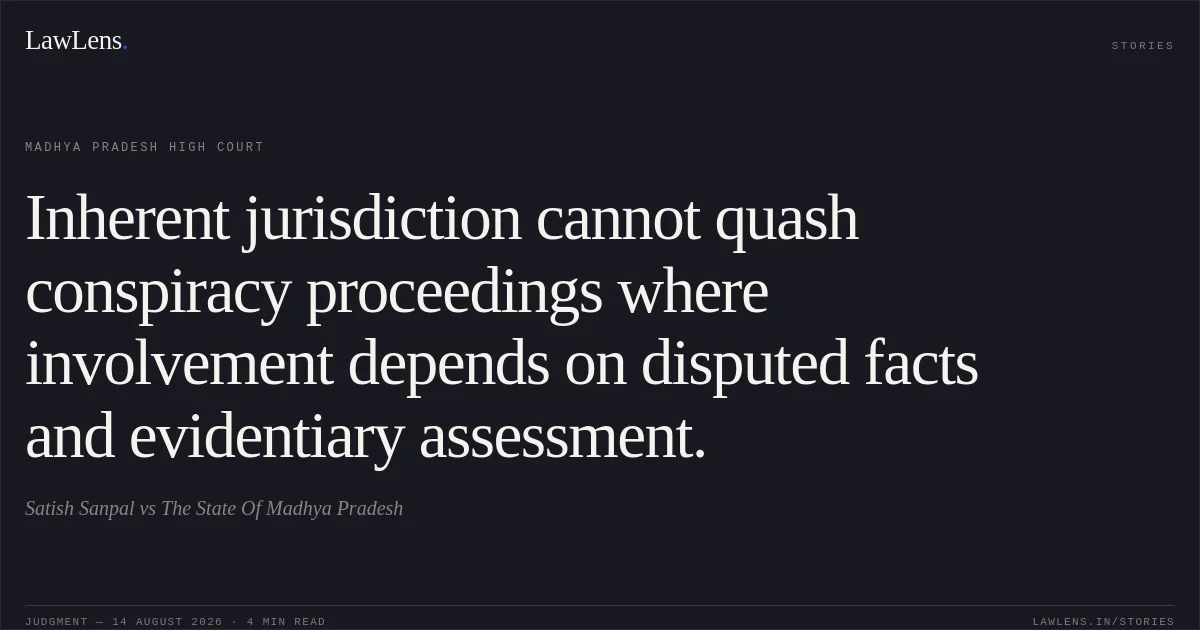
Satish SanpalvsThe State Of Madhya Pradesh
Click to open original judgment
Original judgment, available to read, download and summarize on LawLens.in