Facts
The petitioner, an Assistant Manager at Chhattisgarh Rajya Gramin Bank, sought the quashing of FIR No. 82/2025 and the subsequent Charge Sheet No. 110/2025.
Source reference: para. 2The FIR was lodged by Respondent No. 4, alleging that on September 11, 2025, the petitioner and others unlawfully entered his house, assaulted him, and attempted to extort money and documents.
Source reference: para. 8The petitioner contended that the case was a result of matrimonial discord between Respondent No. 4 and his wife, and that he was falsely implicated due to his professional intervention to prevent workplace harassment of the wife.
Source reference: para. 4He further pleaded alibi based on CCTV footage.
Source reference: para. 6Despite these representations, the police filed a charge sheet under Sections 296, 115(2), 351(3), 331(6), 119(1), 118(1), and 3(5) of the Bharatiya Nyaya Sanhita (BNS), 2023.
Source reference: para. 5Issues
1. Whether the High Court, in exercise of its inherent jurisdiction under Section 528 of the BNSS, can quash criminal proceedings involving disputed questions of fact and pleas of alibi.
Source reference: para. 142. Whether the allegations in the FIR and the material collected during investigation prima facie disclose the commission of cognizable offences under the BNS, 2023.
Source reference: para. 15-16Law Applied
The Court applied Section 528 of the Bharatiya Nagarik Suraksha Sanhita (BNSS), 2023 (corresponding to Section 482 of the CrPC), regarding the inherent powers of the High Court to prevent abuse of process.
Source reference: para. 12It relied on the principle established in Vinubhai Haribhai Malaviya v. State of Gujarat (2019) 17 SCC 1 regarding the necessity of fair and impartial investigation under Article 21 of the Constitution.
Source reference: para. 6The Court further applied the established doctrine that inherent powers for quashment must be exercised sparingly and only when allegations are inherently improbable or do not disclose a prima facie case.
Source reference: para. 14, 16Reasoning
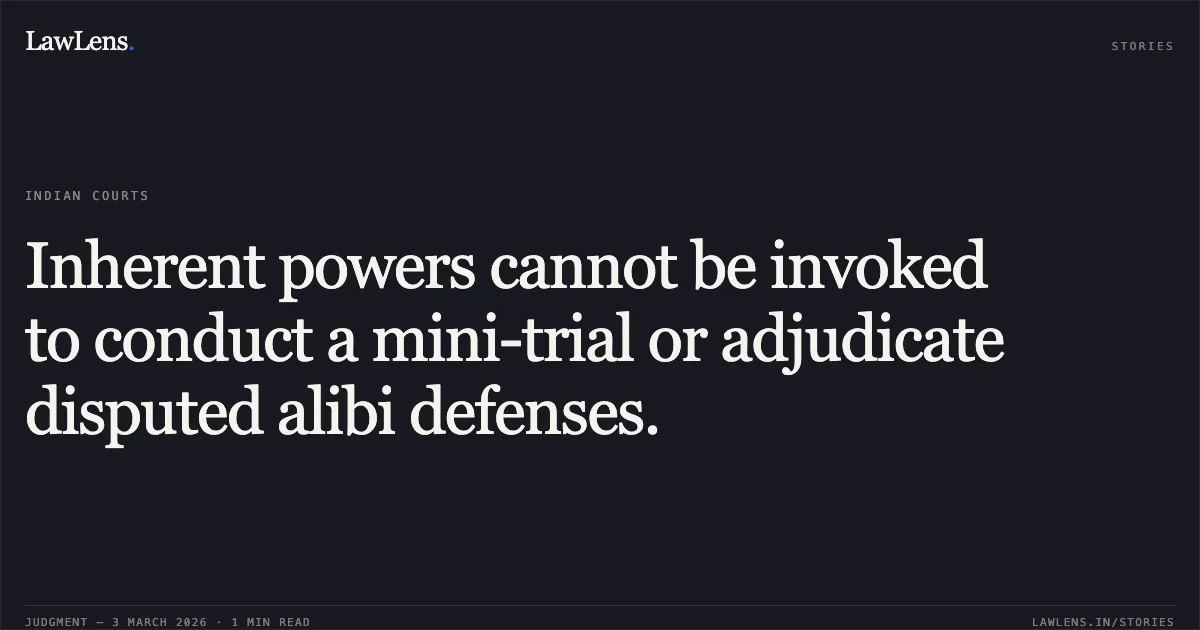
The Court reasoned that at the stage of quashing under Section 528 of the BNSS, it cannot conduct a "mini-trial" or meticulously appreciate evidence.
Source reference: para. 14While the petitioner raised a defense of alibi and alleged mala fide intentions rooted in matrimonial disputes, the Court observed that the prosecution had collected statements from the complainant and independent neighbors that prima facie supported the allegations of assault and house-trespass.
Source reference: para. 13Regarding the challenge to specific sections of the BNS (such as lurking house-trespass under Section 331(6)), the Court held that whether the specific ingredients of these sections are met is a matter for the trial court to determine during the stage of evidence, not at the threshold.
Source reference: para. 15The Court found that since the FIR and charge sheet contained specific overt acts attributed to the petitioner, the proceedings could not be termed a gross abuse of process.
Source reference: para. 16Holding
The Court dismissed the petition, holding that the merits of a defense—including alibi—and disputed questions of fact cannot be adjudicated in a quashing petition.
The Court held that since the material on record disclosed a prima facie case of cognizable offences, the criminal proceedings must continue in accordance with the law.
Source reference: para. 17It clarified that its observations would not influence the trial court’s final adjudication on the merits.
Source reference: para. 17Acts & Sections Cited
13 provisions across 3 statutes referred to in this judgment. Each provision opens on LawLens.
Bharatiya Nyaya Sanhita, 2023
Bharatiya Nagarik Suraksha Sanhita, 20232
Indian Penal Code, 18602
Original Court PDF
Mahendra Sahu v. State of Chhattisgarh & Ors. (2026:CGHC:10495-DB); CRMP No. 493 of 2026
Click to open original judgment
Original judgment, available to read, download and summarize on LawLens.in


![Subsequent exoneration does not retrospectively invalidate a finalized promotion select list.. UNNIKRISHNAN M vs M/o Environment And Forests. CAT - ['Ernakulam']. LawLens](/stories/thumbnails/subsequent-exoneration-does-not-retrospectively-invalidate-a-finalized-promotion-select-li-ce80a0e84f2f4887857271e8b4341c42.webp)