Facts
The petitioner had earlier filed CRL.M.C. 5572/2022 seeking relief substantially identical to that sought in the present petition.
Source reference: pp. 1–3, paras. 1–3A coordinate Bench dismissed that petition by a reasoned judgment dated 10 November 2022.
Source reference: pp. 1–3, paras. 1–3The petitioner later sought dismissal of the complaint before the Magistrate; that application was dismissed because the summoning order had already been upheld.
Source reference: pp. 1–3, paras. 1–3The Sessions Court dismissed the petitioner’s revision.
Source reference: pp. 1–3, paras. 1–3The petitioner then brought the present petition, seeking to set aside those orders and quash the complaint proceedings, arguing that the earlier judgment’s observation about the pre-trial stage no longer applied because a complainant’s witness had since been partly examined.
Source reference: pp. 1–3, paras. 1–3Issues
Whether the petitioner could maintain a fresh petition seeking substantially the same relief already refused by a coordinate Bench, on the basis that a complainant’s witness had since been partly examined.
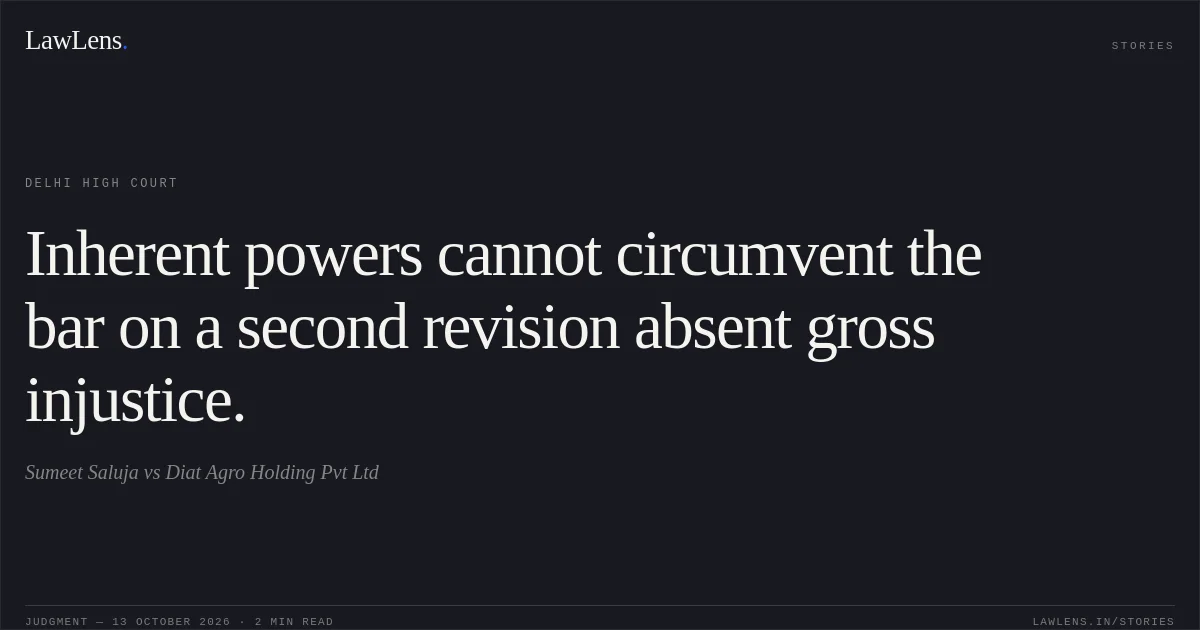
Source reference: pp. 2–3, paras. 2–3Whether the High Court could use its inherent powers to interfere with the Sessions Court’s revisional order despite the statutory bar on a second revision, in the absence of a demonstrated case of gross injustice.
Source reference: pp. 3–5, paras. 4–7Law Applied
Section 438(3) of the Bharatiya Nagarik Suraksha Sanhita, 2023 (corresponding to Section 397(3) CrPC) bars a second revision.
Source reference: pp. 3–5, paras. 4–6The inherent powers of the High Court cannot ordinarily be invoked to circumvent that bar and may be exercised sparingly where necessary to prevent gross failure of justice, abuse of process, or miscarriage of justice.
Source reference: pp. 3–5, paras. 4–6In Krishnan v. Krishnaveni, (1997) 1 SCR 511, the Supreme Court recognised the High Court’s inherent and supervisory powers while cautioning against their use to defeat the statutory restriction on successive revisions.
Source reference: pp. 3–5, paras. 4–6Reasoning
The Court rejected the petitioner’s reliance on the earlier judgment’s observation that relief should be granted cautiously at the pre-trial stage. Treating partial examination of a witness as a basis for renewed proceedings would allow an accused to seek the same relief after each stage of a witness’s examination.
Source reference: pp. 2–3, para. 3The Court also held that the present challenge concerned a Sessions Court order made in revision and could not be used as a backdoor second revision. Although Krishnan recognises a limited power to intervene, the petitioner had not shown gross injustice or another ground warranting its exceptional exercise. The Magistrate’s order had also followed the earlier decision upholding the summoning order.
Source reference: pp. 3–5, paras. 4–7Holding
The High Court held that the petition was not maintainable and found no basis to depart from the coordinate Bench’s earlier decision.
It dismissed the petition and the accompanying applications, and directed the petitioner to deposit exemplary costs of ₹50,000 online with Bharat Ke Veer within one week.
Source reference: p. 6, paras. 8–10A copy of the order was directed to be sent to the trial court.
Source reference: p. 6, paras. 8–10Acts & Sections Cited
5 provisions across 2 statutes referred to in this judgment. Each provision opens on LawLens.
Bharatiya Nagarik Suraksha Sanhita, 20231
Code of Criminal Procedure, 19734
Original Court PDF
Sumeet SalujavsDiat Agro Holding Pvt Ltd
Click to open original judgment
Original judgment, available to read, download and summarize on LawLens.in