Facts
Applicant No. 1 and respondent No. 2 were married on 28 November 2021.
Source reference: para. 1Respondent No. 2 alleged that, after approximately two months of marriage, the applicants subjected her to mental and physical cruelty in connection with demands for a four-wheeler and ₹6,00,000, and that she was harassed during her pregnancy and after the birth of her son.
Source reference: para. 1She also alleged abusive conduct during a video call dated 28 January 2024.
Source reference: para. 1On the basis of these allegations, FIR Crime No. 69/2025 was registered at Police Station Mahila Thana, Bhopal, for offences under Sections 85 and 3(5) of the Bharatiya Nyaya Sanhita, 2023 and Sections 3 and 4 of the Dowry Prohibition Act, 1961.
Source reference: para. 1After investigation, a charge-sheet was filed and charges were framed.
Source reference: para. 2During the proceedings, the parties entered into a compromise, respondent No. 2 withdrew related proceedings, and she and other prosecution witnesses were examined but did not support the prosecution case and were declared hostile.
Source reference: paras. 2–3The applicants therefore sought quashing of the FIR, charge-sheet, order framing charges and consequential proceedings under Section 528 of the BNSS read with Section 482 of the CrPC.
Source reference: para. 3Issues
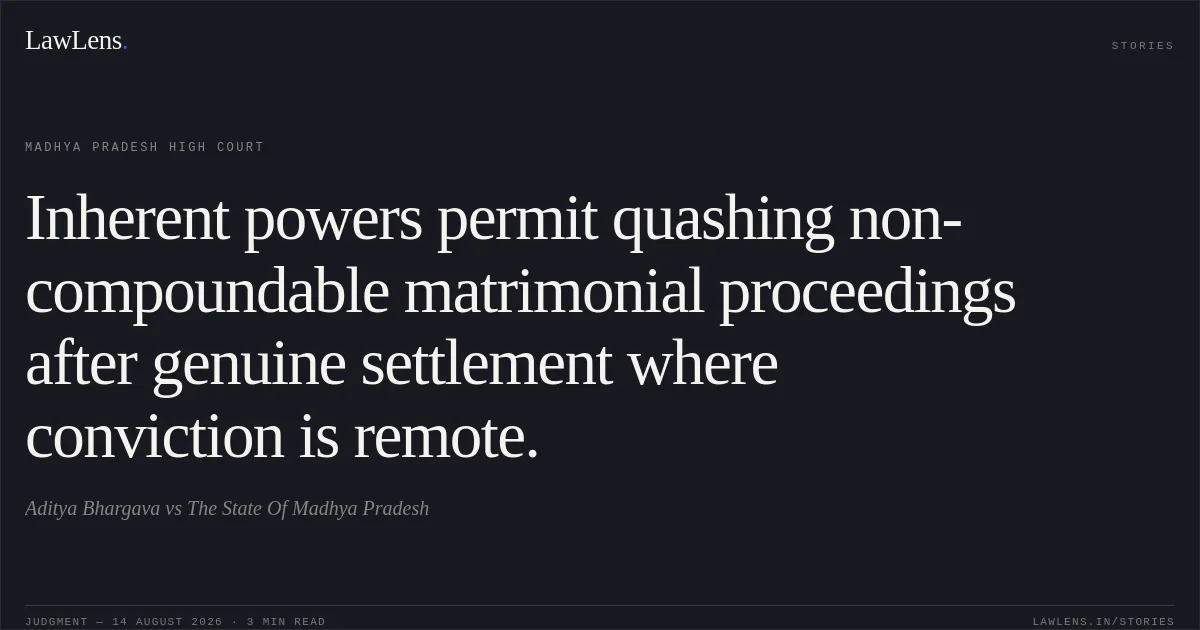
Whether the High Court could exercise its inherent jurisdiction under Section 528 of the BNSS read with Section 482 of the CrPC to quash non-compoundable offences arising from a matrimonial dispute on the basis of a voluntary compromise between the parties.
Source reference: paras. 6, 8–10Whether, in view of the settlement, withdrawal of connected proceedings and hostile testimony of the complainant and other material witnesses, continuation of the criminal prosecution would constitute an abuse of the process of court or otherwise fail to serve the ends of justice.
Source reference: paras. 7–10Law Applied
The Court applied Section 528 of the Bharatiya Nagarik Suraksha Sanhita, 2023, read with Section 482 of the Code of Criminal Procedure, which preserves the High Court’s inherent power to prevent abuse of process and secure the ends of justice.
Source reference: para. 1It considered the offences under Section 85 and Section 3(5) of the Bharatiya Nyaya Sanhita, 2023 and Sections 3 and 4 of the Dowry Prohibition Act, 1961, notwithstanding their non-compoundable nature.
Source reference: paras. 1, 5Relying on B.S. Joshi v. State of Haryana, (2003) 4 SCC 675; Gian Singh v. State of Punjab, (2012) 10 SCC 303; Narinder Singh v. State of Punjab, (2014) 6 SCC 466; and Parbatbhai Aahir v. State of Gujarat, (2017) 9 SCC 641, the Court reaffirmed that criminal proceedings arising predominantly from matrimonial or personal disputes may be quashed on the basis of a genuine and voluntary settlement where continuation of the proceedings would serve no useful purpose and would amount to an abuse of process.
Source reference: paras. 3, 8Reasoning
The Court found that the allegations principally arose out of matrimonial discord, dowry-related disagreements and domestic differences, rather than offences having a predominantly public or societal character.
Source reference: para. 6Although the alleged offences were non-compoundable, the Court held that this did not restrict its inherent jurisdiction to quash proceedings where the parties had voluntarily and amicably resolved their dispute.
Source reference: para. 6Respondent No. 2 confirmed the compromise, stated that it was free from coercion or undue influence, expressed a desire to restore matrimonial relations and did not wish to pursue the prosecution.
Source reference: paras. 4, 6Further, the complainant and other material witnesses had already failed to support the prosecution case and had been declared hostile, substantially weakening the evidentiary foundation of the prosecution.
Source reference: para. 7In these circumstances, the possibility of conviction was considered remote, and continuation of the proceedings was found likely to perpetuate matrimonial bitterness rather than advance the interests of justice.
Source reference: paras. 8–10Holding
The Court answered the issues in favour of the applicants and held that the case was a fit one for exercise of inherent jurisdiction under Section 528 of the BNSS.
The petition was allowed, and the FIR dated 1 March 2025 in Crime No. 69/2025, the charge-sheet, the order framing charges, proceedings in RCT No. 4002/2025 and all consequential proceedings against the applicants were quashed on the basis of the settlement and the circumstances demonstrating that continuation of the prosecution would serve no useful purpose.
Source reference: paras. 10–11Acts & Sections Cited
6 provisions across 4 statutes referred to in this judgment. Each provision opens on LawLens.
Bharatiya Nagarik Suraksha Sanhita, 20231
Code of Criminal Procedure, 19731
Bharatiya Nyaya Sanhita, 20232
Original Court PDF
Aditya BhargavavsThe State Of Madhya Pradesh
Click to open original judgment
Original judgment, available to read, download and summarize on LawLens.in