Facts
The petitioner filed a petition under Section 528 of the Bharatiya Nagarik Suraksha Sanhita (BNSS) seeking the quashment of FIR Crime No. 52/2024 registered at Police Station Nayagaon, District Bhind, for offences under Sections 307 (Attempt to murder) and 294 (Obscene acts) of the IPC
Source reference: para. 1During the pendency of the case, the petitioner and respondent No. 2 filed interlocutory applications stating they had reached an amicable settlement and had no intention to pursue the criminal matter further
Source reference: para. 2Pursuant to a court order dated March 5, 2026, the Principal Registrar verified the compromise, recording statements from both parties, and reported that the settlement was voluntary and free from coercion
Source reference: para. 3Issues
1. Whether the High Court, in the exercise of its inherent powers, can quash criminal proceedings for non-compoundable offences based on a private settlement between the parties.
Source reference: para. 1, 4-102. Whether the continuation of prosecution in the present matter would constitute an abuse of the process of law following a voluntary compromise.
Source reference: para. 11Law Applied
The court primarily applied Section 528 of the BNSS (corresponding to Section 482 of the Cr.P.C.) regarding the inherent powers of the High Court to prevent abuse of process and secure the ends of justice
Source reference: para. 1It relied on Gian Singh v. State of Punjab (2012) 10 SCC 303, which established that the High Court’s power to quash proceedings is distinct from the power of compounding under Section 320
Source reference: para. 5The court further cited State of M.P. v. Laxmi Narayan (2019) 5 SCC 688, which provides that while heinous crimes (murder, rape) should not be quashed, offences that are predominantly private or matrimonial in nature may be quashed if parties resolve their disputes
Source reference: para. 8Additional precedents included K. Bharthi Devi v. State of Telangana (2024) and Narinder Singh v. State of Punjab (2014) to affirm that quashing is permissible in non-compoundable cases to save judicial time
Source reference: para. 4, 6Reasoning
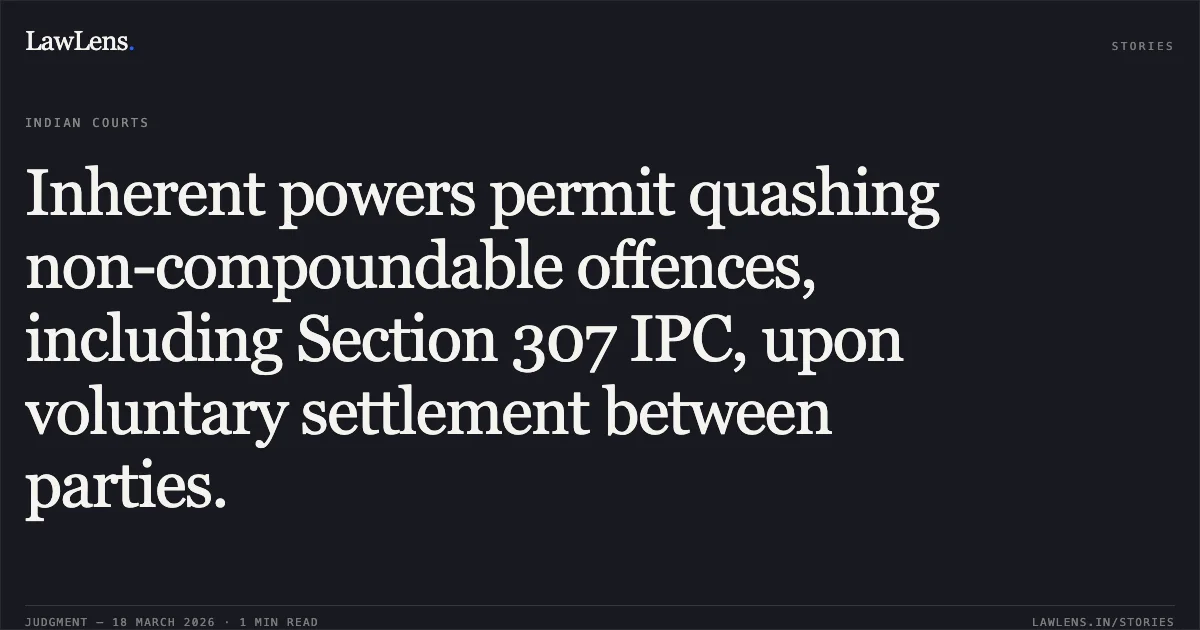
The Court reasoned that although the FIR included Section 307 of the IPC, which is typically non-compoundable, the inherent powers of the High Court are wide enough to quash proceedings to prevent a "futile exercise" when the victim and the accused have settled their differences
Source reference: para. 11The Court observed that the Principal Registrar had already verified the authenticity and voluntary nature of the compromise
Source reference: para. 3Drawing from the principles in Laxmi Narayan and Jaswant Singh, the Court determined that because the parties had amicably resolved the issue, the possibility of conviction was remote, and continuing the trial would lead to a wasteful exercise of judicial resources and an unnecessary burden on the parties
Source reference: para. 11-12The Court emphasized that quashing such matters serves the ends of justice by allowing the parties to move forward without the shadow of a criminal trial that is unlikely to result in conviction
Source reference: para. 10-11Holding
The High Court answered the issues in the affirmative, holding that the settlement justified the exercise of inherent powers to quash the proceedings
The Court allowed the petition and ordered the quashment of FIR Crime No. 52/2024 (Sections 307 and 294 of the IPC) and all consequential proceedings arising therefrom
Source reference: para. 12No order as to costs was made
Source reference: para. 13Acts & Sections Cited
3 provisions across 2 statutes referred to in this judgment. Each provision opens on LawLens.
Indian Penal Code, 18602
Bharatiya Nagarik Suraksha Sanhita, 20231
Original Court PDF
Upendra Singh RajawatvsThe State Of Madhya Pradesh
Click to open original judgment
Original judgment, available to read, download and summarize on LawLens.in


![Subsequent exoneration does not retrospectively invalidate a finalized promotion select list.. UNNIKRISHNAN M vs M/o Environment And Forests. CAT - ['Ernakulam']. LawLens](/stories/thumbnails/subsequent-exoneration-does-not-retrospectively-invalidate-a-finalized-promotion-select-li-ce80a0e84f2f4887857271e8b4341c42.webp)