Facts
The complainant, a member of the Dom Scheduled Caste community, alleged that the appellants assaulted and threatened him and his wife, and used caste-related abuses during a village dispute on 11 June 2016.
Source reference: para. 3The complaint was first taken up by an ACJM, who recorded statements under Sections 200 and 202 CrPC.
Source reference: paras. 4–5After the complaint was transferred to the Special Judge, SC/ST Act, that court summoned the appellants for offences under Sections 323, 504 and 506 IPC and Section 3(1)(r) of the SC/ST Act.
Source reference: paras. 4–5, 7The appellants challenged the summoning order, principally arguing that the Magistrate’s initial proceedings were contrary to Sections 2(bd) and 14 of the SC/ST Act.
Source reference: para. 5Issues
Whether the ACJM’s initial cognizance and recording of statements, followed by transfer of the complaint to the Special Judge, invalidated the subsequent summoning order under the SC/ST Act.
Source reference: paras. 5–7Whether the complaint and preliminary statements disclosed sufficient prima facie material to summon the appellants for the alleged offences.
Source reference: paras. 11–12Law Applied
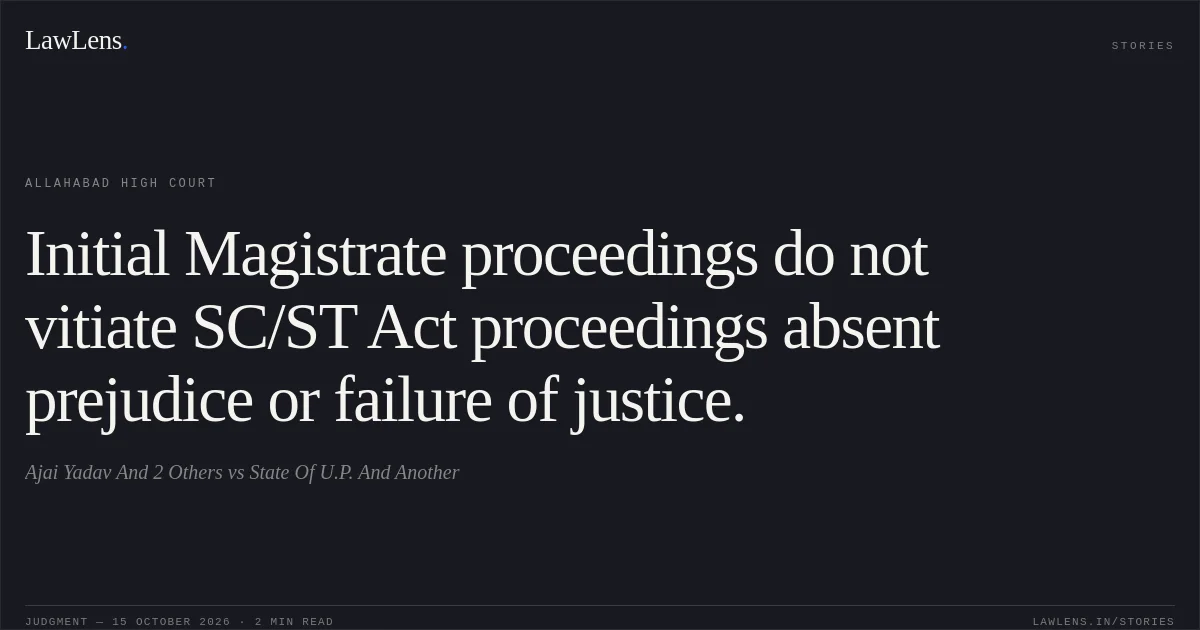
Section 14 of the SC/ST Act empowers the Special Court or Exclusive Special Court to take direct cognizance of offences under the Act; that power does not, by itself, make proceedings following a Magistrate’s cognizance void.
Source reference: paras. 6, 8In Shantaben Bhurabhai Bhuriya v. Anand Athabhai Chaudhari, (2022) 15 SCC 228, the Supreme Court held that proceedings are not automatically vitiated merely because a Magistrate takes cognizance and the case thereafter proceeds before the Special Court; prejudice or failure of justice must be established.
Source reference: para. 8Sections 460 and 461 CrPC distinguish specified irregular acts that do not invalidate proceedings from acts expressly rendered void; Section 460(e) protects, subject to its conditions, a Magistrate’s erroneous but good-faith cognizance under Section 190(1)(a) or (b).
Source reference: para. 9At the summoning stage, the court determines whether the material provides a prima facie basis for proceedings, not whether guilt is proved or the evidence will ultimately secure conviction.
Source reference: paras. 11–12Reasoning
The Special Judge—not the ACJM—passed the challenged summoning order after the complaint was transferred and the material was considered.
Source reference: para. 7The appellants showed neither that the Special Judge lacked statutory competence nor that the earlier proceedings caused prejudice or a failure of justice; the court therefore treated the objection as insufficient to invalidate the subsequent proceedings, applying Shantaben and the relevant CrPC provisions.
Source reference: paras. 8–10, 13On the merits, the complaint and recorded statements made specific allegations of assault, caste-related abuse and threats, which supplied a prima facie basis for summoning.
Source reference: paras. 11–12The court declined to assess credibility or conduct a mini-trial at that stage.
Source reference: paras. 11–12Holding
The Court held that the ACJM’s initial proceedings and the subsequent transfer did not provide a legally sufficient ground to set aside the summoning order, and that the material supported summoning the appellants for the alleged offences.
The appeal was dismissed.
Source reference: paras. 15–17The appellants were directed, if not already on bail, to appear and apply for regular bail within two weeks; the trial court was directed to decide any such application expeditiously, preferably the same day.
Source reference: paras. 15–17Acts & Sections Cited
17 provisions across 3 statutes referred to in this judgment. Each provision opens on LawLens.
Code of Criminal Procedure, 19738
Indian Penal Code, 18606
Scheduled Castes and the Scheduled Tribes (Prevention of Atrocities) Act, 19893
Original Court PDF
Ajai Yadav And 2 OthersvsState Of U.P. And Another
Click to open original judgment
Original judgment, available to read, download and summarize on LawLens.in


