Facts
The appellants claimed that their 22-year-old son, Mohd. Javed, was travelling by EMU train from Mathura Junction to Faridabad on 13 January 2016, when he accidentally fell from the train and died.
Source reference: pp. 1–3, paras. 1–4His body was found the following morning in the New Town Faridabad railway yard.
Source reference: pp. 1–3, paras. 1–4A journey ticket from Mathura Junction to Faridabad, issued that day, was recorded as recovered from his person.
Source reference: pp. 1–3, paras. 1–4The Railway Claims Tribunal dismissed the claim, finding that the appellants had not established either that the deceased was a bona fide passenger or that his death resulted from an untoward incident.
Source reference: pp. 1–3, paras. 1–4The appellants appealed under Section 23 of the Railway Claims Tribunal Act, 1987.
Source reference: pp. 1–3, paras. 1–4The High Court also condoned a 440-day delay in filing the appeal.
Source reference: pp. 1–3, paras. 1–4Issues
1. Whether the recovered journey ticket and surrounding evidence established that the deceased was a bona fide passenger
Source reference: p. 3, para. 72. Whether the evidence established, on a preponderance of probabilities, that the deceased died in an “untoward incident” under Section 123(c)(2) of the Railways Act, 1989, rather than while crossing the railway tracks
Source reference: pp. 5–6, paras. 9–12Law Applied
Section 2(29) of the Railways Act, 1989 defines a “passenger” by reference to travel with a valid pass or ticket; Section 123(c)(2) defines the relevant “untoward incident.”
Source reference: pp. 3–6, paras. 7–11Under Union of India v. Rina Devi, the claimant’s initial burden to establish bona fide passenger status may be discharged by the relevant facts and circumstances, after which the burden shifts to the Railways to rebut the claim with cogent evidence; non-recovery of a ticket alone does not negate passenger status.
Source reference: pp. 3–6, paras. 7–11The Court also relied on Lata v. Union of India and Delhi High Court decisions concerning assessment of railway-death evidence, including Rajendri Devi v. Union of India, Rinavati v. Union of India and Surendra Prasad Verma v. Union of India.
Source reference: pp. 3–6, paras. 7–11Those authorities support assessing the manner of death from the totality of the evidence, rather than drawing a conclusive inference from the injuries, body location or delayed discovery alone.
Source reference: pp. 3–6, paras. 7–11Reasoning
The recovered ticket, which was neither found invalid nor unrelated to the pleaded journey, provided direct evidence of passenger status.
Source reference: pp. 3–4, paras. 7–8The Tribunal therefore could not reject that status based on the family’s lack of knowledge of the journey or on circumstances bearing primarily on the manner of death.
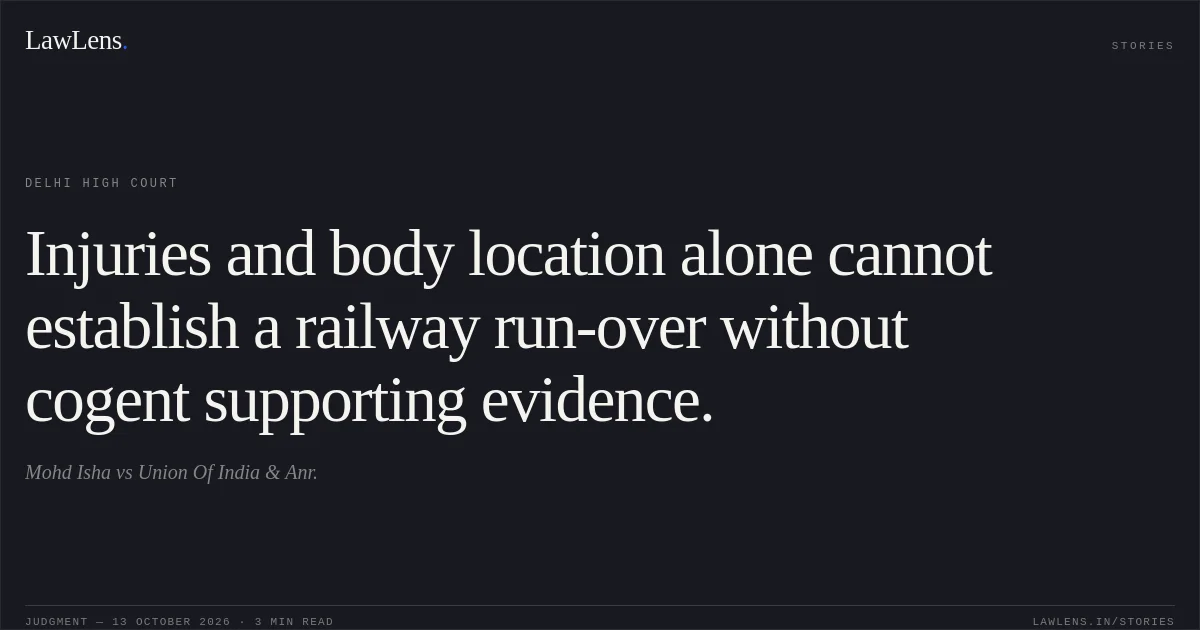
Source reference: pp. 3–4, paras. 7–8As to the cause of death, the crush injuries and amputation established the violent nature of the death but, without expert medical evidence, did not establish that the deceased had been run over while crossing the tracks or exclude an accidental fall.
Source reference: pp. 5–6, paras. 9–12The body’s location and discovery the following morning were likewise inconclusive, and there was no eyewitness evidence that the deceased was crossing the tracks.
Source reference: pp. 5–6, paras. 9–12Considering the ticket, post-mortem report and contemporaneous record cumulatively, the Court held that the possibility of an accidental fall remained and that the appellants’ case was supported on a preponderance of probabilities.
Source reference: pp. 5–6, paras. 9–12Holding
The Court set aside the Tribunal’s dismissal of the claim, accepted that the deceased was a bona fide passenger and found the evidence sufficient to support the claim that his death resulted from an untoward incident.
It allowed the appeal and remanded the matter to the Tribunal to assess compensation in accordance with law and direct its disbursement within two months of receiving the order.
Source reference: p. 7, paras. 13–15The matter was directed to be listed before the Tribunal on 19 January 2027.
Source reference: p. 7, paras. 13–15Acts & Sections Cited
3 provisions across 2 statutes referred to in this judgment. Each provision opens on LawLens.
Railway Claims Tribunal Act, 19871
Railways Act, 19892
Original Court PDF
Mohd IshavsUnion Of India & Anr.
Click to open original judgment
Original judgment, available to read, download and summarize on LawLens.in