Facts
Devender Kumar Soni died in a railway incident on 18 July 2012. A New Delhi–New Town Faridabad ticket was recovered from his personal search. The claimants alleged that he fell from a crowded EMU train after a sudden jerk; the Railway Claims Tribunal dismissed the compensation claim, finding that he had been run over while crossing the tracks.
Source reference: pp. 1–2, paras. 1–3The claimants appealed under Section 23 of the Railway Claims Tribunal Act, 1987.
Source reference: pp. 1–2, paras. 1–3Issues
Whether the deceased was a bona fide passenger
Source reference: p. 3, para. 7Whether his death resulted from an accidental fall from a train constituting an “untoward incident” under Section 123(c) of the Railways Act, 1989
Source reference: p. 4, para. 10Law Applied
Under Section 123(c)(2) of the Railways Act, 1989, an accidental fall from a train may constitute an “untoward incident”.
Source reference: p. 4, para. 10Under Union of India v. Rina Devi, the claimant’s initial burden to establish bona fide passenger status is not onerous; it may be discharged through relevant facts and surrounding circumstances, after which the burden shifts to the Railways to rebut the claim with cogent evidence. The Court also relied on Lata v. Union of India and Sukhabhai Nanjibhai Makwana v. Union of India for a non-technical assessment of evidence in railway-claim cases.
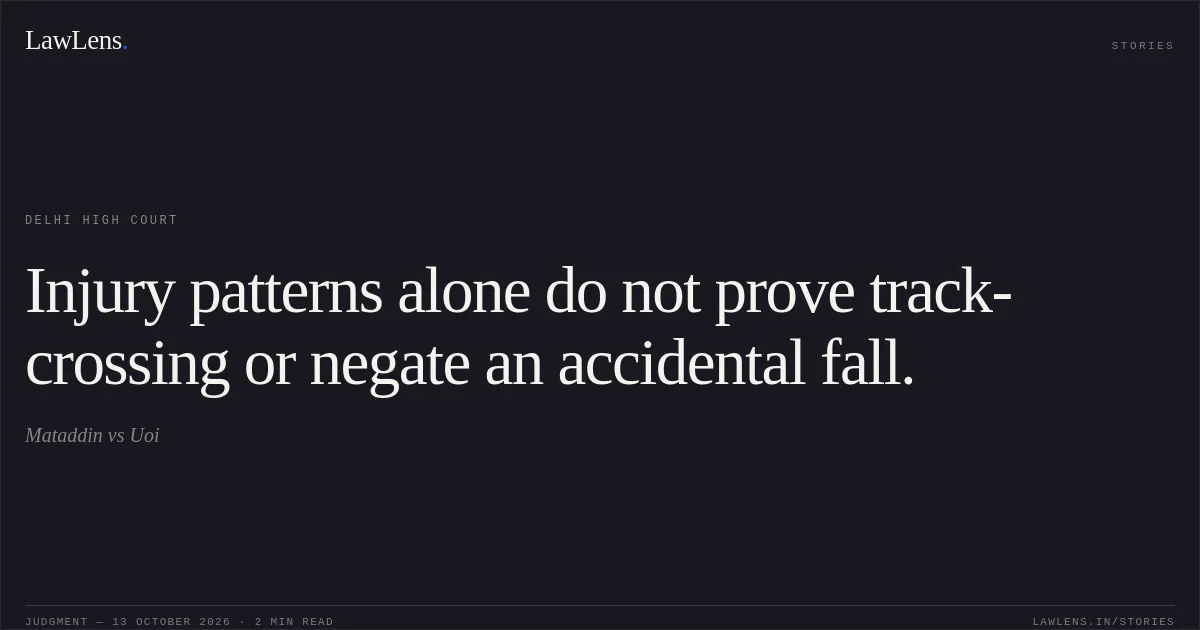
Source reference: p. 4, para. 9The Court further applied Prempal Singh v. Union of India and Union of India v. Smt. Pratima Devi for the principle that the nature or extent of injuries, including a severed body, does not by itself establish that the deceased was crossing the tracks.
Source reference: pp. 5–6, para. 12Reasoning
The recovered journey ticket, considered with the other travel tickets found on the deceased, sufficiently discharged the claimants’ initial burden to establish bona fide passenger status; the Railways led no oral evidence to rebut those circumstances.
Source reference: p. 4, para. 8The Station Master’s memo confirmed a fatal train-related incident but did not say that the deceased was crossing the tracks. Nor did the post-mortem report or other medical evidence establish that the injuries could only have resulted from his being run over while crossing. The police report’s reference to a fall from an unknown running train was relevant, though not conclusive. In the absence of an eyewitness or cogent evidence of track-crossing, the Tribunal could not infer that circumstance from the injuries and condition of the body alone.
Source reference: pp. 4–6, paras. 11–13On the evidence as a whole, and applying the beneficial purpose of the Act, the Court found an accidental fall more probable.
Source reference: p. 6, para. 14Holding
The Court held that the deceased was a bona fide passenger and that his death resulted from an accidental fall from a train, amounting to an untoward incident under Section 123(c)(2) of the Railways Act.
It set aside the Tribunal’s judgment and remanded the matter to the Tribunal to assess compensation and direct its disbursement within two months of receiving the order. The matter was directed to be listed before the Tribunal on 19 January 2027; the appeal was allowed and disposed of accordingly.
Source reference: p. 6, paras. 15–16Acts & Sections Cited
2 provisions across 2 statutes referred to in this judgment. Each provision opens on LawLens.
Railway Claims Tribunal Act, 19871
Railways Act, 19891
Original Court PDF
MataddinvsUoi
Click to open original judgment
Original judgment, available to read, download and summarize on LawLens.in