Facts
The petitioners challenged the dismissal of their suit by a judgment and decree dated 15 March 2017.
Source reference: para. 2–4, 6–9They filed an appeal in 2024, and the Appellate Court refused to condone the delay.
Source reference: para. 2–4, 6–9The petitioners attributed the delay to COVID-19, the death of petitioner No. 2’s son in April 2021, and difficulty reaching agreement among co-owners about pursuing an appeal.
Source reference: para. 2–4, 6–9They challenged the refusal to condone delay under Article 227 of the Constitution.
Source reference: para. 2–4, 6–9The petitioners’ counsel did not provide the delay-condonation application when asked by the Court.
Source reference: para. 2–4, 6–9Issues
1. Whether the Appellate Court erred in refusing to condone the delay in filing the appeal against the 2017 decree
Source reference: para. 6–92. Whether the High Court should interfere under Article 227 with the Appellate Court’s refusal to condone the delay
Source reference: para. 2, 11Law Applied
Under Section 5 of the Limitation Act, 1963, delay may be condoned where sufficient cause is established; the discretion must be exercised judicially, taking account of the explanation, the length of delay, negligence, inaction, and bona fides.
Source reference: para. 10.1–10.5A liberal approach does not justify condoning inordinate delay where the litigant has not acted diligently.
Source reference: para. 10.1–10.5The Court relied on Rajneesh Kumar v. Ved Prakash (2024), K.B. Lal v. Gyanendra Pratap (2024), Pathapati Subba Reddy v. Special Deputy Collector (LA) (2024), Basawaraj v. Special Land Acquisition Officer (2013), and Shivamma v. Karnataka Housing Board (2025) for these principles.
Source reference: para. 10.1–10.5The Court’s supervisory jurisdiction under Article 227 was also invoked in the petition.
Source reference: para. 2Reasoning
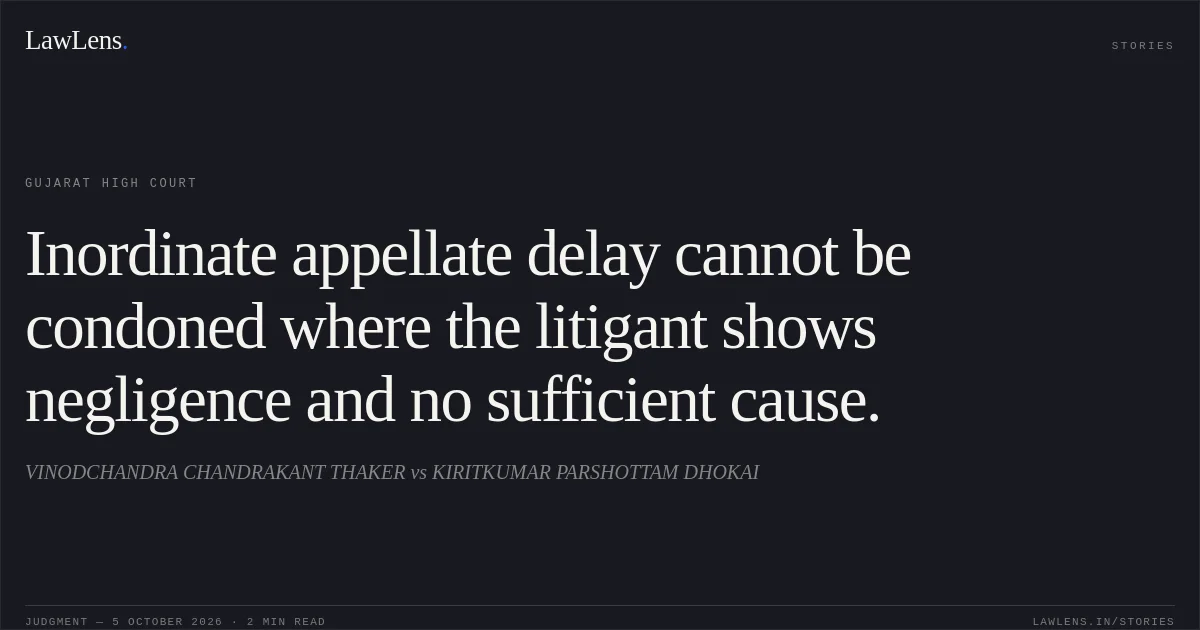
The Court found that the petitioners had allowed more than seven years to pass between the trial decree and the appeal, without establishing sufficient cause for the delay.
Source reference: para. 7–11The disagreement among co-plaintiffs did not explain why petitioner No. 1, an advocate, could not file an appeal and join the others as respondents.
Source reference: para. 7–11The son’s death occurred about four years after the decree and was followed by a further delay of nearly three years before the appeal was filed; COVID-19 also arose after the decree.
Source reference: para. 7–11The petitioners’ failure to provide the delay application prevented the Court from examining its averments, and the Court confined its review to the impugned order.
Source reference: para. 7–11On these facts, it found negligence and no sufficient cause, and discerned no legal error warranting interference.
Source reference: para. 7–11Holding
The High Court held that the petitioners had not shown sufficient cause to condone the inordinate delay and that the Appellate Court had committed no gross error of law in rejecting the delay application.
It dismissed the petition, discharged the notice, and made no order as to costs.
Source reference: para. 11–12Acts & Sections Cited
2 provisions across 1 statute referred to in this judgment. Each provision opens on LawLens.
Original Court PDF
VINODCHANDRA CHANDRAKANT THAKERvsKIRITKUMAR PARSHOTTAM DHOKAI
Click to open original judgment
Original judgment, available to read, download and summarize on LawLens.in