Facts
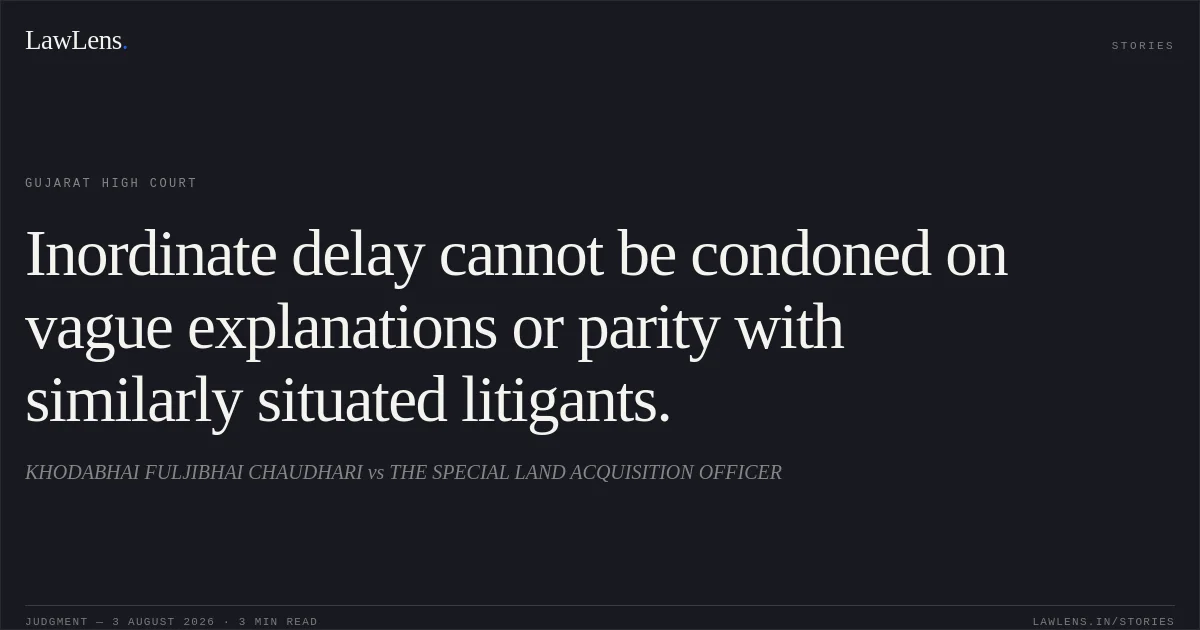
The applicants, original claimants/legal heirs in LAQ Case No. 38 of 2004 concerning acquisition of land at village Lakhvad, sought condonation of a delay of 6,472 days in filing a first appeal against the Reference Court’s order dated 6 May 2008.
Source reference: p.1, para. 2; pp.5–6, para. 5They contended that the acquisition for the same public purpose had been divided into five groups and that appeals arising from other groups had been entertained after condoning delay.
Source reference: pp.2, 5–6, paras. 3, 8They further relied on the alleged recent deposit of deficient compensation, including solatium-related amounts, in March 2025, their status as poor and illiterate agriculturists, and their later knowledge of proceedings before the High Court and Supreme Court.
Source reference: pp.2–7, paras. 3.1–3.4, 5–7, 9–15The State opposed the application on the ground that the extraordinary delay had not been satisfactorily explained.
Source reference: p.2, para. 4Issues
Whether the applicants had shown “sufficient cause” under Section 5 of the Limitation Act, 1963 for condoning the delay of 6,472 days in filing the first appeal.
Source reference: p.8, paras. 6–10Whether the condonation of delay could be justified merely because similarly situated claimants in connected land-acquisition matters had obtained condonation or pursued further proceedings.
Source reference: pp.10–12, para. 11; pp.15–16, paras. 13–14Whether the applicants’ poverty, illiteracy, lack of legal knowledge, recent discovery of alleged compensation deficiencies, and need to arrange court fees constituted sufficient cause for the delay.
Source reference: pp.3–7, paras. 5–9; pp.15–16, para. 14Law Applied
Section 5 of the Limitation Act, 1963 permits admission of an appeal after limitation only when the applicant establishes “sufficient cause” for the delay.
Source reference: p.8, para. 6Although the provision is to be construed liberally to advance substantial justice, liberal or justice-oriented considerations cannot override the limitation statute; the applicant must demonstrate diligence and absence of negligence, inaction or lack of bona fides.
Source reference: pp.8–9, paras. 7–8In Pathapati Subba Reddy (D) by LRs v. Special Deputy Collector (LA), (2024) 12 SCC 336, the Supreme Court held that condonation is discretionary, that inordinate delay, negligence and want of due diligence may justify refusal, and that relief granted to other persons does not automatically entitle similarly situated litigants to condonation.
Source reference: pp.10–12, para. 11The Court also relied on State of Odisha v. Managing Committee of Namatara Girls High Schools, 2026 INSC 148, for the principle that an explanation must be distinguished from a mere excuse and that condonation cannot be claimed as of right.
Source reference: pp.12–15, para. 12The Court further applied the principle in Government of Karnataka v. Gowramma, (2007) 13 SCC 482, that cases cannot be decided by blindly relying on precedents because even a single differing fact may materially affect the outcome.
Source reference: pp.16–17, para. 13Reasoning
The Court found that the delay of nearly twenty years was “inordinate and colossal” and remained substantially unexplained.
Source reference: pp.9, 15–17, paras. 9–10, 13, 16The applicants’ reliance on proceedings involving other acquisition groups did not explain why they themselves failed to file an appeal within limitation; nor did the alleged division of the acquisition proceedings establish a legally sufficient ground for delay.
Source reference: p.15, para. 13The subsequent deposit of compensation in March 2025, the applicants’ alleged discovery of deficiencies in compensation, their lack of legal awareness, poverty, and need to arrange court fees were considered general and vague assertions unsupported by substantive evidence, and none was shown to have prevented filing the appeal within time.
Source reference: pp.3–7, 9, 15–16, paras. 5–10, 14Applying Pathapati Subba Reddy, the Court held that parity with other litigants and the merits of the proposed appeal could not substitute for proof of sufficient cause.
Source reference: pp.10–12, para. 11The applicants’ prolonged silence and lack of due diligence therefore outweighed the Court’s ordinarily liberal approach under Section 5.
Source reference: pp.8–9, 15–17, paras. 7–10, 13–16Holding
The Court answered the issues against the applicants and held that no cogent or credible explanation had been furnished for the delay of 6,472 days.
The application for condonation of delay was dismissed, the rule was discharged, and the prayer for registration of the first appeal was rejected.
Source reference: p.17, paras. 16–17Any connected civil applications were held not to survive and were disposed of accordingly.
Source reference: p.18, para. 18Acts & Sections Cited
2 provisions across 1 statute referred to in this judgment. Each provision opens on LawLens.
Original Court PDF
KHODABHAI FULJIBHAI CHAUDHARIvsTHE SPECIAL LAND ACQUISITION OFFICER
Click to open original judgment
Original judgment, available to read, download and summarize on LawLens.in