Facts
The applicants were original claimants in LAQ Case No. 38 of 2004 concerning acquisition of land at village Lakhvad for a public purpose.
Source reference: no citationThe acquisition proceedings were divided into separate groups, and awards were made on 27 September 2004.
Source reference: no citationThe Reference Court decided the references by separate orders dated 6 May 2008.
Source reference: pp. 4–5, para. 5The applicants sought registration of a First Appeal against the Reference Court’s decision after a delay of 6,472 days.
Source reference: p. 2, para. 2To explain the delay, the applicants stated that they became aware in 2025 that compensation had allegedly been incorrectly calculated, including non-payment of interest on solatium and the statutory 12% additional amount.
Source reference: pp. 3–4, paras. 5–7The deficit compensation was deposited in March 2025.
Source reference: pp. 3–4, paras. 5–7They also relied on similar appeals arising from other LAQ cases, in which delay had allegedly been condoned, and claimed that they were poor and illiterate agriculturists unaware of legal remedies.
Source reference: pp. 4–7, paras. 8–18The State opposed the application on the ground that the inordinate delay was unexplained.
Source reference: p. 8, para. 4Issues
Whether the applicants had shown “sufficient cause” under Section 5 of the Limitation Act, 1963 for condoning the delay of 6,472 days in filing the First Appeal?
Source reference: pp. 8–9, paras. 6–10Whether reliance on similarly situated claimants, subsequent knowledge of alleged compensation deficiencies, poverty, illiteracy, and pending proceedings could justify condonation of such an inordinate delay?
Source reference: pp. 15–17, paras. 13–16Law Applied
The Court applied Section 5 of the Limitation Act, 1963, under which an appeal may be admitted after limitation only when the applicant satisfies the Court that sufficient cause prevented timely filing.
Source reference: p. 8, para. 6Although Section 5 is to be construed liberally to advance substantial justice, liberal or justice-oriented considerations cannot dispense with the requirement of a credible explanation, particularly where negligence, inaction, want of bona fides, or lack of due diligence is evident.
Source reference: pp. 8–9, paras. 7–8Relying on Pathapati Subba Reddy (D) by LRs v. Special Deputy Collector (LA), (2024) 12 SCC 336, the Court held that condonation is discretionary; inordinate delay, negligence, and want of due diligence may justify refusal, and relief granted to other litigants does not automatically entitle similarly placed persons to condonation.
Source reference: pp. 10–12, para. 11The Court also relied on State of Odisha v. Managing Committee of Namatara Girls High School, 2026 INSC 148, for the principle that condonation cannot be claimed as a matter of right and that an “excuse” is not equivalent to a legally acceptable explanation.
Source reference: pp. 12–15, para. 12Government of Karnataka v. Gowramma, (2007) 13 SCC 482 was cited for the rule that precedents cannot be applied mechanically because even a material difference in facts may alter the result.
Source reference: pp. 16–17, para. 13Reasoning
The Court found that the applicants had not explained the delay continuously or specifically for nearly twenty years.
Source reference: pp. 15–17, paras. 13–15Their reliance on the 2025 discovery regarding compensation calculations, the deposit of deficit amounts, advice from co-villagers or a local advocate, poverty, illiteracy, and the pendency of other claimants’ proceedings did not demonstrate that any legally sufficient impediment prevented them from filing the appeal within limitation.
Source reference: pp. 15–17, paras. 13–15The Court held that the applicants had referred primarily to other proceedings instead of explaining their own inaction.
Source reference: pp. 10–12, 15–17, paras. 11, 13–16The fact that delay had been condoned in appeals arising from other LAQ cases could not create an automatic right to similar treatment, particularly in view of the discretionary nature of Section 5 and the requirement of due diligence.
Source reference: pp. 10–12, 15–17, paras. 11, 13–16The applicants’ pleadings were also unsupported by substantive documentary evidence establishing sufficient cause.
Source reference: p. 9, para. 9Holding
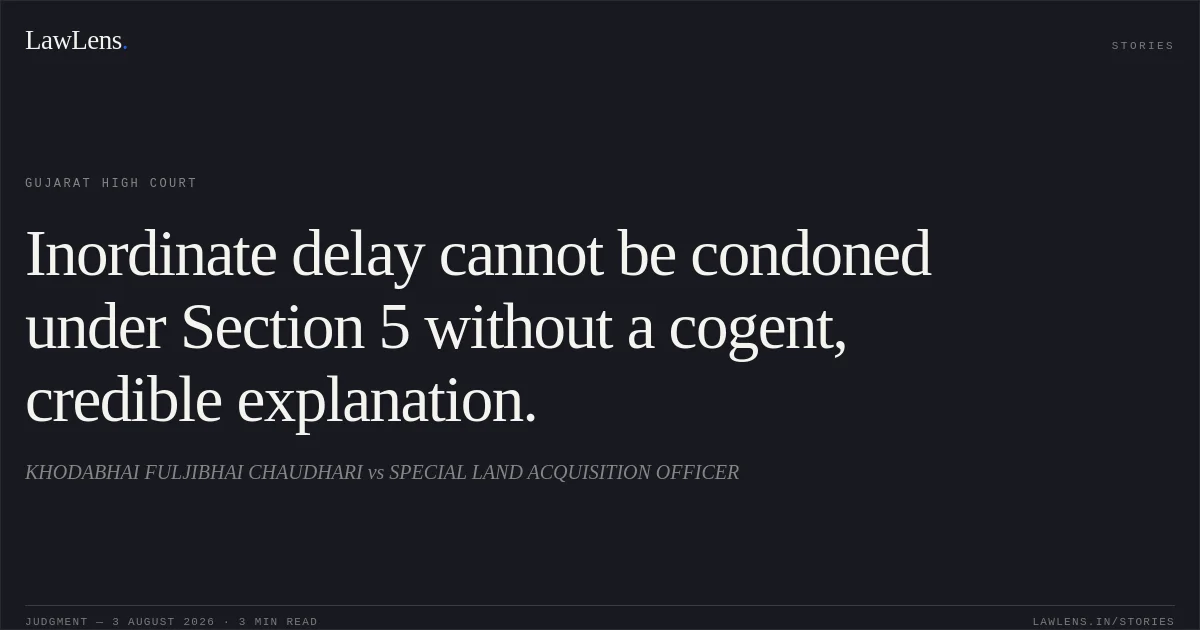
The High Court held that the applicants failed to establish any cogent, credible, or sufficient cause for condoning the delay of 6,472 days.
The Civil Application for condonation of delay was therefore dismissed, and the Rule was discharged.
Source reference: p. 17, para. 16Consequently, the prayer for registration of the First Appeal was rejected, and any connected applications were disposed of as having become infructuous.
Source reference: p. 18, paras. 17–18Acts & Sections Cited
2 provisions across 1 statute referred to in this judgment. Each provision opens on LawLens.
Original Court PDF
KHODABHAI FULJIBHAI CHAUDHARIvsSPECIAL LAND ACQUISITION OFFICER
Click to open original judgment
Original judgment, available to read, download and summarize on LawLens.in