Facts
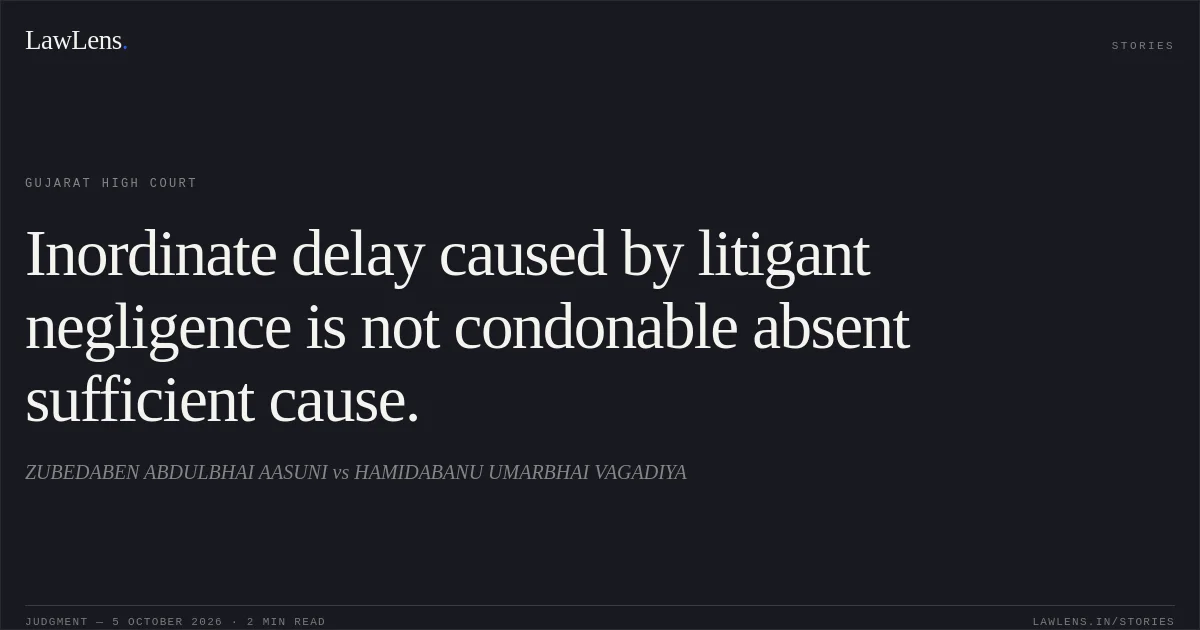
The petitioners, plaintiffs in Special Civil Suit No. 21 of 2012, challenged the Trial Court’s refusal to condone the delay in applying to restore their suit, which had been dismissed for non-prosecution on 19 February 2020.
Source reference: para. 2, 4Before dismissal, the Trial Court had issued a notice to the plaintiffs (Exhibit 98), which was served; the plaintiffs had also filed an evidence affidavit in 2018.
Source reference: para. 4.1They claimed they learned of the dismissal after receiving notice in the respondents’ writ petition. That notice was served in October 2021, but the restoration application was filed only on 24 August 2023, resulting in a delay of 3 years, 6 months and 6 days.
Source reference: para. 3, 4.2, 4.4The Trial Court rejected the delay application, and the petitioners sought relief under Article 227 of the Constitution.
Source reference: para. 2, 4.2Issues
Whether the petitioners established sufficient cause to condone the delay in filing their application to restore the suit.
Source reference: para. 3, 4.2–4.5Whether the Trial Court’s refusal to condone the delay warranted interference under Article 227 of the Constitution.
Source reference: para. 2, 6Law Applied
Section 5 of the Limitation Act, 1963 permits condonation where sufficient cause is shown, and should be applied with a liberal, justice-oriented approach; however, that discretion is not warranted where the delay is inordinate and the applicant demonstrates negligence, want of diligence, or lack of bona fides (*K.B. Lal v. Gyanendra Pratap*, *Esha Bhattacharjee v. Managing Committee of Raghunathpur Nafar Academy*, and *Pathapati Subba Reddy v. Special Deputy Collector (LA)*).
Source reference: para. 5.1–5.2The length of delay and the bona fides of the explanation must be assessed, and substantial justice cannot be used to override limitation requirements (*Shivamma v. Karnataka Housing Board*).
Source reference: para. 5.4A litigant must remain vigilant about proceedings initiated at their instance and cannot, by itself, shift responsibility for prolonged inaction to their advocate (*Rajneesh Kumar v. Ved Prakash*).
Source reference: para. 5The Court also relied on *Basawaraj v. Special Land Acquisition Officer*, which holds that delay cannot be condoned absent an adequate explanation, including by imposing conditions or costs.
Source reference: para. 5.3Reasoning
The petitioners’ assertion that their advocate did not inform them of the suit’s progress did not explain their failure to address the Trial Court’s served notice before dismissal.
Source reference: para. 4.1, 4.3The Court considered that omission material, particularly since the petitioners had filed evidence in 2018.
Source reference: para. 4.1, 4.3Nor did they explain why, after receiving notice of the respondents’ writ petition in October 2021 and learning of the dismissal, they waited a further 1 year and 10 months before applying for restoration.
Source reference: para. 4.4In light of the prolonged, unexplained delay and the petitioners’ lack of diligence, the Court found no sufficient cause and no basis to disturb the Trial Court’s order under Article 227.
Source reference: para. 4.5, 6Holding
The Court held that the petitioners had not established sufficient cause to condone the delay and that their negligence could not be remedied by imposing costs.
The petition was dismissed in limine, with no order as to costs.
Source reference: para. 7Acts & Sections Cited
2 provisions across 1 statute referred to in this judgment. Each provision opens on LawLens.
Original Court PDF
ZUBEDABEN ABDULBHAI AASUNIvsHAMIDABANU UMARBHAI VAGADIYA
Click to open original judgment
Original judgment, available to read, download and summarize on LawLens.in