Facts
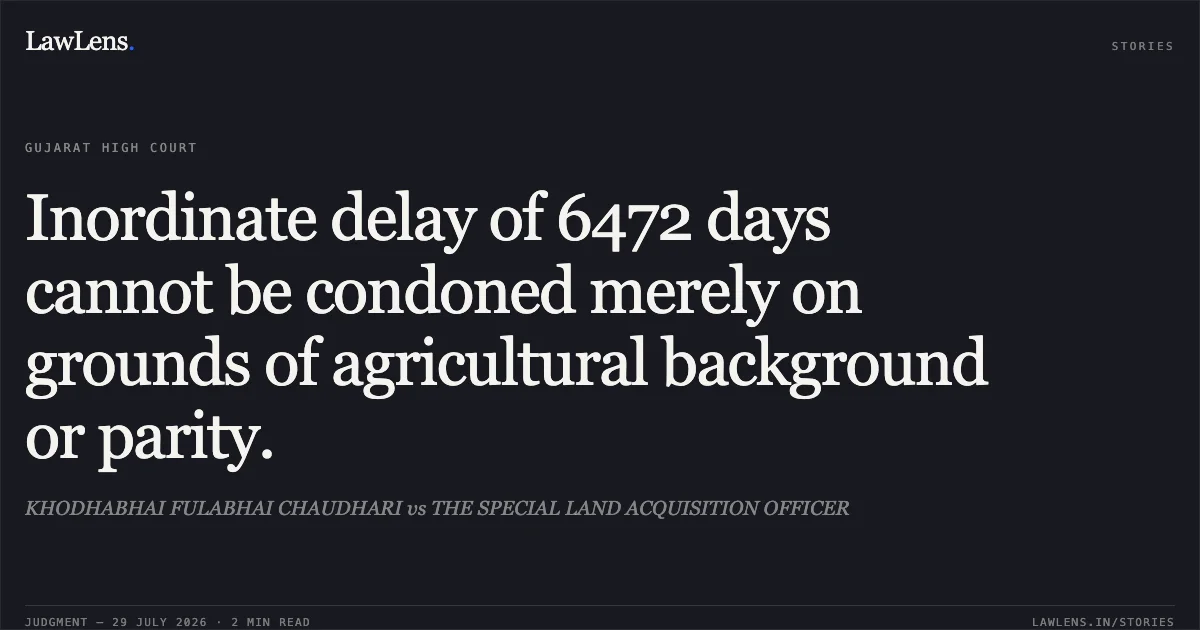
The applicants sought condonation of an inordinate delay of 6472 days (approximately 18–20 years) in filing First Appeals against a Land Reference Award dated 06/05/2008.
Source reference: p. 1-2, 4The land in Village Lakhvad was acquired for a public purpose and divided into five administrative groups (LAQ Case Nos. 35/2004 to 39/2004).
Source reference: p. 1-2The applicants, legal heirs of the original claimants, argued that delay occurred because they were illiterate agriculturists unaware of legal intricacies.
Source reference: p. 5They noted that some co-villagers had recently approached the Supreme Court for enhancement, and that the State only deposited deficit solatium and interest amounts in March 2025.
Source reference: p. 3-4They further cited that other similar cases from the same village had their delays condoned by the High Court in 2022.
Source reference: p. 4-5Issues
1. Whether the applicants established "sufficient cause" under Section 5 of the Limitation Act, 1963, to warrant the condonation of a 6472-day delay.
Source reference: p. 1, 72. Whether the fact that similarly situated claimants in related acquisition proceedings obtained relief / condonation constitutes a valid ground for condoning delay for the present applicants.
Source reference: p. 9-10Law Applied
Section 5 of the Limitation Act, 1963, which requires the applicant to satisfy the court that "sufficient cause" prevented the timely filing of an appeal.
Source reference: p. 7Pathapati Subba Reddy v. Special Deputy Collector (LA) (2024), which establishes that the law of limitation is public policy to end litigation and that a "liberal approach" cannot defeat Section 3 of the Act, nor is delay condonable merely because others obtained relief in similar matters.
Source reference: para. 11State of Odisha v. Managing Committee of Namatara Girls High Schools (2026), distinguishing between a valid "explanation" and a "lame excuse".
Source reference: para. 12Government of Karnataka v. Gowramma (2007) regarding the limitations of following precedents blindly without considering specific factual differences.
Source reference: para. 13Reasoning
The court found the 6472-day delay to be "colossal" and "unexplained".
Source reference: para. 9It rejected the plea of "parity" with other claimants, noting that under the Pathapati Subba Reddy precedent, the negligence of one party cannot be excused simply because another party was diligent or successful in a separate application.
Source reference: para. 11The court observed that the applicants’ claims of illiteracy and lack of advice were vague, general, and unsupported by documentary evidence.
Source reference: para. 9, 14It reasoned that the theory of a "liberal approach" must be balanced against "due diligence"; sleeping on rights for 20 years creates vested rights for the opposing party that should not be lightly defeated.
Source reference: para. 8, 14The court concluded the reasons proffered were "superficial," "shallow," and constituted an "excuse" rather than a judicially acceptable "explanation".
Source reference: para. 12, 14, 16Holding
The court held that the applicants failed to establish "sufficient cause" for the inordinate delay.
Consequently, the Civil Applications for condonation of delay were dismissed, the Rule was discharged, and the request for registration of the First Appeals was rejected.
Source reference: para. 16-17Acts & Sections Cited
2 provisions across 1 statute referred to in this judgment. Each provision opens on LawLens.
Original Court PDF
KHODHABHAI FULABHAI CHAUDHARIvsTHE SPECIAL LAND ACQUISITION OFFICER
Click to open original judgment
Original judgment, available to read, download and summarize on LawLens.in


