Facts
The Petitioner filed a revision petition challenging an order dated 19.12.2024 passed by the Principal District & Sessions Judge, which had set aside a summoning order against Respondents 2 and 3 for offences under Sections 465/466/469/471/120 of the IPC
Source reference: p. 2The Petitioner filed the present revision petition with a delay of 281 days
Source reference: p. 3Procedurally, the Petitioner had previously filed two petitions under Section 528 of the BNSS (Crl. M.C. 3826/2025 and 5654/2025), both of which were withdrawn—the first due to "typographical and bookmarking errors" on 27.05.2025, and the second on 22.09.2025 to pursue alternate remedies
Source reference: p. 3-4The Petitioner attributed the delay to being a lay woman, changing counsel, summer vacations, and time taken to obtain certified copies
Source reference: p. 4-5Respondents opposed the application, noting that the Petitioner had been duly served via email in the lower court proceedings but chose to remain absent
Source reference: p. 5-7Issues
Whether the Petitioner demonstrated "sufficient cause" under Section 5 of the Limitation Act, 1963, to warrant the condonation of a 281-day delay in filing the revision petition
Source reference: p. 3, 10Whether the conduct of the Petitioner, including the repeated withdrawal of prior petitions and claims of non-service despite evidence to the contrary, constitutes due diligence
Source reference: p. 11-13Law Applied
The court applied Section 5 of the Limitation Act, 1963, regarding the condonation of delay, and Section 528 of the BNSS
Source reference: p. 3It relied on the principle from *Pathapati Subba Reddy v. Collector (LA)* that while Section 5 is construed liberally to advance justice, it cannot defeat substantive limitation law where there is inordinate delay, negligence, or lack of due diligence
Source reference: p. 14-15It further applied *H. Guruswamy v. A. Krishnaiah*, establishing that courts must first ascertain the *bona fides* of the explanation before considering merits
Source reference: p. 15-16and *State of Odisha v. Managing Committee of Namatara Girls High School*, which distinguished between a valid "explanation" and a "mere excuse"
Source reference: p. 16-18Reasoning
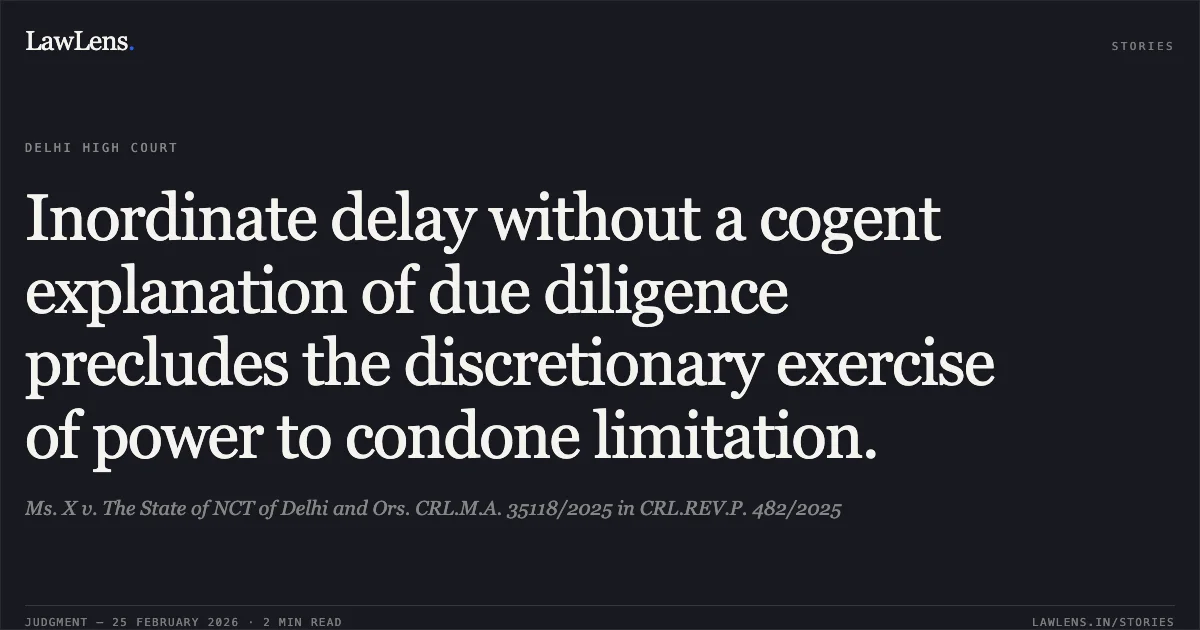
The Court found the Petitioner’s explanation for the 281-day delay unsatisfactory and lacking in due diligence.
Source reference: no citationIt noted that the Petitioner was aware of the impugned order as of 19.12.2024 yet failed to file an effective petition for five months
Source reference: p. 11The Court dismissed the excuse regarding "typographical errors" and "bookmarking issues" as insufficient for withdrawing and re-filing petitions over several months
Source reference: p. 12Furthermore, the Court observed a recurring pattern of unexplained gaps: a one-month delay in engaging new counsel after the first withdrawal, and a two-month delay in filing the present revision after the second withdrawal in September 2025
Source reference: p. 13The Court also rejected the Petitioner's plea of being a "lay person," noting she had legal assistance when filing applications in the lower court and that service of notice via her registered email was valid
Source reference: p. 9-10Consequently, the Court determined the Petitioner had not acted with the urgency required to protect her legal rights
Source reference: p. 18-19Holding
The Court held that the Petitioner failed to meet the threshold of "sufficient cause" for condoning the 281-day delay
The application for condonation of delay (CRL.M.A. 35118/2025) was dismissed
Source reference: p. 20Consequently, the main criminal revision petition (CRL.REV.P. 482/2025) was also dismissed as time-barred
Source reference: p. 20Acts & Sections Cited
9 provisions across 3 statutes referred to in this judgment. Each provision opens on LawLens.
Limitation Act, 19631
Indian Penal Code, 18605
Bharatiya Nagarik Suraksha Sanhita, 20233
Original Court PDF
Ms. X v. The State of NCT of Delhi and Ors. CRL.M.A. 35118/2025 in CRL.REV.P. 482/2025
Click to open original judgment
Original judgment, available to read, download and summarize on LawLens.in


![Authorities must decide pensionary and retiral-benefit claims through a reasoned order within eight weeks.. Habibullah khan vs HOME DEPARTMENT. CAT - ['Srinagar']. LawLens](/stories/thumbnails/authorities-must-decide-pensionary-and-retiral-benefit-claims-through-a-reasoned-order-wit-d0cbe8a8119c48fbabe7df9f2d353488.webp)