Facts
The petitioner (PGVCL) filed a suit in 2001 for recovery of electricity dues.
Source reference: para 2Though the respondent appeared via an advocate, he failed to file a written statement, and the suit was decreed in favor of PGVCL on 29.02.2008.
Source reference: para 2In 2019, PGVCL initiated execution proceedings, leading to the issuance of a recovery warrant.
Source reference: para 2The respondent then filed an appeal under Section 96 of the CPC, accompanied by an application to condone a delay of 14 years and 09 months.
Source reference: para 3The respondent claimed he was under the impression that his acquittal in a concurrent criminal case (decided on 31.12.2010) would result in the dismissal of the civil suit.
Source reference: para 5.1/7The Principal District Judge, Porbandar, condoned the delay on 07.08.2023, subject to costs.
Source reference: para 3The petitioner challenged this order before the High Court.
Source reference: para 1Issues
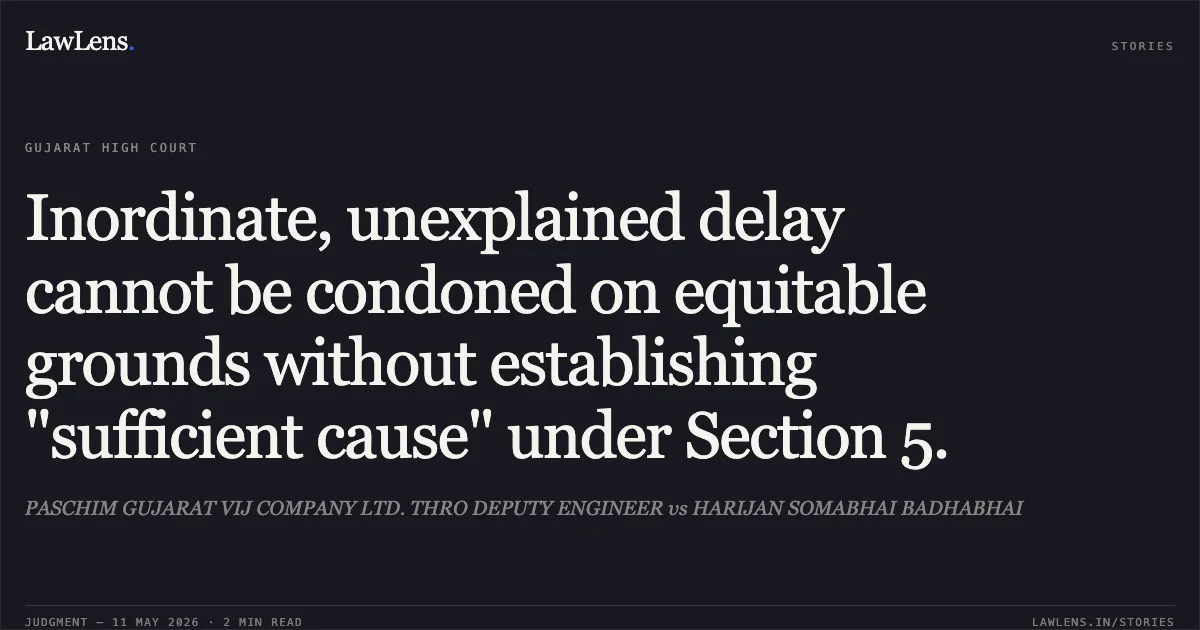
1. Whether the respondent established "sufficient cause" under Section 5 of the Limitation Act to condone an inordinate delay of 14 years and 09 months.
Source reference: para 5.1/72. Whether the Lower Appellate Court exercised its discretionary power judiciously in condoning delay based on facts that were ex-facie incorrect.
Source reference: para 14/15Law Applied
The Court applied Section 5 of the Limitation Act, 1963, emphasizing that while "sufficient cause" should be interpreted liberally to advance justice, it cannot be used to override the rigors of the law when negligence or lack of bona fides is evident.
Source reference: para 7/11It relied on P.K. Ramachandran v. State of Kerala, holding that equity cannot be a basis for extending limitation.
Source reference: para 7It further cited Esha Bhattacharjee v. Managing Committee of Raghunathpur Nafar Academy, establishing that inordinate delay warrants a strict approach and that concocted explanations must be rejected.
Source reference: para 9The doctrine of dura lex sed lex (the law is hard, but it is the law) was invoked to state that statutes of limitation are based on public policy to end stale litigations.
Source reference: para 12/13Reasoning
The Court observed that the respondent’s primary justification—waiting for the criminal case outcome—was factually fraudulent. The civil suit was decreed in 2008, nearly two years before the criminal acquittal in 2010; thus, the claim that the respondent remained inactive awaiting the criminal judgment was logically impossible.
Source reference: para 7/14The Court noted that the respondent failed to provide any other reasons to explain the "colossal" delay of nearly 15 years.
Source reference: para 7It criticized the Principal District Judge for recording a "strange finding" that PGVCL failed to produce evidence to challenge the delay, noting that the burden of proof lies entirely on the applicant seeking condonation.
Source reference: para 14The High Court reasoned that condoning such a massive delay without a bona fide explanation violates the principles of judicial discretion and creates a sense of insecurity for decree-holders.
Source reference: para 13/15Holding
The High Court held that the respondent failed to establish sufficient cause and that the lower court's order lacked objective reasoning.
The Court allowed the petition, quashed the order dated 07.08.2023 passed in Civil Miscellaneous Application No. 60 of 2022, and dismissed the respondent's application for condonation of delay. The Court ordered that any costs deposited or paid by the respondent pursuant to the impugned order be refunded.
Source reference: para 16Acts & Sections Cited
3 provisions across 2 statutes referred to in this judgment. Each provision opens on LawLens.
Code of Civil Procedure, 19081
Original Court PDF
PASCHIM GUJARAT VIJ COMPANY LTD. THRO DEPUTY ENGINEERvsHARIJAN SOMABHAI BADHABHAI
Click to open original judgment
Original judgment, available to read, download and summarize on LawLens.in


![Subsequent exoneration does not retrospectively invalidate a finalized promotion select list.. UNNIKRISHNAN M vs M/o Environment And Forests. CAT - ['Ernakulam']. LawLens](/stories/thumbnails/subsequent-exoneration-does-not-retrospectively-invalidate-a-finalized-promotion-select-li-ce80a0e84f2f4887857271e8b4341c42.webp)