Facts
The applicant, a Superintendent of Central Excise, was issued a Show Cause Notice on 19.05.2009 regarding an incident dated 24.04.2008 involving the alleged smuggling of betel nuts.
Source reference: para 2.1, 2.3A Memorandum of Charges was issued on 15.11.2011, approximately one month before his superannuation on 31.12.2011.
Source reference: para 2.1, 2.3The proceedings continued as deemed proceedings under Rule 9 of the CCS (Pension) Rules.
Source reference: para 2.3While the Inquiry Officer's report dated 20.12.2013 found the charges only "partly proved," the Disciplinary Authority issued a Disagreement Note on 29.03.2022—nearly nine years later—after the matter was returned by the UPSC due to deficiencies.
Source reference: para 3.2, 3.3Finally, on 01.01.2024, the 1st Respondent imposed a penalty of withholding 20% of the applicant’s monthly pension for three years.
Source reference: para 2.2, 3.4The applicant challenged this order on the grounds of inordinate delay and prejudice.
Source reference: para 2.3Issues
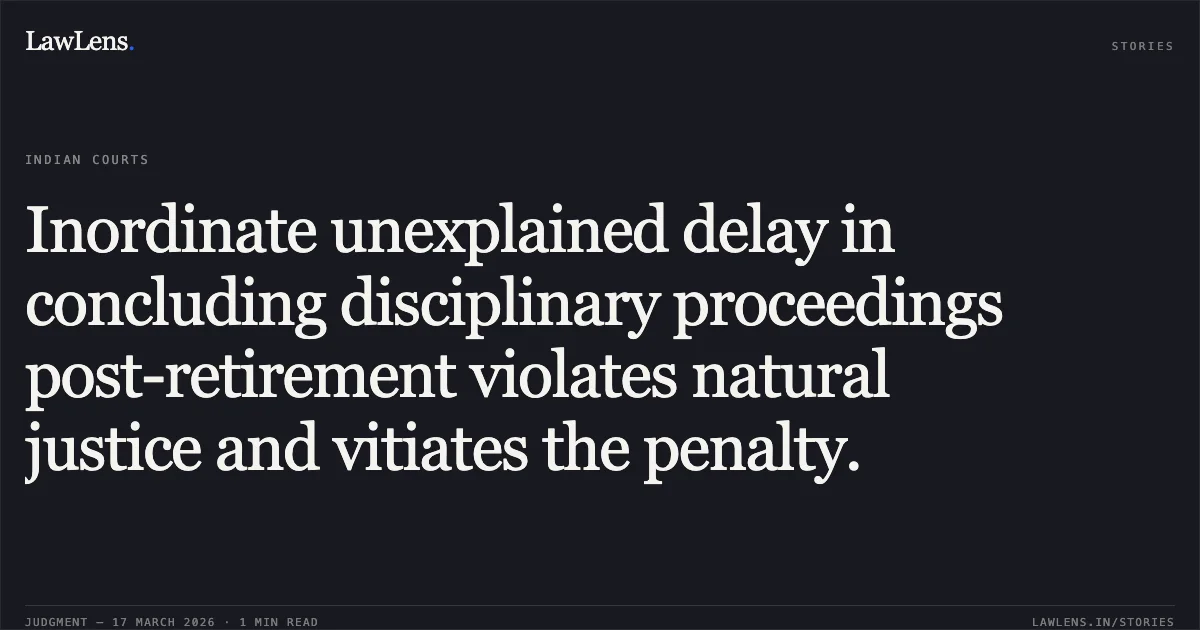
1. Whether the inordinate and unexplained delay of over 12 years in concluding disciplinary proceedings post-retirement vitiates the impugned penalty order.
Source reference: para 6, 72. Whether the Disciplinary Authority’s disagreement with the Inquiry Report was an independent exercise of discretion or was unduly influenced by external advisory agencies.
Source reference: para 13Law Applied
The court primarily applied Rule 9 of the CCS (Pension) Rules, 1972 (now Rule 8 of the 2021 Rules), which governs disciplinary proceedings against retired government servants.
Source reference: para 2.3It relied on the legal principle established in State of Andhra Pradesh v. N. Radhakrishnan, holding that while delay is not always fatal, unexplained and abnormal delay that causes prejudice and mental agony to the delinquent employee warrants the termination of proceedings.
Source reference: para 9The court further cited P.V. Mahadevan v. M.D. Tamil Nadu Housing Board, which emphasized that the mental agony of protracted proceedings can be more severe than the punishment itself.
Source reference: para 12Additionally, the court applied the principle that a Disciplinary Authority must reach an independent conclusion when disagreeing with an Inquiry Officer’s findings.
Source reference: para 13Reasoning
The Tribunal observed that although the incident occurred in 2008, the charge memo was only issued in 2011, just before the applicant's retirement, and the final order was passed 12 years and 2 months later in 2024.
Source reference: para 6, 14The Bench noted that only a negligible portion of this delay (approx. 45 days) could be attributed to the applicant, leaving the remaining decade-long delay entirely on the respondents.
Source reference: para 6Applying the balancing test from N. Radhakrishnan, the court found that this "unjustified delay" caused "irreparable damage" to the applicant’s ability to defend himself and violated the principles of natural justice.
Source reference: para 6, 15Furthermore, the court critiqued the Disciplinary Authority’s Disagreement Note issued in 2022, observing it appeared to be "heavily influenced" by advice from the DGoV and UPSC rather than being an independent decision, thus casting doubt on the fairness of the proceedings.
Source reference: para 13Holding
The Tribunal answered the issues in the affirmative, holding that the delay was fatal and the proceedings lacked independent adjudication.
The Tribunal quashed and set aside the impugned penalty order dated 01.01.2024 and the communication dated 18.01.2024.
Source reference: para 15The respondents were directed to disburse all monetary and retirement benefits to the applicant within three months from the date of receipt of the order.
Source reference: para 15The OA was allowed with no order as to costs.
Source reference: para 16Original Court PDF
N MOHAMED ATHAMvsM/o Finance
Click to open original judgment
Original judgment, available to read, download and summarize on LawLens.in