Facts
The appellant, M/s Lupin Ltd., manufactured bulk drugs under Chapter 29 of the Central Excise Tariff Act, 1985 and availed Cenvat credit on capital goods, inputs and input services.
Source reference: paras. 1–4The Commissioner, by Order-in-Original dated 25 June 2020, confirmed demands arising from a Show Cause Notice dated 6 March 2019.
Source reference: paras. 1–4The disputed amounts concerned: (i) ₹2,34,58,942 credit on input services used for setting up the factory before commercial production; (ii) ₹8,40,735 credit on common infrastructure services, including roads, street lights and drainage; (iii) ₹14,55,256 credit on goods such as stainless-steel stools, containers, racks, ladders, fire extinguishers and glass fittings; (iv) ₹2,66,731 differential duty on clearances to a related unit based on alleged non-adoption of 110% of CAS-4 value; and (v) ₹6,48,171 allegedly remaining unappropriated out of ₹15,01,222 reversed by the appellant.
Source reference: paras. 1–4The appellant also challenged interest, penalties and invocation of the extended period of limitation.
Source reference: para. 4Issues
1. Whether Cenvat credit was admissible on input services used for setting up the manufacturing facility before commencement of commercial production, despite deletion of the expression “setting up” from the inclusive part of Rule 2(l) of the Cenvat Credit Rules, 2004?
Source reference: paras. 7–122. Whether credit was admissible on common infrastructure services, such as maintenance of roads, street lights and drainage, situated outside the physical factory premises?
Source reference: paras. 13–153. Whether goods such as stools, buckets, containers, racks, ladders, fire extinguishers and glass fittings qualified as “inputs” under Rule 2(k), even if they were not capital goods or components directly used in the final product?
Source reference: paras. 16–194. Whether the alleged differential duty on clearances to a related unit had been discharged through the supplementary GST invoice dated 29 March 2019 issued under the transitional provisions?
Source reference: paras. 20–245. Whether the appellant was entitled to credit for the entire ₹15,01,222 allegedly reversed through GSTR-3B, and whether the balance amount of ₹6,48,171 could be demanded merely because the electronic credit ledger reflected a lower positive balance?
Source reference: paras. 25–276. Whether interest was recoverable on credit that had been availed but not utilised, and whether the extended period of limitation and penalties were invokable?
Source reference: paras. 28–33Law Applied
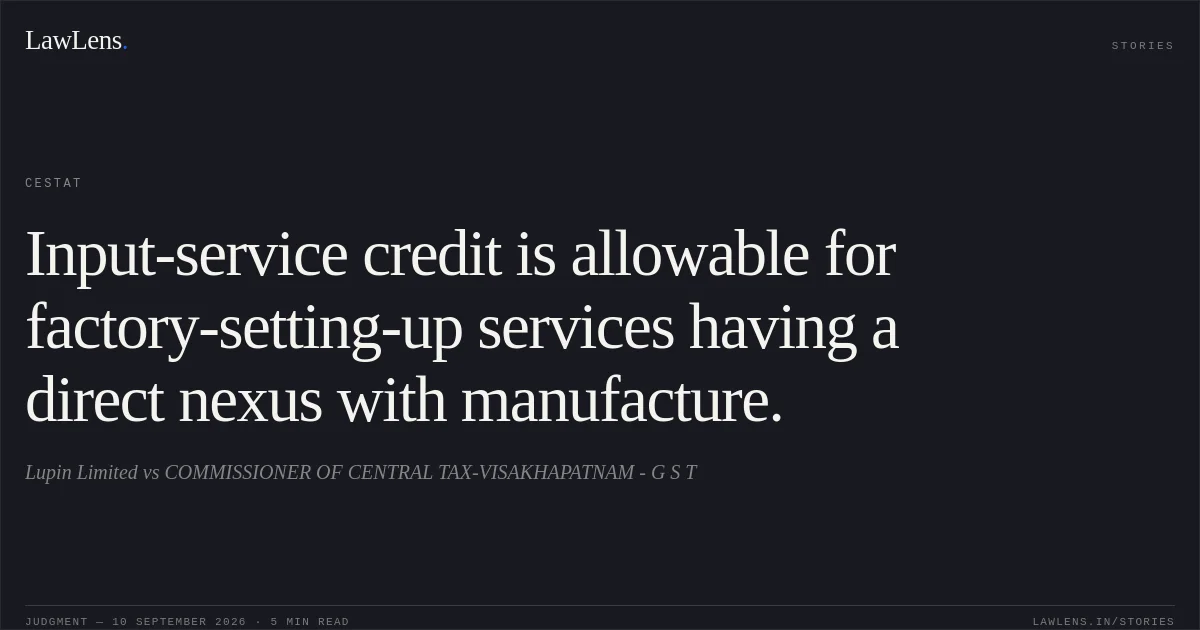
The Tribunal applied Rule 2(l) of the Cenvat Credit Rules, 2004, holding that services having a direct or indirect nexus with the manufacture or manufacturing business may qualify as input services under the substantive “means” portion of the definition, notwithstanding deletion of “setting up” from the inclusive portion with effect from 1 April 2011.
Source reference: paras. 7–12It applied Rule 2(k), under which goods used in the factory by the manufacturer may qualify as inputs subject to specified exclusions, and held that eligibility is not confined to capital goods or items directly incorporated into the final product.
Source reference: paras. 16–19For the related-party valuation issue, the Tribunal relied on Section 142(2)(a) of the CGST Act, 2017 and CBIC Circular No. 76/50/2018-GST, which permit and recognise supplementary invoices or debit notes for upward revision of prices relating to pre-GST supplies.
Source reference: paras. 20–24Under Rule 14(1)(ii) of the Cenvat Credit Rules, interest is confined to wrongly availed and utilised credit, not credit that remained unutilised until reversal.
Source reference: para. 28The Tribunal further applied the principle that extended limitation requires fraud, collusion, wilful misstatement or suppression with intent to evade duty, relying on International Merchandising Company, LLC v. Commissioner of Service Tax [2022 (67) GSTL 129 (SC)].
Source reference: paras. 29–32It also relied on Pepsico India Holdings, Mangalam Cement, Hindustan Zinc, Merino Industries, India Cements and other cited authorities concerning input-service eligibility, inputs, procedural defects and transitional payment mechanisms.
Source reference: paras. 11, 14, 17 and 24Reasoning
The Tribunal held that the deletion of “setting up” from the inclusive limb of Rule 2(l) did not automatically exclude all services used before production commenced.
Source reference: paras. 9–12Since a manufacturing facility must first be created and made operational, services with a demonstrable nexus to that facility could fall within the substantive part of the definition; therefore, the ₹2,34,58,942 demand was unsustainable.
Source reference: paras. 9–12Similarly, the fact that roads, drainage and lighting were common or located outside the factory boundary did not defeat eligibility where they facilitated ingress, egress and operation of the industrial premises; the ₹8,40,735 demand was accordingly set aside.
Source reference: paras. 13–15In relation to the disputed goods, the Department had not established that they were excluded under Rule 2(k), and denial solely because they were not capital goods or directly incorporated into the finished product was legally insufficient.
Source reference: paras. 16–19The related-unit valuation issue required factual verification of the supplementary invoice and corresponding payment; charging IGST or citing an incorrect statutory provision did not, by itself, establish non-payment.
Source reference: paras. 20–24Regarding the reversal, the relevant inquiry was whether the entire amount had been recorded and discharged through the appellant’s statutory records, including Cenvat records, TRAN-1, GSTR-3B and the electronic credit ledger; the matter therefore required reconciliation rather than automatic confirmation of the balance demand.
Source reference: paras. 25–27Finally, because interest could arise only upon utilisation of wrongly availed credit, and because the principal credit disputes were interpretational with no positive evidence of suppression or intent to evade, interest had to be restricted accordingly and the extended limitation and related penalties could not be sustained.
Source reference: paras. 28–33Holding
The appeal was partly allowed and partly remanded.
The demands of ₹2,34,58,942 on pre-production setting-up services, ₹8,40,735 on common infrastructure services and ₹14,55,256 on the disputed goods were set aside.
Source reference: para. 34(i)–(iii)The ₹2,66,731 related-unit valuation issue was remanded for limited verification of the supplementary GST invoice dated 29 March 2019 and the corresponding payment, with a direction against double recovery.
Source reference: para. 34(iv)The alleged unappropriated amount of ₹6,48,171 was also remanded for reconciliation of the appellant’s Cenvat records, TRAN-1, GSTR-3B and electronic credit ledger, with credit to be granted for the amount actually reversed or discharged.
Source reference: para. 34(v)Interest was restricted to credit proved to have been utilised, in accordance with Rule 14.
Source reference: para. 34(vi)The invocation of the extended period and penalties based on suppression or wilful misstatement were set aside.
Source reference: para. 34(vii)The Adjudicating Authority was directed to conduct only the limited verification ordered, after granting the appellant an opportunity of hearing.
Source reference: para. 35Acts & Sections Cited
1 provisions across 1 statute referred to in this judgment. Each provision opens on LawLens.
Central Goods and Services Tax Act, 20171
Original Court PDF
Lupin LimitedvsCOMMISSIONER OF CENTRAL TAX-VISAKHAPATNAM - G S T
Click to open original judgment
Original judgment, available to read, download and summarize on LawLens.in