Facts
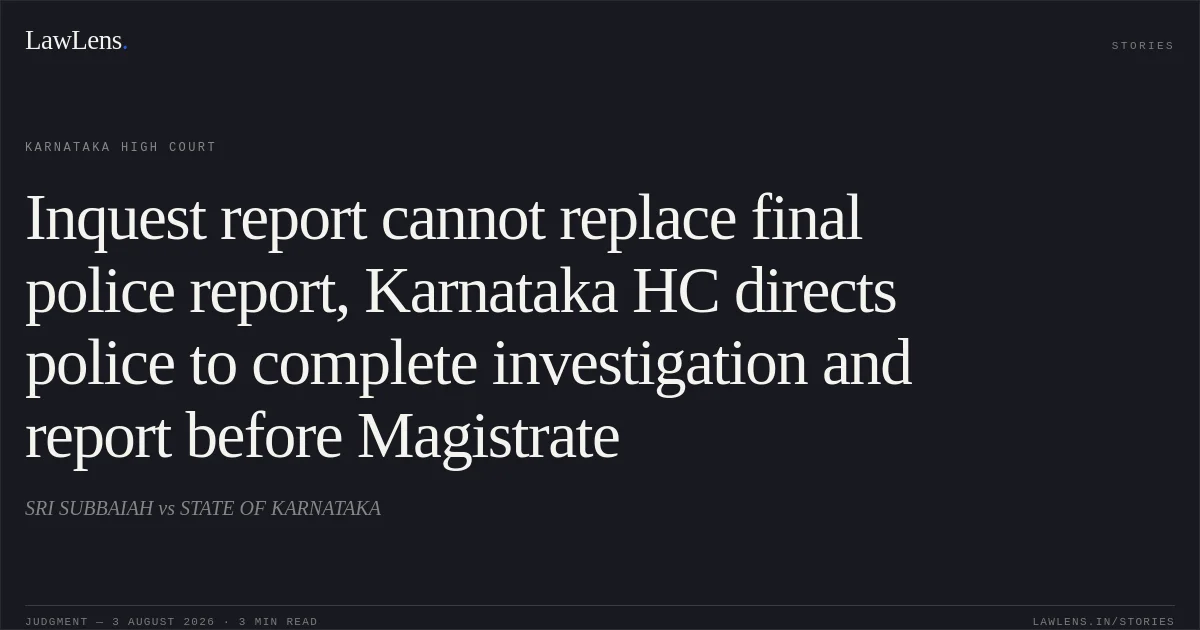
Santhosh died on 9 December 2023 allegedly due to failure to provide proper medical treatment. On the basis of a complaint, the Yesalur Police registered an Unnatural Death Report (UDR No. 22/2023) under Section 174 of the Code of Criminal Procedure, 1973 (CrPC).
Source reference: para. 3An inquest was conducted by the Executive Magistrate, and the Inquest Report was submitted on 10 December 2023. However, the jurisdictional police did not file any final report before the jurisdictional Magistrate.
Source reference: para. 3The petitioner therefore sought a writ directing the police to complete the investigation and file a final report or chargesheet so that he could, if necessary, file a protest petition.
Source reference: para. 3Issues
1. Whether an Inquest Report submitted by the Executive Magistrate under Section 174 CrPC constitutes the final report concluding proceedings relating to an unnatural death, or whether the police must conduct further investigation and file a final report before the jurisdictional Judicial Magistrate.
Source reference: paras. 4–122. Whether the petitioner was entitled to a mandamus directing the police to complete the investigation in UDR No. 22/2023 and submit the final report before the jurisdictional Magistrate.
Source reference: paras. 2–3, 12–13Law Applied
Section 174 CrPC contemplates a limited inquest to ascertain the apparent cause of death and the circumstances indicating whether the death was unnatural; an Inquest Report is not equivalent to a final report under Section 173(2) CrPC.
Source reference: paras. 7–9The police retain an independent duty to investigate and, upon completion of the investigation, file either a chargesheet or a closure report before the jurisdictional Judicial Magistrate.
Source reference: paras. 9–12The Court relied on Manohari v. District Superintendent of Police, 2018 SCC OnLine Mad 14216, which held that an Executive Magistrate’s inquest report is merely investigative material and cannot substitute the police final report.
Source reference: paras. 5–10The same principles were held applicable to Section 194 of the Bharatiya Nagarik Suraksha Sanhita, 2023 (BNSS), which replaced Section 174 CrPC.
Source reference: para. 11Where a closure report is filed, the victim must receive notice enabling the filing of a protest petition, in accordance with law.
Source reference: para. 5, extracted principle 24(j)Reasoning
The Court held that the Executive Magistrate’s inquest was only a fact-finding exercise concerning the apparent cause of Santhosh’s death and did not determine whether any offence had been committed or conclude the police investigation.
Source reference: paras. 7–9Since the Inquest Report merely formed part of the investigative material, the police could not treat its submission as the culmination of UDR No. 22/2023.
Source reference: para. 12Applying the principle in Manohari, the Court rejected the State’s contention that no further report was required and held that the Investigating Officer was obliged to consider the Inquest Report along with the other materials, complete the investigation, and submit an appropriate final report under Section 173(2) CrPC—or the corresponding BNSS provision—before the jurisdictional Judicial Magistrate.
Source reference: para. 12Holding
The writ petition was allowed.
The Court issued a mandamus directing the Police Sub-Inspector, Yesalur Police Station, to complete the investigation and file the final report in UDR No. 22/2023 before the Additional Civil Judge and JMFC Court, Sakleshpura.
Source reference: para. 13(ii)The Director General of Police was directed to circulate the Manohari judgment, in English and Kannada, along with the present order, to all Investigating Officers and submit a compliance report within four weeks.
Source reference: para. 13(iii)The matter was ordered to be re-listed on 25 August 2026 for reporting compliance.
Source reference: para. 13(iv)Acts & Sections Cited
7 provisions across 2 statutes referred to in this judgment. Each provision opens on LawLens.
Code of Criminal Procedure, 19736
Bharatiya Nagarik Suraksha Sanhita, 20231
Original Court PDF
SRI SUBBAIAHvsSTATE OF KARNATAKA
Click to open original judgment
Original judgment, available to read, download and summarize on LawLens.in