Facts
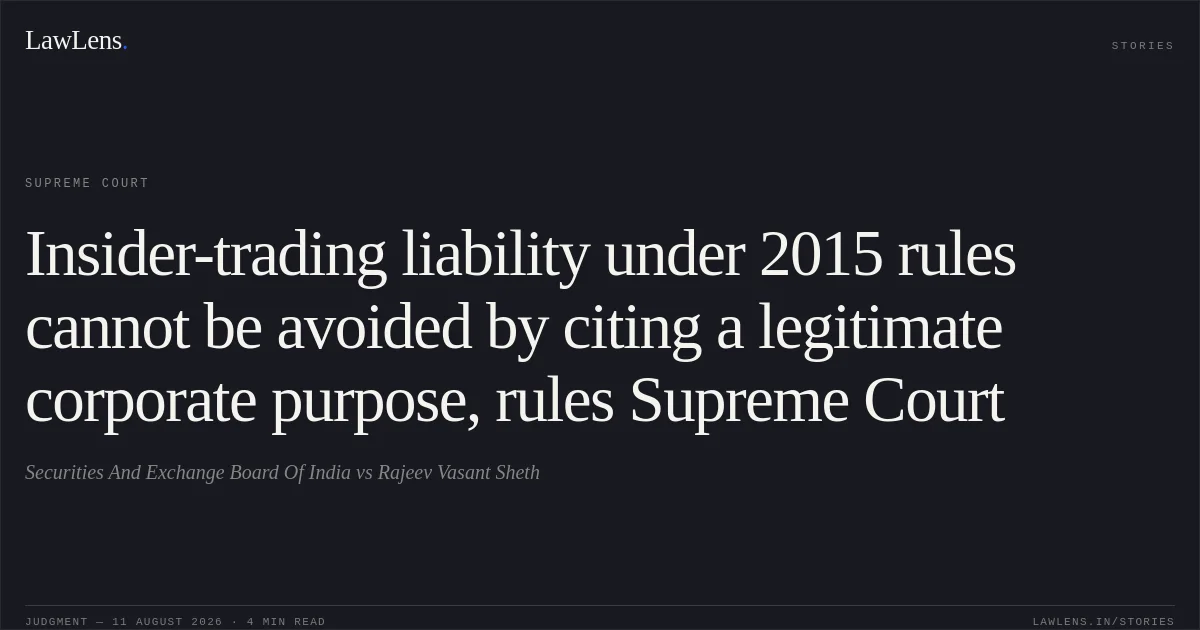
Tara Jewels Ltd. (“TJL”), a listed jewellery company, suffered a substantial deterioration in its financial position, recording a net loss of ₹166.80 crores for the quarter ending September 2017, compared with a loss of ₹6.62 crores in the preceding quarter; its net sales also declined by approximately 69%.
Source reference: para. 2.2During the UPSI period from 2 October 2017 to 29 November 2017, Rajeev Vasant Sheth, TJL’s Chairman and Managing Director, sold 30,93,948 shares and subsequently 29,75,000 shares, while his daughters, Aarti Sheth and Divya Sheth, sold their entire holdings of 1,14,440 shares each.
Source reference: para. 2.3SEBI issued an impounding order-cum-show cause notice, and the Whole Time Member (“WTM”) found the respondents guilty of insider trading under the SEBI Act and the SEBI (Prohibition of Insider Trading) Regulations, 2015 (“PIT Regulations”).
Source reference: paras. 2.4–3The Securities Appellate Tribunal (“SAT”) allowed the respondents’ appeal, holding that their explanation—namely, that TJL was at risk of being classified as a non-performing asset—could establish their innocence under the proviso to Regulation 4(1), and that there was little difference in the share price before and after disclosure of the information.
Source reference: para. 4Issues
1. Whether the respondents’ sale of TJL shares while in possession of UPSI constituted insider trading under Section 12A of the SEBI Act and Regulation 4(1) of the PIT Regulations, notwithstanding their claimed corporate or financial purpose for the transactions?
Source reference: paras. 8–11, 192. Whether the respondents could establish their innocence by invoking a defence not expressly enumerated in Regulation 4(1), including the defence of a legitimate corporate purpose?
Source reference: paras. 9–153. Whether the directions for disgorgement and the penalties imposed by the WTM were legally sustainable, and whether the penalty imposed on Respondent No. 1 required modification?
Source reference: paras. 16–18Law Applied
The Court applied Section 12A(d) and (e) of the SEBI Act, which prohibit insider trading and dealing in securities while in possession of material non-public information.
Source reference: para. 6.1Section 11B, whose Explanation expressly authorises SEBI to direct disgorgement of an amount equivalent to wrongful gain or loss avoided through contravention of the Act or regulations.
Source reference: para. 6.5Regulation 4(1) creates a presumption that trades by a person in possession of UPSI were motivated by that information; the trader may rebut the presumption by demonstrating the circumstances specified in the provision, which are illustrative rather than exhaustive because they are preceded by the word “including”.
Source reference: paras. 9, 9.7, 13The Court also applied the principle concerning ejusdem generis stated in P. Mohanraj v. Shah Bros. Ispat (P) Ltd. , (2021) 6 SCC 258, referring to Vikram Singh v. Union of India , (2015) 9 SCC 502, and Siddeshwari Cotton Mills (P) Ltd. v. Union of India , (1989) 2 SCC 458.
Source reference: para. 12Reasoning
The Court found it undisputed that the respondents possessed UPSI and sold substantial portions, or the entirety, of their TJL holdings during the relevant period. Regulation 4(1) therefore raised the presumption that the trades were motivated by the UPSI.
Source reference: para. 11The note to Regulation 4(1) expressly renders irrelevant both the reasons for trading and the purposes to which the sale proceeds are applied; consequently, the respondents’ explanation that the transactions served TJL’s financial or corporate interests could not exonerate them.
Source reference: paras. 9.7, 11The Court held that the listed defences are not exhaustive, but any analogous defence must be similar in character to those expressly provided. A general “legitimate corporate purpose” defence, as recognised under the earlier regulatory regime, could not override the express language of the 2015 Regulations.
Source reference: paras. 13, 19The Court accordingly held that the SAT erred in relying on the respondents’ purpose for trading and the marginal price movement surrounding disclosure. Since insider trading was established, the respondents’ failure to make a profit, or their avoidance of loss rather than acquisition of profit, was immaterial.
Source reference: para. 11Holding
The appeal was allowed. The Court set aside the SAT’s judgment and restored the WTM’s finding that the respondents had engaged in insider trading under the SEBI Act and the PIT Regulations.
The avoided loss of approximately ₹1.38 crores justified disgorgement under Section 11B.
Source reference: para. 16The penalties for violation of the code of conduct were also sustained, although the ₹25 lakh penalty imposed on Respondent No. 1 under Section 15G was reduced to the statutory minimum of ₹10 lakhs in light of the cumulative circumstances.
Source reference: paras. 17–18The directions restraining the respondents from accessing or dealing in the securities market, the disgorgement of the loss avoided with 12% interest, and the penalties under Section 15HB were restored.
Source reference: paras. 3, 16–17The penalty imposed on Rajeev Vasant Sheth under Section 15G was modified from ₹25 lakhs to ₹10 lakhs, while the penalties imposed on Aarti Sheth and Divya Sheth remained undisturbed. The modified penalties were directed to be paid within three months, if not already paid.
Source reference: paras. 18, 20Acts & Sections Cited
7 provisions across 2 statutes referred to in this judgment. Each provision opens on LawLens.
Securities and Exchange Board of India Act, 19926
Companies Act, 20131
Original Court PDF
Securities And Exchange Board Of IndiavsRajeev Vasant Sheth
Click to open original judgment
Original judgment, available to read, download and summarize on LawLens.in