Facts
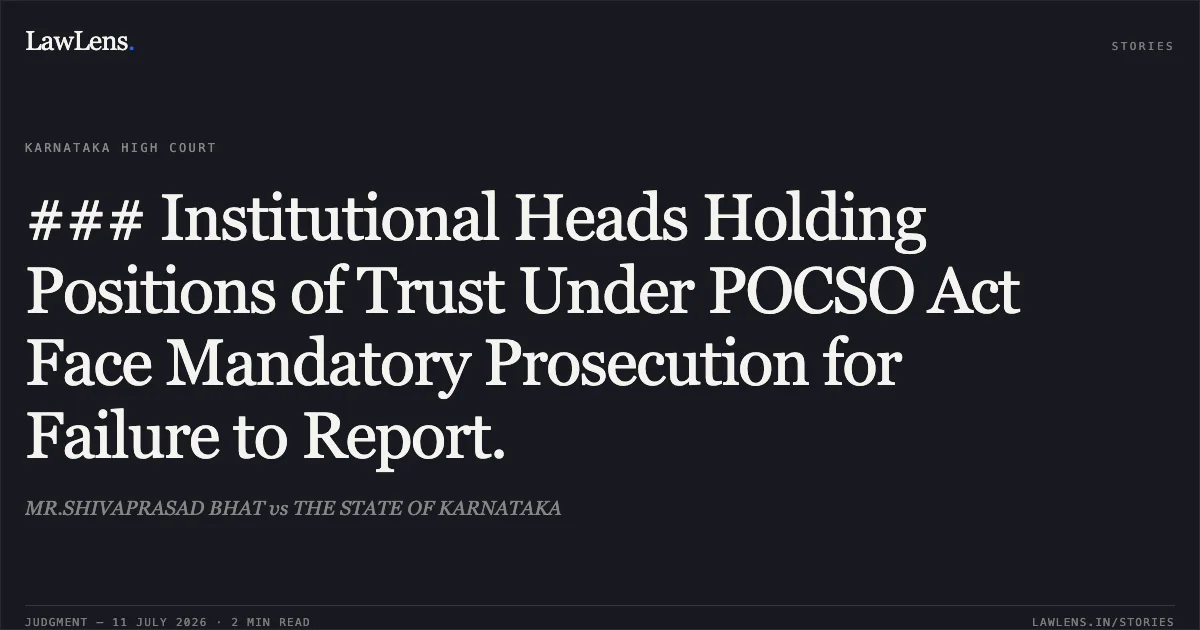
The Petitioners (Head Master, Assistant Head Master/Warden, and Child Welfare Officer) of a residential school moved the High Court to quash an FIR filed under Sections 4, 8, and 21 of the POCSO Act.
Source reference: p. 2-3The victim, a 10th-standard student, alleged he was sexually assaulted by a roommate on 02-06-2026.
Source reference: p. 3The complaint asserts that although the victim reported the incident to school authorities immediately, they failed to take action, labeled the act "consensual," and the Child Welfare Officer (Petitioner 3) allegedly destroyed the victim’s original written statement, forcing him to write a false version through threats.
Source reference: p. 4The victim eventually informed his father after being disciplined for a separate mobile phone violation.
Source reference: p. 5The Petitioners argued they had no knowledge of the incident and sought to quash the proceedings, claiming Section 21 is a bailable offense being used mechanically against institutional heads.
Source reference: p. 6-7Issues
1. Whether the crime registered against the institutional heads (Petitioners) for failure to report a sexual offense should be quashed at the FIR stage.
Source reference: p. 8Law Applied
Section 19 of the POCSO Act, which mandates that any person with knowledge or apprehension of a child sexual offense "shall" report it to the Special Juvenile Police Unit or local police.
Source reference: p. 9-10Section 21(2), which imposes higher penal liability (up to one year imprisonment) specifically on persons in charge of institutions for failure to report such offenses.
Source reference: p. 9, 12Just Rights for Children Alliance v. S. Harish and State of Maharashtra v. Dr. Maroti, establishing that Section 21 is mandatory and non-compliance defeats the Act’s purpose.
Source reference: p. 13, 25Shankar Kisanrao Khade v. State of Maharashtra, affirming that the "best interest of the child" is paramount and institutional silence amounts to screening offenders.
Source reference: p. 14, 20-21Reasoning
The Court reasoned that the statutory scheme of POCSO excludes institutional discretion; the duty to report is a "statutory command," not a matter of subjective satisfaction regarding a complaint's veracity.
Source reference: p. 11The Court noted that the allegations went beyond passive non-reporting: Petitioners were accused of active suppression, including destroying evidence (the original letter) and threatening the victim to alter his narrative.
Source reference: p. 48-49The Court rejected the Petitioners' defense of lack of knowledge, observing that since the victim reported the matter to the warden and resident authorities, the institutional "knowledge" was triggered.
Source reference: p. 48Referring to Sanjeev Kumar v. State and Seyed Ahamed v. State of TN, the Court emphasized that school heads stand in loco parentis and cannot hide behind a facade of ignorance or institutional reputation to shield perpetrators.
Source reference: p. 33, 39, 50Holding
The Court answered the issue in the negative, holding that the material on record prima facie disclosed the commission of an offense under Section 21 of the POCSO Act.
The Court held that the gravity of an offense is not determined by the quantum of punishment but by the sanctity of the duty breached.
Source reference: p. 51The High Court refused to truncate the investigation at the nascent stage and dismissed the criminal petition, directing that the investigation take its lawful course.
Source reference: p. 52-53Acts & Sections Cited
2 provisions across 2 statutes referred to in this judgment. Each provision opens on LawLens.
Bharatiya Nagarik Suraksha Sanhita, 20231
Code of Criminal Procedure, 19731
Original Court PDF
MR.SHIVAPRASAD BHATvsTHE STATE OF KARNATAKA
Click to open original judgment
Original judgment, available to read, download and summarize on LawLens.in