Facts
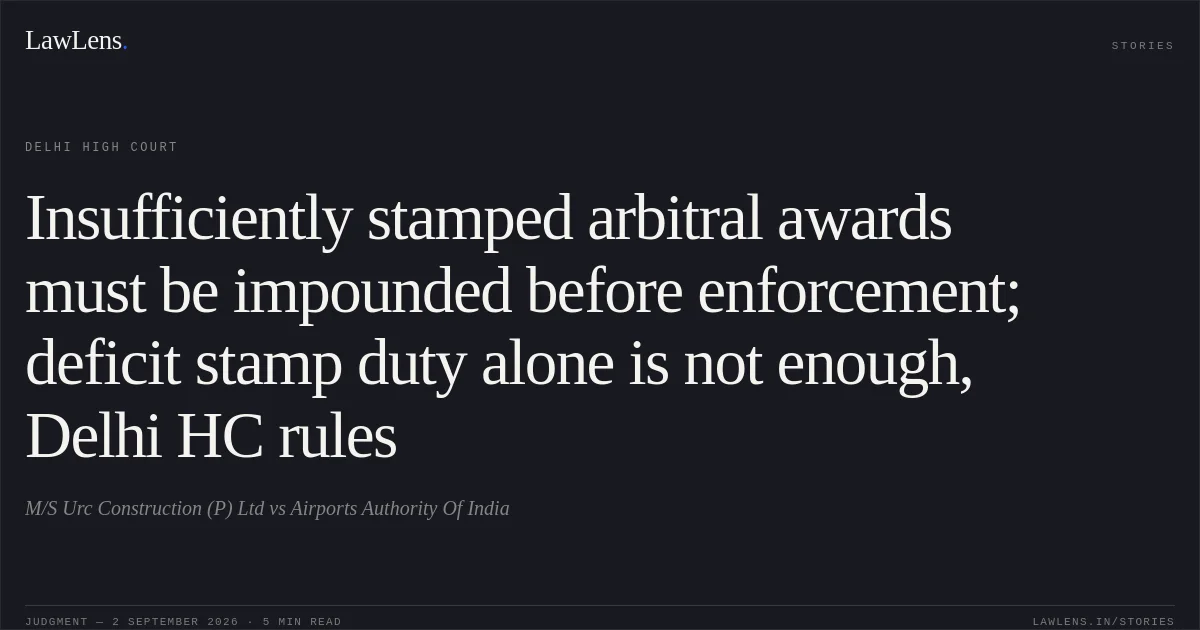
The Decree Holder sought enforcement under Section 36 of the Arbitration and Conciliation Act, 1996 (“Arbitration Act”) of an arbitral award dated 26.03.2019, corrected on 07.05.2019 under Section 33 of the Arbitration Act, awarding approximately Rs. 2.59 crores with pendente lite and future interest at 10% per annum.
Source reference: para. 1–3The award originally bore stamp duty of only Rs. 100/-, after which the Decree Holder deposited deficient stamp duty of Rs. 25,850/- on 29.07.2026.
Source reference: para. 2The Court consequently examined whether unilateral payment of deficient stamp duty at the enforcement stage, without payment of penalty and without impounding the award, was legally sufficient.
Source reference: para. 3–5The Decree Holder argued that stamping was a curable defect and that payment of the deficit duty satisfied the fiscal purpose of the Stamp Act; the Judgment Debtor contended that the award was required to be impounded under Section 33 and dealt with under Sections 35, 38 and 40 of the Stamp Act, including payment of applicable penalty.
Source reference: para. 4–43Issues
Whether an arbitral award is required to be duly stamped before or at the time of its execution/signing, or whether stamp duty becomes payable only when enforcement is sought under Section 36 of the Arbitration Act.
Source reference: para. 46–55, 108–119Whether the decision in M. Anasuya Devi v. M. Manik Reddy permits deferred payment of stamp duty until enforcement or merely postpones consideration of stamp-related objections beyond Section 34 proceedings.
Source reference: para. 66–83, 191–197Whether an insufficiently stamped arbitral award produced in enforcement proceedings must be impounded under Section 33 of the Stamp Act.
Source reference: para. 120–129, 176–184Whether the Decree Holder may unilaterally cure deficient stamping after expiry of one month from execution by paying only the deficient stamp duty, without penalty or statutory endorsement.
Source reference: para. 147–155, 193–199Whether the executing Court possesses power to waive or reduce the penalty prescribed under the Stamp Act.
Source reference: para. 245–253What procedure should be followed where an insufficiently stamped award is produced for enforcement, particularly where only a copy is filed or the original award is not initially before the Court.
Source reference: para. 200–243, 254–262Law Applied
The Court applied Sections 2(6), 2(11), 2(12), 2(14), 3, 17, 31, 32, 33, 35, 38, 39, 40, 41 and 42 of the Indian Stamp Act, 1899, as applicable in Delhi, read with Article 12 and Article 15 of Schedule IA.
Source reference: para. 109–119An arbitral award is an “instrument” and stamp duty is attracted upon its execution, meaning signing; under Section 17, it must be stamped before or at execution, subject to the one-month mechanism under the proviso to Section 32(3).
Source reference: para. 109–119Section 33 imposes a mandatory duty upon the competent authority to impound an insufficiently stamped instrument, while Section 35 prohibits its admission or being acted upon—including enforcement—until the deficit duty and applicable penalty are paid.
Source reference: para. 120–129Sections 38 and 40 prescribe the procedure following impounding, with the Collector empowered to determine and impose penalty and to endorse the instrument under Section 42.
Source reference: para. 132–154M. Anasuya Devi v. M. Manik Reddy, (2003) 8 SCC 565, was read as holding only that insufficiency of stamp duty is not a ground for setting aside an award under Section 34; it does not exempt the award from stamping requirements.
Source reference: para. 67–68, 80–83In Re: Interplay Between Arbitration Agreements under the Arbitration and Conciliation Act, 1996 and the Stamp Act, 1899, (2024) 6 SCC 1, was confined principally to Sections 8 and 11 and was understood as preserving the Stamp Act’s revenue-collection purpose while postponing impounding at the referral or appointment stage.
Source reference: para. 90–108The Court also relied on State of A.P. v. P. Laxmi Devi, (2008) 4 SCC 720, Ram Rattan v. Bajrang Lal, (1978) 3 SCC 236, H.C. Dhanda Trust v. State of M.P., (2020) 9 SCC 510, and Peteti Subba Rao v. Anumala S. Narendra, (2002) 10 SCC 427, for the mandatory nature of impounding and the principle that penalty is to be determined reasonably by the Collector and is not automatically required to be imposed at the maximum rate.
Source reference: para. 157–170, 178–180, 251–252Reasoning
The Court held that the Stamp Act and the Arbitration Act operate independently and must be harmoniously construed.
Source reference: para. 171–175, 185–199Under the Stamp Act, the chargeable event is execution or signing of the award, not its subsequent enforceability under Section 36; the three-month period for challenging or enforcing an award does not extend the statutory period for stamping.
Source reference: para. 187–196, 268–269M. Anasuya Devi merely prevents a stamp objection from being used as a ground under Section 34 and does not create an exemption from Sections 17, 33 or 35 of the Stamp Act.
Source reference: para. 191–197Since the award in the present case was produced for enforcement after expiry of the one-month period and was insufficiently stamped, Section 33 was triggered and the Court was bound to impound it.
Source reference: para. 193–199The Decree Holder’s subsequent payment of Rs. 25,850/- alone could not cure the defect because, after the statutory period, the award had to be dealt with under Sections 35 or 38(2), including payment of applicable penalty and endorsement under Section 42.
Source reference: para. 193–199, 264–271The Court clarified that it could not waive or reduce the penalty; that discretion belonged to the Collector under Sections 39–41, although bona fide pendency of Section 34, Section 37 or SLP proceedings could constitute grounds for imposing minimal or waiving penalty where legally permissible.
Source reference: para. 244–253, 270To avoid unnecessary delay, the Court stated that the award could be admitted under Section 35 read with Section 38(1) upon payment of deficit duty and prescribed penalty, with an authenticated copy and payment details forwarded to the Collector; otherwise, the original award had to be sent to the Collector under Section 38(2).
Source reference: para. 254–257The Court further directed that the original award be furnished where necessary, while recognising that only the original instrument—not a photocopy—could be impounded.
Source reference: para. 200–203, 234–243Holding
The Court held that an arbitral award is chargeable to stamp duty upon execution/signing and that Section 36 of the Arbitration Act does not postpone or exempt compliance with the Stamp Act.
An insufficiently stamped award produced in enforcement proceedings must be impounded under Section 33, and cannot be acted upon under Section 35 until the deficient duty and applicable penalty are paid and the instrument is duly endorsed.
Source reference: para. 272(vii)–(xiv)The Decree Holder’s unilateral payment of deficient stamp duty without penalty was therefore insufficient.
Source reference: no citationThe award dated 26.03.2019, together with the correction order dated 07.05.2019, was directed to be impounded; the Decree Holder was directed to furnish the original award before the Joint Registrar, who was to proceed under the Stamp Act.
Source reference: para. 280–282The Collector of Stamps/SDM was requested to expedite adjudication, preferably within six weeks of receiving the award.
Source reference: para. 283–284The Court also issued procedural directions requiring declarations and proof of stamp duty in Section 36 enforcement petitions, with the caveat that the directions did not apply to foreign arbitral awards.
Source reference: para. 277–279, 285Acts & Sections Cited
49 provisions across 7 statutes referred to in this judgment. Each provision opens on LawLens.
Arbitration and Conciliation Act, 1996
Indian Stamp Act, 1899
KARNATAKA STAMP ACT, 19577
Code of Civil Procedure, 19083
Registration Act, 19082
Information Technology Act, 20001
Probation of Offenders Act, 19581
Original Court PDF
M/S Urc Construction (P) LtdvsAirports Authority Of India
Click to open original judgment
Original judgment, available to read, download and summarize on LawLens.in