Facts
On 21 July 2010, a Tata 207 DI vehicle bearing registration No. AS-19-C/1501, carrying 11 labourers, collided with truck No. AS-01-P/9354. The claimant’s husband, Dilip Mandal, sustained fatal injuries and died at the spot
Source reference: p.3, para. 3The Motor Accident Claims Tribunal, Jorhat, held the drivers responsible and awarded compensation of ₹6,87,600, imposing 50% of the liability on the appellant-insurer and the remaining liability on the other insurer
Source reference: p.6, para. 6The insurer challenged its liability, contending that the deceased was travelling as an unauthorised passenger in a goods vehicle and that the policy did not cover such risk.
Source reference: p.6, para. 7The policy described the vehicle as a Tata 207 DI with seating capacity of 2+1 and restricted passenger carriage, except for permitted employees covered under the Workmen’s Compensation Act
Source reference: p.9, para. 14Issues
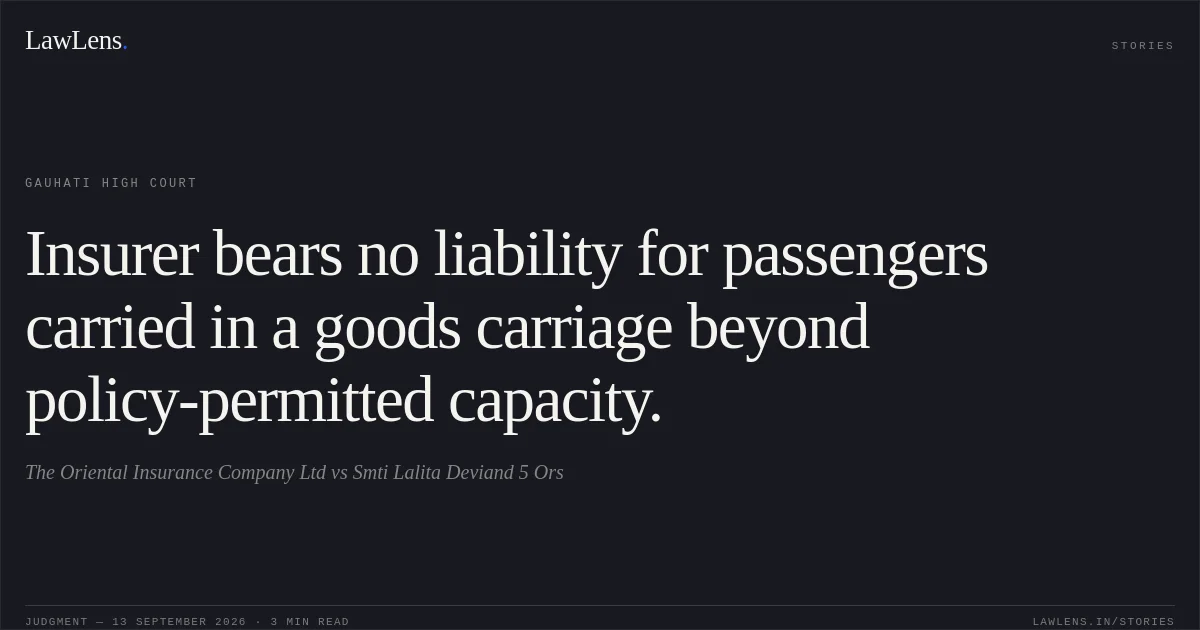
Whether the appellant-insurer was liable to indemnify the claimant for the death of a labourer travelling in a Tata 207 DI goods/public carriage vehicle beyond its permitted seating capacity?
Source reference: pp.6–10, paras. 7–17Whether the policy was a private package policy covering the deceased as an occupant, or a public-carriage package policy subject to restrictions on carrying passengers?
Source reference: p.10, para. 15Whether the insurer could be directed to pay the compensation and recover it from the vehicle owner despite the absence of policy coverage?
Source reference: pp.8–9, para. 11Law Applied
The Court applied the Motor Vehicles Act, 1988, particularly the statutory scheme governing goods carriages, public-service vehicles and compulsory insurance coverage under Section 147, together with the express terms of the insurance policy.
Source reference: no citationIt relied on New India Assurance Co. Ltd. v. Vedwati, (2007) 9 SCC 486, which held that a goods carriage is intended for carriage of goods and that the insurer has no statutory liability for gratuitous passengers travelling in it; coverage for employees carried in a goods vehicle is limited to the statutory requirements under the Workmen’s Compensation Act
Source reference: pp.7–8, para. 9The Court also relied on National Insurance Co. Ltd. v. Prema Devi, 2008 (2) SCC 627, concerning the insurer’s non-liability for gratuitous passengers in a goods carriage
Source reference: p.8, para. 10The principle in National Insurance Co. Ltd. v. Balakrishnan—that a comprehensive/package policy covers occupants of a private car—was held inapplicable because the present vehicle was a public carriage/goods vehicle and the policy expressly restricted passenger carriage
Source reference: pp.4–6, paras. 5, 15The Court further followed Oriental Insurance Co. Ltd. v. Miss Monjuma Begum, MACApp. No. 166/2018, holding that where the risk is not covered, the insurer cannot be directed to pay and recover; liability must remain with the owner
Source reference: pp.8–9, para. 11Reasoning
The Court found that the Tribunal had proceeded on an incorrect factual and legal premise by treating the policy as a private package policy
Source reference: p.10, para. 15The policy was in fact a package policy for a public carriage other than a three-wheeler, with a permitted seating capacity of 2+1 and an express exclusion of passenger carriage beyond the permitted limit
Source reference: pp.6–7, paras. 7–8; p.10, para. 15Although additional premium had been paid for the driver, conductor and cleaner, no premium had been paid for additional passenger liability
Source reference: p.10, para. 16Since the deceased was one of 11 labourers travelling in the vehicle, his carriage was outside the policy coverage and the statutory liability recognised under Vedwati and Prema Devi.
Source reference: no citationThe principle in Balakrishnan concerning occupants of private cars under comprehensive policies therefore did not apply.
Source reference: no citationIn the absence of coverage, the insurer could not be made liable even on a pay-and-recover basis
Source reference: pp.9–10, paras. 15–17Holding
The appeal was allowed.
The award was set aside to the extent that it imposed 50% of the compensation liability on the appellant-insurer
Source reference: p.10, para. 17The claimant’s right to recover the corresponding amount from the owner of the offending vehicle was expressly preserved, and the claimant was permitted to approach the Tribunal for recovery against the owner
Source reference: p.10, paras. 18–19The deposits made by the appellant were directed to be refunded in accordance with the applicable procedure
Source reference: p.11, para. 20The appeal was accordingly disposed of
Source reference: p.11, para. 21Acts & Sections Cited
2 provisions across 1 statute referred to in this judgment. Each provision opens on LawLens.
Motor Vehicles Act, 19882
Original Court PDF
The Oriental Insurance Company LtdvsSmti Lalita Deviand 5 Ors
Click to open original judgment
Original judgment, available to read, download and summarize on LawLens.in