01Facts
The deceased, Budhdeo Dubey, died in a motor-vehicle accident involving a vehicle owned by Shekhar Constructions Pvt. Ltd. and insured by ICICI Lombard General Insurance Company Limited.
p. 3 · ¶ 2His widow and four sons filed a claim petition before the Motor Accident Claims Tribunal, Palamau, which awarded ₹7,10,000 with interest at 6% per annum from the date of filing.
p. 3 · ¶ 2The insurer appealed, contending principally that the vehicle had no valid permit and that the insurer should receive a “pay and recover” direction.
pp. 3–4 · ¶ 3–5The claimants filed a cross-objection seeking enhancement and contended that the vehicle, being used for road-construction work, was exempt from the permit requirement.
pp. 3–4 · ¶ 3–5The insurer had pleaded the policy conditions but did not specifically plead that the vehicle had no permit, did not produce the insurance policy, and led neither oral nor documentary evidence on the alleged breach.
pp. 5–7 · ¶ 9–1202Issues
i.1. Whether the insurer established a fundamental breach of the insurance policy by proving that the offending vehicle lacked a valid permit, thereby justifying a “pay and recover” direction?
p. 4 · ¶ 6(i)ii.2. Whether the compensation awarded by the Tribunal was just and reasonable, and, if not, to what extent it required enhancement?
p. 4 · ¶ 6(ii)03Law Applied
The Court applied Sections 149(2), 134(c), 140 and 66 of the Motor Vehicles Act, 1988, holding that the insurer bears the burden of specifically pleading and proving a fundamental breach of the policy conditions, including absence of a valid permit.
pp. 7–10 · ¶ 13–17It relied on National Insurance Co. Ltd. v. Swaran Singh, (2004) 3 SCC 297, and Narcinva V. Kamat v. Alfredo Antonio Doe Martins, 1985 ACJ 397 (SC), for the principle that the party alleging breach must establish it by cogent evidence.
pp. 7–10 · ¶ 13–17National Insurance Co. Ltd. v. Challa Upendra Rao, (2004) 8 SCC 517, and Amrit Paul Singh v. TATA AIG General Insurance Co. Ltd., (2018) 7 SCC 558, were distinguished as cases involving positive evidence or admission that no permit existed.
pp. 9–11 · ¶ 18–21For computation of compensation, the Court applied Sarla Verma v. Delhi Transport Corporation, (2009) 6 SCC 121, regarding deduction for personal expenses and multiplier; Pranay Sethi, (2017) 16 SCC 680, regarding future prospects; Magma General Insurance Co. Ltd. v. Nanu Ram, (2018) 18 SCC 130, regarding consortium; and Chameli Devi v. Jivrail Mian, (2019) 4 SCC 415, Chandra v. Mukesh Kumar Yadav, (2022) 1 SCC 198, Sri Ramachandrappa v. Manager, Royal Sundaram Alliance Insurance Co. Ltd., (2011) 13 SCC 236, and Oriental Insurance Co. Ltd. v. Kalu Ram, 2026 INSC 653, regarding assessment of income through credible oral evidence and reasonable estimation where documentary proof is unavailable.
pp. 12–16 · ¶ 27–41Provisions in the judgment · 4 · Linked ones open on LawLens
Motor Vehicles Act, 1988 Section 149Section 134Section 66Section 67
04Reasoning
The Court held that the insurer’s general pleading that the owner and driver should produce the permit and other documents did not amount to a specific allegation that the vehicle actually lacked a permit.
pp. 5–6 · ¶ 9–10The insurer neither produced the policy nor examined any transport authority official or otherwise proved the alleged breach.
pp. 6–11 · ¶ 11–24The temporary permit relied upon by the insurer was produced by the claimants and, by itself, did not safely establish that no valid permit existed on the date of the accident.
pp. 6–11 · ¶ 11–24Consequently, the statutory burden under Swaran Singh remained undischarged, and no “pay and recover” direction was warranted.
pp. 17–18 · ¶ 24–25, 48–49On quantum, the Court found that the Tribunal’s assessment of ₹6,000 per month was unduly low in view of consistent oral evidence that the deceased worked as an agriculturist and block-level contractor.
pp. 12–15 · ¶ 27–36Balancing that evidence against the absence of documentary proof, it assessed monthly income at ₹8,000.
pp. 12–15 · ¶ 27–36Applying a 25% addition for future prospects, a one-fourth deduction for personal expenses, and multiplier 14, the loss of dependency was calculated at ₹12,60,000.
pp. 15–16 · ¶ 37–42Consortium of ₹40,000 was awarded to each of the five claimants, along with ₹15,000 for funeral expenses and ₹15,000 for loss of estate.
pp. 15–16 · ¶ 37–42The Court further deducted ₹50,000 paid under Section 140 and ₹2,50,000 paid by the vehicle owner in connection with the accident.
pp. 16–17 · ¶ 43–4505Holding
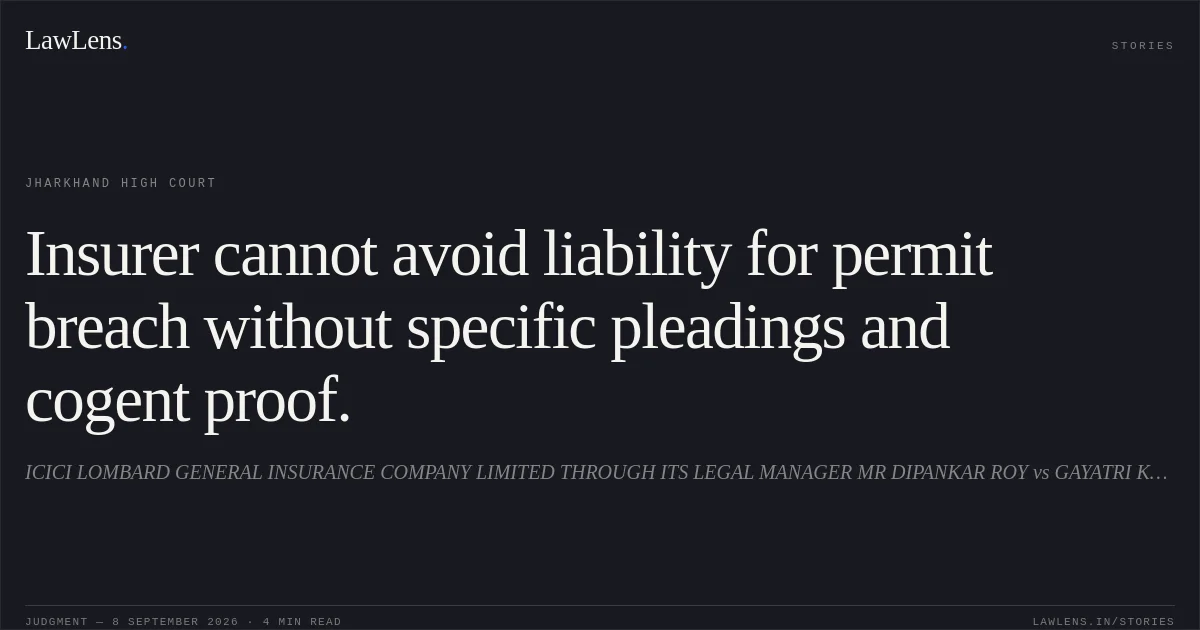
The insurer failed to prove the alleged permit violation or any fundamental breach of the policy; accordingly, its appeal was dismissed and no “pay and recover” direction was issued.
pp. 17–18 · ¶ 24–25, 48–49The claimants’ cross-objection was allowed, and the net compensation was enhanced to ₹11,90,000, after adjusting the amounts already received, with interest at 6% per annum from the date of filing of the claim petition until payment.
pp. 17–18 · ¶ 45–49The amount was to be apportioned equally among the five claimants, with the minor children’s shares kept in fixed deposits until they attained majority.
p. 18 · ¶ 50The insurer was directed to deposit the amount, together with applicable interest and after giving credit for prior deposits, within eight weeks.
pp. 18–19 · ¶ 51–53Original Court PDF
ICICI LOMBARD GENERAL INSURANCE COMPANY LIMITED THROUGH ITS LEGAL MANAGER MR DIPANKAR ROYvsGAYATRI KUAR AND ORS
Click to open original judgment
Original judgment, available to read, download and summarize on LawLens.in