Facts
On 10.08.2011, Karam Chand was travelling as a pillion rider on motorcycle No. HP-58-2633 when a truck bearing No. HP-34-0852 allegedly driven rashly and negligently collided with the motorcycle and crushed his right leg.
Source reference: paras. 2, 13He suffered grievous injuries, underwent treatment at IGMC Shimla, Fortis Hospital Chandigarh and other hospitals, and was assessed to have 60% permanent disability.
Source reference: paras. 2, 13The Motor Accidents Claims Tribunal awarded Rs.17,69,561 with interest at 9% per annum, apportioning liability between the truck and motorcycle sides.
Source reference: para. 8The truck’s owner admitted that the permit fee had been deposited only after September 2011, whereas the accident occurred on 10.08.2011; therefore, the truck was being operated without a permit.
Source reference: para. 14The Insurance Company appealed, challenging its liability, the assessment of income at Rs.6,000 per month, and the Tribunal’s finding that 60% disability resulted in 100% loss of earning capacity.
Source reference: paras. 9, 11Issues
1. Whether the use of the transport truck in a public place without a valid permit constituted a fundamental breach of the insurance policy and relieved the insurer of primary liability.
Source reference: paras. 15–20, 32–332. Whether the Tribunal was justified in treating the claimant’s 60% permanent disability as resulting in 100% loss of earning capacity.
Source reference: paras. 21, 25–273. Whether the claimant’s monthly income of Rs.6,000, future prospects, multiplier, and compensation under the various heads were correctly assessed.
Source reference: paras. 21–314. What amount of compensation was payable and which party was liable to satisfy the award.
Source reference: paras. 31–34Law Applied
Section 66 of the Motor Vehicles Act, 1988 requires a transport vehicle to be operated in a public place only in accordance with a valid permit; operation without a permit is a fundamental statutory infraction and constitutes a defence available to the insurer under Section 149(2).
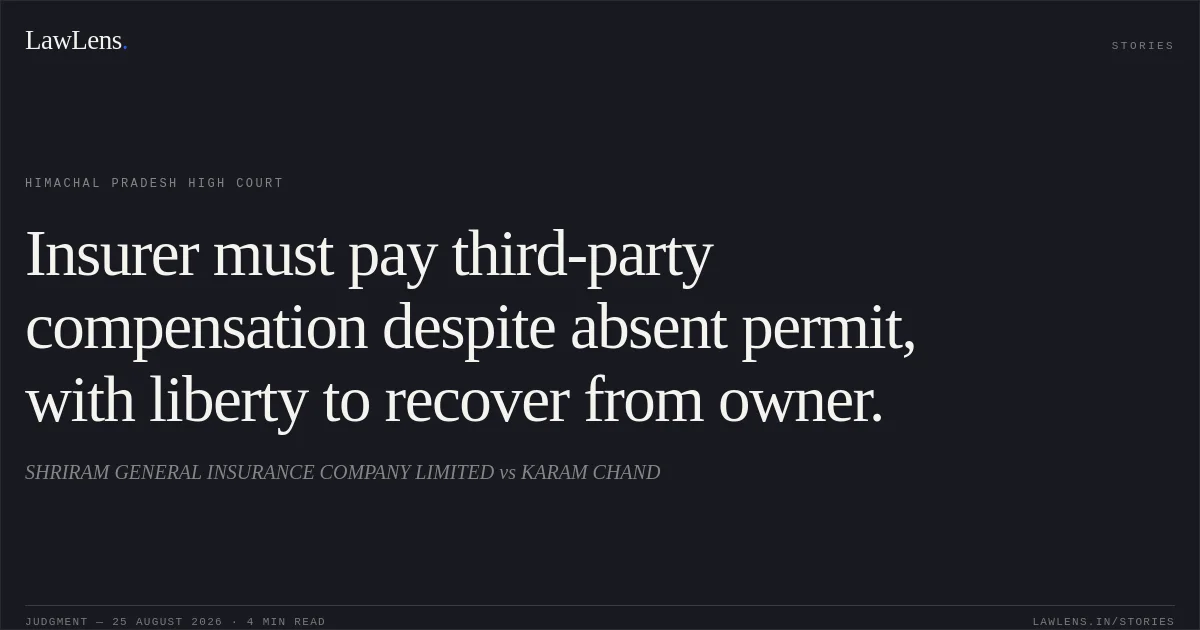
Source reference: paras. 18–25Relying on National Insurance Co. Ltd. v. Challa Upendra Rao, (2004) 8 SCC 517, and Amrit Paul Singh v. TATA AIG General Insurance Co. Ltd., (2018) 7 SCC 558, the Court held that, notwithstanding the breach, the insurer may be directed to first satisfy the award payable to a third-party victim, with liberty to recover the amount from the owner.
Source reference: paras. 18–25Under Raj Kumar v. Ajay Kumar, (2011) 1 SCC 343, the percentage of permanent physical disability is not automatically equivalent to the percentage of loss of earning capacity, which must be assessed with reference to the claimant’s occupation and circumstances.
Source reference: paras. 18–25Under Pranay Sethi v. National Insurance Co. Ltd., (2017) 16 SCC 680, a self-employed claimant below 40 years is entitled to a 40% addition for future prospects.
Source reference: paras. 18–25The multiplier is to be selected in accordance with Sarla Verma v. Delhi Transport Corporation, (2009) 6 SCC 121.
Source reference: paras. 18–25Compensation may include medical expenses, loss of earnings, future loss of earning capacity, pain and suffering, and loss of amenities, as explained in R.D. Hattangadi v. Pest Control (India) Pvt. Ltd., (1995) 1 SCC 551, and Raj Kumar.
Source reference: paras. 18–25Reasoning
The evidence established that the truck was a transport vehicle being operated without a permit on the date of the accident.
Source reference: paras. 14, 16–20Since the owner neither pleaded nor proved any statutory exception under Section 66, the Court held that there was a fundamental breach of the policy conditions.
Source reference: paras. 14, 16–20However, because the claimant was a third-party victim and the Motor Vehicles Act is beneficial legislation, the insurer was required to satisfy the applicable portion of the award first, subject to recovery from the truck owner under the pay-and-recover principle.
Source reference: paras. 32–33On quantum, the Court accepted Rs.6,000 per month as a reasonable notional income in the absence of documentary evidence.
Source reference: para. 26It rejected the Tribunal’s finding of 100% loss of earning capacity, but held that, considering the claimant’s occupation as a mason and agriculturist/horticulturist and the 60% disability to his right leg, the loss of earning capacity should be assessed at 60%.
Source reference: para. 26Applying a 40% future-prospects addition, the monthly loss was calculated at Rs.5,040, resulting in annual loss of Rs.60,480; applying the multiplier of 18 for a 25-year-old claimant, future loss of income was assessed at Rs.10,88,640.
Source reference: para. 27The Court increased the awards for pain and suffering and loss of amenities to Rs.60,000 each, while affirming the medical, taxi and attendant expenses.
Source reference: paras. 28–30Holding
The appeal was partly allowed.
The total compensation was reduced and reassessed at Rs.16,62,201, comprising Rs.10,88,640 for future loss of earnings, Rs.60,000 for loss of amenities, Rs.4,09,711 for medical expenses, Rs.33,850 for taxi charges, Rs.10,000 for attendant charges, and Rs.60,000 for pain and suffering.
Source reference: para. 31The appellant-Insurance Company was directed to first pay 60% of the compensation amount, with liberty to recover that amount from the owner of the offending truck because it had been operated without a permit.
Source reference: para. 34The remaining portion and the other terms of the Tribunal’s award, including interest at 9% per annum, were left undisturbed.
Source reference: para. 34Acts & Sections Cited
6 provisions across 1 statute referred to in this judgment. Each provision opens on LawLens.
Motor Vehicles Act, 19886
Original Court PDF
SHRIRAM GENERAL INSURANCE COMPANY LIMITEDvsKARAM CHAND
Click to open original judgment
Original judgment, available to read, download and summarize on LawLens.in
![Courts will not interfere with transfers absent mala fides or violation of statutory rules.. M Ramya vs EMPLOYEES STATE INSURANCE CORPORATION (ESIC). CAT - ['Chennai']. LawLens](/stories/thumbnails/courts-will-not-interfere-with-transfers-absent-mala-fides-or-violation-of-statutory-rules-a6845e9ca6f548fca284c51c8351957f.webp)
![Courts cannot direct one-time recruitment age relaxation absent authority in the governing rules or advertisement.. UT OF PUDUCHERRY vs M ANDAL. CAT - ['Chennai']. LawLens](/stories/thumbnails/courts-cannot-direct-one-time-recruitment-age-relaxation-absent-authority-in-the-governing-895d78fde47143e2a8ed0207c4b6a44f.webp)
![A review cannot correct an allegedly erroneous decision absent an error apparent on the record.. Ajit Kumar Jha vs RAILWAY BOARD. CAT - ['Delhi']. LawLens](/stories/thumbnails/a-review-cannot-correct-an-allegedly-erroneous-decision-absent-an-error-apparent-on-the-re-8ac952fd4eba470c92f7da20af72a220.webp)