Facts
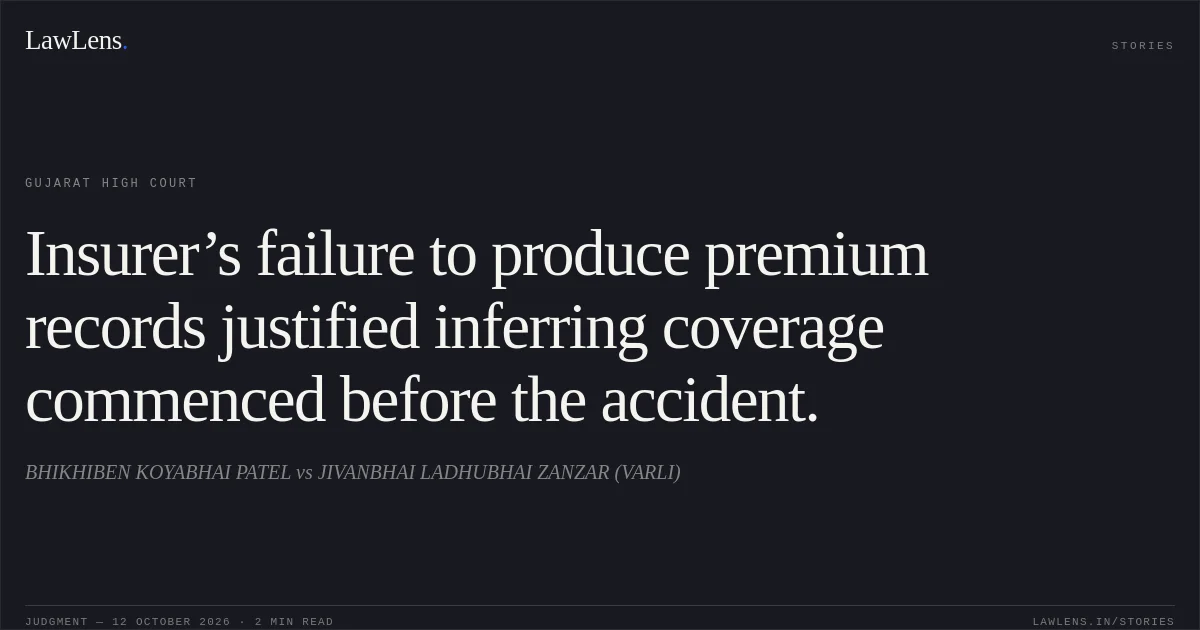
The claimants appealed against a Motor Accident Claims Tribunal award of ₹83,000 with 12% annual interest, which held the driver and owner jointly and severally liable but exonerated the insurer.
Source reference: pp. 1–3, 5–8The accident occurred on 26 January 1990; the policy stated that cover began on 1 February 1990.
Source reference: pp. 1–3, 5–8The claimants relied on a proposal form bearing the date 18 January 1990 and argued that the insurer had not proved when it received the premium.
Source reference: pp. 1–3, 5–8The insurer’s Divisional Manager could not say when the proposal was submitted or the premium received, and stated that no relevant record was available. In later appellate proceedings, he asserted that the proposal bore the date 18 June 1990, which the Court found inconsistent with the policy and his earlier evidence.
Source reference: pp. 1–3, 5–8Issues
Whether the proposal form was submitted before the accident, and when the premium was received.
Source reference: pp. 4, 6–8Whether the insurer was liable to indemnify the vehicle owner and pay the compensation despite the policy’s stated commencement date of 1 February 1990.
Source reference: pp. 4, 8–9Law Applied
Section 173 of the Motor Vehicles Act, 1988, provides for an appeal against an award of the Claims Tribunal.
Source reference: p. 1Relying on Oriental Insurance Co. Ltd. v. Dharam Chand (2010 ACJ 2659), the Court applied the principle that an insurer’s risk commences upon receipt of the premium; once received, the insurer cannot disown its liability to third parties.
Source reference: p. 8The insurer relied on National Insurance Co. Ltd. v. Sobina Lakai, (2007) 7 SCC 786, for the proposition that cover ordinarily commences on the date specified in the policy, but the Court did not accept that submission on the evidence before it.
Source reference: pp. 4–5The claimants also cited United India Insurance Co. Ltd. v. Laxmamma, (2012) 5 SCC 234.
Source reference: p. 3Reasoning
The Court treated the proposal date and receipt of premium as material to determining when the risk commenced.
Source reference: pp. 5–8The contemporaneous policy material indicated a proposal date of 18 January 1990, before the accident, while the insurer failed to produce records establishing that the premium was received after the accident. Its witness could not verify the proposal or premium dates, and the later assertion that the proposal was signed on 18 June 1990 was inconsistent with the policy’s commencement on 1 February 1990 and with the witness’s earlier evidence.
Source reference: pp. 5–8In those circumstances, the Court drew the inference that the proposal and cover note were signed on 18 January 1990 and held that the insurer could not avoid liability on the basis of the policy’s stated commencement date.
Source reference: pp. 5–8Holding
The appeal was partly allowed. The Court set aside the Tribunal’s finding exonerating the insurer and modified the award to make the driver, owner and insurer jointly and severally liable for ₹83,000, with interest at 12% per annum from the date of the claim petition until realization.
The insurer was directed to pay the decretal amount and accrued interest to the Tribunal within eight weeks; the remaining directions of the Tribunal were left undisturbed.
Source reference: p. 9Acts & Sections Cited
1 provisions across 1 statute referred to in this judgment. Each provision opens on LawLens.
Motor Vehicles Act, 19881
Original Court PDF
BHIKHIBEN KOYABHAI PATELvsJIVANBHAI LADHUBHAI ZANZAR (VARLI)
Click to open original judgment
Original judgment, available to read, download and summarize on LawLens.in