Facts
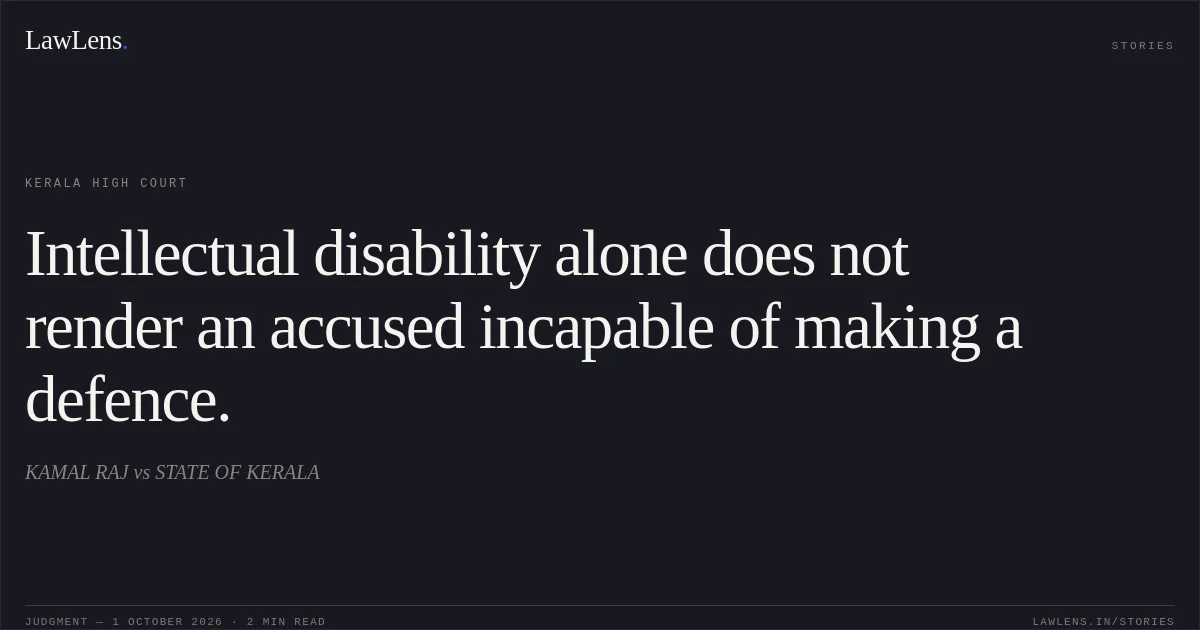
The revision petitioner, the sole accused in S.C. No. 314 of 2025, contended that intellectual disability rendered him incapable of making his defence and that proceedings should therefore be postponed under Section 368 of the Bharatiya Nagarik Suraksha Sanhita, 2023 (BNSS).
Source reference: para. 1, 6Following psychiatric evaluation, a Medical Board assessed the petitioner and reported both developmental and adaptive difficulties and a low IQ, but also found that he could understand the allegations and proceedings, answer questions coherently, and communicate relevant information to his advocate.
Source reference: para. 11–12The trial court, after enquiry, found him capable of making his defence and fit to stand trial. He challenged that order in revision, alleging that the court had failed to properly assess the medical evidence.
Source reference: para. 2, 4–5Issues
Whether the petitioner’s intellectual disability and reported low IQ rendered him incapable of making his defence under Section 368 of the BNSS
Source reference: para. 6–9Whether the trial court’s finding that the petitioner was fit to stand trial, based on the medical reports and his functional capacity, warranted interference in revision
Source reference: para. 13, 17Law Applied
Section 368 of the BNSS requires an enquiry into an accused’s mental condition and capacity to make a defence; if the accused is found incapable, further proceedings are to be postponed in accordance with law.
Source reference: para. 6–7The relevant test is functional: whether the accused can understand the nature and substance of the proceedings, comprehend the accusation, answer questions relevantly and coherently, and communicate relevant facts and instructions to counsel.
Source reference: para. 8–9Intellectual disability, low IQ, poor academic performance, or a lower social age does not, by itself, establish incapacity to stand trial.
Source reference: para. 8–9, 14No judicial precedents were cited.
Source reference: no citationReasoning
The Court held that the Medical Board’s findings directly addressed the petitioner’s functional capacity: he could understand the allegations and proceedings, comprehend and answer questions coherently, and communicate information relevant to his defence to counsel.
Source reference: para. 15–16Although the reports recorded developmental difficulties and intellectual disability, those matters did not establish incapacity under the statutory test. The trial court had conducted the Section 368 enquiry and considered the medical reports and the petitioner’s functional abilities; accordingly, its finding involved no demonstrated error warranting revision.
Source reference: para. 13–17Holding
The Court concluded that the petitioner’s intellectual disability and low IQ did not, without more, make him incapable of making his defence, and upheld the finding that he was fit to stand trial.
The criminal revision petition was dismissed.
Source reference: para. 17Acts & Sections Cited
1 provisions across 1 statute referred to in this judgment. Each provision opens on LawLens.
Bharatiya Nagarik Suraksha Sanhita, 20231
Original Court PDF
KAMAL RAJvsSTATE OF KERALA
Click to open original judgment
Original judgment, available to read, download and summarize on LawLens.in