Facts
The petitioner, a transferee from the Junior Assistant cadre, claimed that he was senior to respondents 4–10 and eligible for promotion from Assistant Commissioner (Commercial Taxes) to Deputy Commissioner.
Source reference: pp. 3–8, paras. 2–9He challenged G.O. (Ms.) No. 132 dated 18 October 2013, which included 40 Assistant Commissioners in the temporary promotion list but excluded him.
Source reference: pp. 3–8, paras. 2–9He argued that he had completed the prescribed probation in September 2012, while the respondents’ probation requirements had been relaxed.
Source reference: pp. 3–8, paras. 2–9The State opposed the petition, contending that the petitioner was not in the permanent cadre list of Assistant Commissioners and that respondents 4–10 were senior under the settled inter se seniority principles governing direct recruits and transferees.
Source reference: pp. 9–14, paras. 11–18Issues
Whether the petitioner could claim that respondents 4–10 were his juniors, and challenge their inclusion in the 2013 promotion list, despite not establishing his prior inclusion in the relevant permanent cadre list.
Source reference: pp. 15–18, paras. 21–28Whether the petitioner’s completion of probation and service in a temporary promotion enabled him to claim consideration for promotion as Deputy Commissioner.
Source reference: pp. 12–14, paras. 14–18; p. 17, para. 25Law Applied
The Court applied the seniority guidelines laid down by the Madras High Court in W.P. No. 12786 of 1985, affirmed by the Supreme Court in Civil Appeal No. 1454 of 1987, and subsequently directed to be followed in related proceedings, including Contempt Petition No. 263 of 2007.
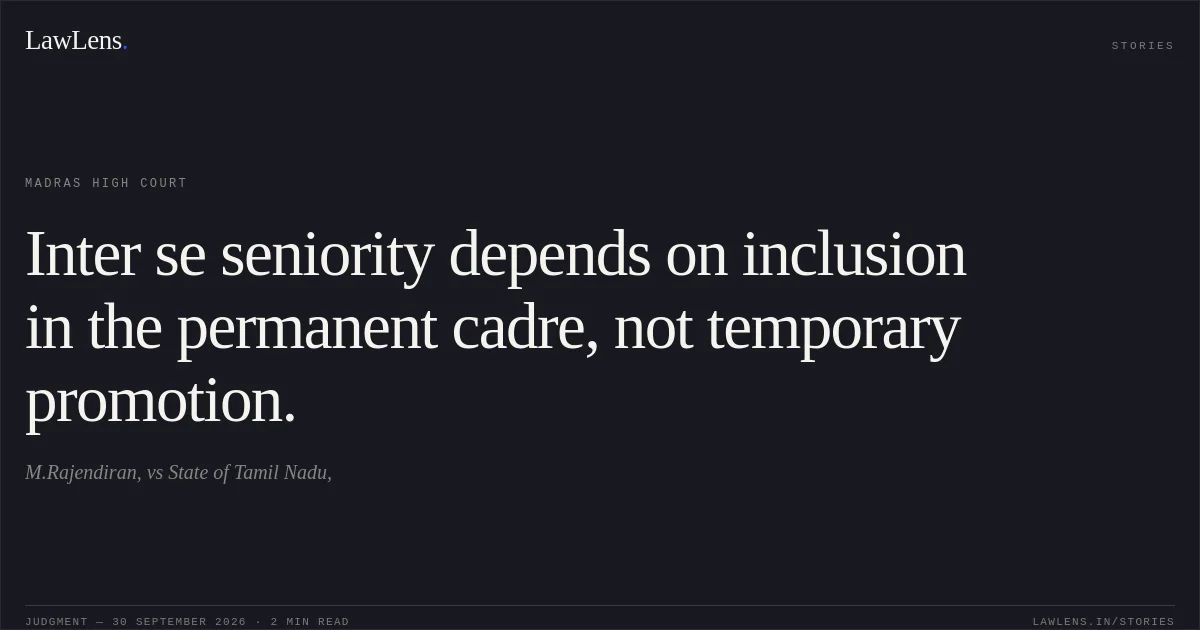
Source reference: pp. 9–11, paras. 11–13Under those principles, inter se seniority was to be determined by reference to inclusion in the permanent cadre list, rather than merely by earlier service or temporary promotion.
Source reference: pp. 15–16, paras. 21–25The Court also considered Rule 48 of the General Rules and the relevant provisions of the Tamil Nadu Commercial Taxes Service Rules concerning probation and promotion, as reflected in the impugned proceedings and the parties’ submissions.
Source reference: pp. 6–8, paras. 7–9Reasoning
The Court held that the petitioner’s claim of being senior arose from his service in the ACTO cadre, where respondents 4–10 were direct recruits and the petitioner was a transferee.
Source reference: p. 15, paras. 21–22The governing seniority principles had already been settled and affirmed by the Supreme Court; the petitioner therefore could not reopen them in this proceeding.
Source reference: p. 15, paras. 21–22The respondents were included in the permanent list for 2002, whereas the petitioner’s name appeared in the permanent list only for 2004.
Source reference: pp. 16–17, paras. 23–25His earlier service and temporary promotions did not establish seniority over them or entitlement to inclusion in the Deputy Commissioner promotion list.
Source reference: pp. 16–17, paras. 23–25The petitioner had also not challenged his placement in the 2004 list or the respondents’ inclusion in the 2002 list, and the Court regarded his belated claim as acquiesced in and an afterthought.
Source reference: pp. 17–18, paras. 26–28Holding
The Court answered the issues against the petitioner.
It held that he had not established that respondents 4–10 were his juniors or that his exclusion from the 2013 promotion list was unlawful.
Source reference: p. 19, paras. 29–30The writ petition was dismissed as devoid of merit, and the connected miscellaneous petitions were closed; no costs were ordered.
Source reference: p. 19, paras. 29–30Original Court PDF
M.Rajendiran,vsState of Tamil Nadu,
Click to open original judgment
Original judgment, available to read, download and summarize on LawLens.in