Facts
The appellant manufactured coconut oil in small and large containers. The Department, relying on CBEC Circular No. 890/10/2009-CX dated 3 June 2009, treated coconut oil packed in containers of up to 200 ml as excisable under Chapter 33.
Source reference: paras. 2, 15–16The appellant challenged the circular before the Madras High Court and obtained an interim order restraining the Department from demanding duty, subject to execution of a bond with surety/security.
Source reference: paras. 2, 15–16Subsequently, citing difficulty in arranging the required security, the appellant registered with the Department and paid duty under protest from 2011, while simultaneously filing refund claims electronically through the ACES portal.
Source reference: paras. 2, 15–16The Madras High Court ultimately declared the circular ultra vires on 29 April 2014.
Source reference: para. 3Pursuant to departmental instructions, the appellant filed physical refund claims in Form ‘R’ on 31 January 2015, received on 6 February 2015.
Source reference: para. 5The refund claims were sanctioned on 5 May 2015 under Section 11B of the Central Excise Act, 1944.
Source reference: para. 5On 17 June 2019, the appellant claimed statutory interest under Section 11BB of the Act, computed from three months after the dates of the electronic refund claims.
Source reference: para. 4The adjudicating authority rejected the claims, and the Commissioner (Appeals) upheld the rejection on the grounds that the refund became due only after the High Court’s judgment, that the physical claims were processed within three months, and that the interest claim was barred by delay, laches and limitation.
Source reference: paras. 4–6Issues
1. Whether the appellant’s claim for statutory interest under Section 11BB was barred by delay, laches or limitation because it was made several years after sanction of the refund and without appeal against the refund-sanctioning orders?
Source reference: para. 12(i)2. Whether the duty payments made by the appellant from 2011 and the contemporaneous electronic refund claims were voluntary payments made at the appellant’s own peril, or payments made under protest with the Department’s knowledge?
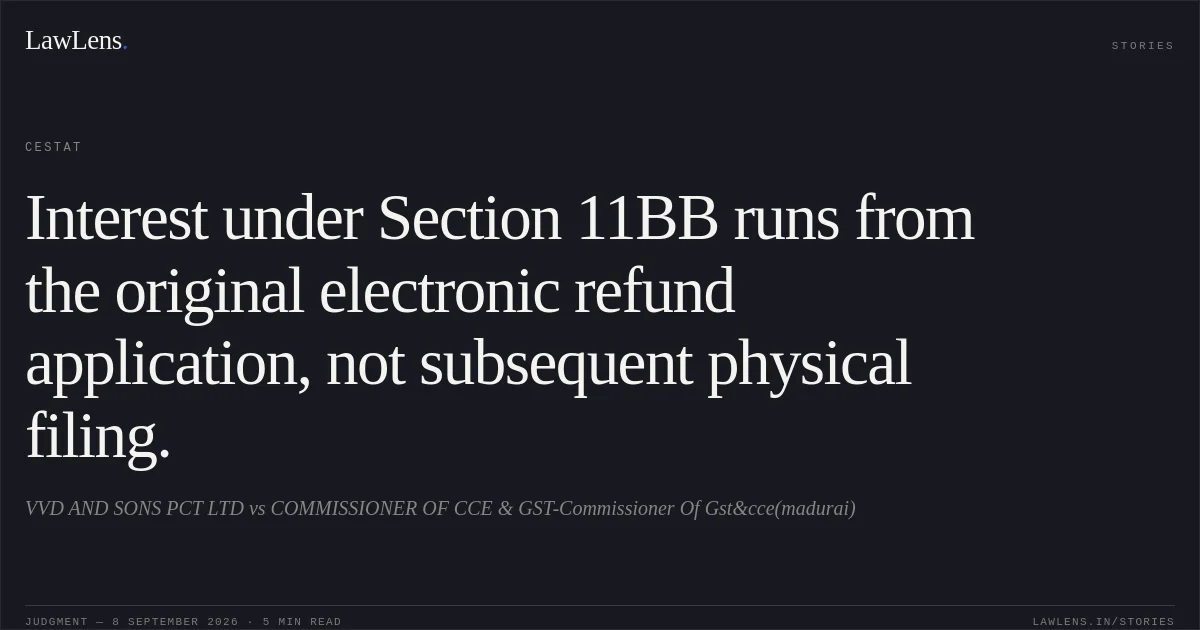
Source reference: para. 12(ii)3. Whether the electronic refund claims filed through ACES, rather than the subsequent physical Form ‘R’ claims filed in 2015, constituted the applications under Section 11B(1) for calculating the three-month period under Section 11BB?
Source reference: para. 12(iii)4. Whether the appellant was entitled to interest under Section 11BB and, if so, for what period and in what amount?
Source reference: para. 12(iv)Law Applied
Section 11BB of the Central Excise Act imposes an automatic statutory obligation to pay interest where a refund is not made within three months from receipt of the application under Section 11B(1), as held in Ranbaxy Laboratories Ltd. v. Union of India, 2011 (273) E.L.T. 3 (S.C.).
Source reference: para. 13The obligation is not dependent upon a separate claim for interest, an appellate direction, or an appeal against the refund order; the Tribunal relied on Siddhant Chemicals v. Union of India, 2014 (307) E.L.T. 44 (All.), and Shakti Enterprises v. Commissioner of Central Excise, 2003 (157) E.L.T. 514 (Kar.).
Source reference: para. 13The second proviso to Section 11B(1) protects refund claims relating to duty paid under protest, notwithstanding the pendency of the underlying dispute.
Source reference: para. 18An electronic refund claim received without objection or a deficiency memo must be treated as a complete application from its date, consistent with Union of India v. Hamdard (Waqf) Laboratories, 2017 (51) S.T.R. 214 (S.C.), Swaraj Mazda Ltd. v. Union of India, 2009 (235) E.L.T. 788 (Bom.), and ABS Professional Services India Pvt. Ltd. v. Commissioner, 2018 (362) E.L.T. 920 (Tri.-Mumbai).
Source reference: paras. 17–18Clause (ec) of Explanation (B) to Section 11B, which identifies the relevant date where refund follows a judgment or court order, governs the limitation period for filing a refund claim under Section 11B(1), but does not postpone the commencement of interest under Section 11BB.
Source reference: para. 21Reasoning
The Tribunal held that the appellant’s 2019 letter was merely a reminder of an interest liability that arose automatically under Section 11BB and was not a fresh, limitation-barred claim.
Source reference: para. 13The Department’s own appeal against the refund orders remained pending until 30 May 2016, and the original refund orders contained no adverse determination concerning interest; therefore, the appellant’s failure to appeal or file cross-objections did not extinguish its statutory entitlement.
Source reference: para. 13The payments were treated as payments under protest because the appellant expressly communicated its decision to pay under protest, the Department accepted the registration, payments and electronic claims without objection, and ultimately sanctioned the refund.
Source reference: paras. 15–16The interim order restrained the Department, but did not prevent the appellant from voluntarily paying under protest under the statutory protection of Section 11B(1).
Source reference: paras. 15–16The Tribunal further held that the electronic claims were valid applications under Section 11B(1).
Source reference: paras. 18–20, 24They were filed contemporaneously with the protest payments, received by the Department without a deficiency memo or rejection, and sought the same amounts later refunded.
Source reference: paras. 18–20, 24The subsequent physical Form ‘R’ claims were therefore only administrative reiterations and could not displace the earlier filing dates.
Source reference: paras. 18–20, 24Clause (ec) of Explanation (B) did not make the High Court’s order dated 29 April 2014 the starting point for interest because that clause concerns the limitation period for filing a refund claim, whereas Section 11BB expressly refers to the date of receipt of the application under Section 11B(1).
Source reference: para. 21The Tribunal distinguished JSW Steel Ltd. v. Commissioner of Customs, since that case involved later quantification of an initially unascertained excess payment, whereas the present refund amounts corresponded exactly to the duty paid and claimed from the outset.
Source reference: para. 22Holding
The Tribunal allowed the appeals and set aside the impugned Orders-in-Appeal insofar as they rejected the appellant’s claim for interest.
It held that the appellant was entitled to interest under Section 11BB, calculated from the expiry of three months after receipt of each electronic refund claim, rather than from the date of the physical Form ‘R’ claims filed in February 2015.
Source reference: paras. 24, 26The matter was remanded to the jurisdictional Assistant/Deputy Commissioner solely to verify the exact dates of receipt of the electronic claims and quantify interest at the notified rate up to 5 May 2015, the date on which the refunds were sanctioned.
Source reference: para. 25The authority was directed to complete the proceedings, after following natural justice, and sanction the quantified interest within ninety days of receiving the order.
Source reference: para. 25Original Court PDF
VVD AND SONS PCT LTDvsCOMMISSIONER OF CCE & GST-Commissioner Of Gst&cce(madurai)
Click to open original judgment
Original judgment, available to read, download and summarize on LawLens.in
![Pay fixation under Rule 11, not Rule 7, applies to employees promoted before revised-pay adoption who opted from promotion date.. ANIL KUMAR & ORS vs General Manager N C Rly. CAT - ['Allahabad']. LawLens](/stories/thumbnails/pay-fixation-under-rule-11-not-rule-7-applies-to-employees-promoted-before-revised-pay-ado-ff90b7d9eeba468e8f873872fd10d767.webp)
![Post-acquittal representation against dismissal must be considered under Rule 12 by the competent authority.. VINIT YADAV vs HOME AFFAIRS. CAT - ['Delhi']. LawLens](/stories/thumbnails/post-acquittal-representation-against-dismissal-must-be-considered-under-rule-12-by-the-co-c979b525ee9a4311a0f3bf3d9621b50c.webp)