Facts
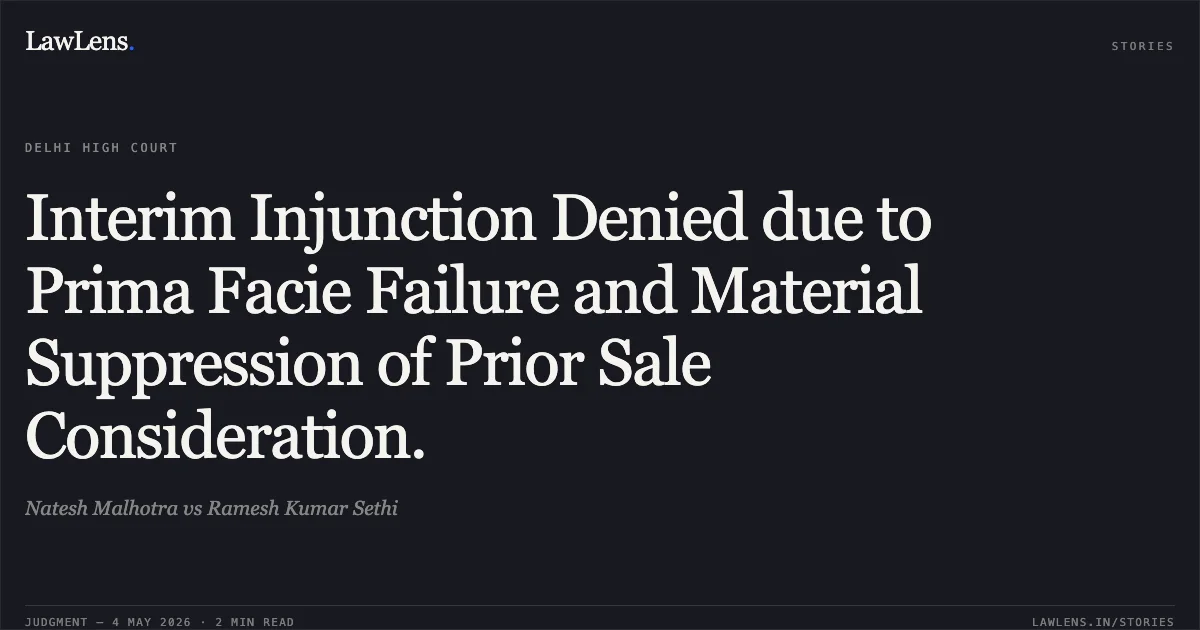
The Appellant (plaintiff), a tenant on the first floor of property B-20, Jungpura Extension, entered into an Agreement to Sell with the Respondent (landlord) on 27.12.2022 for the said first floor.
Source reference: p. 1-2Subsequently, the Appellant alleged that a second Agreement to Sell was executed on 12.09.2023 for both the ground and first floors for a total consideration of ₹1,65,00,000/-.
Source reference: p. 2The Appellant claimed he paid ₹45,55,000/- via bank transfers and offered the balance, which the Respondent refused.
Source reference: p. 2-3The Respondent contested the suit, claiming the first agreement for the first floor alone was for ₹2,26,00,000/- and that the second agreement was forged/fabricated.
Source reference: p. 3The Trial Court dismissed the Appellant’s Order XXXIX Rule 1 & 2 CPC application for interim injunction on 31.01.2025, leading to this appeal.
Source reference: p. 1Issues
1. Whether the Appellant established a prima facie case, balance of convenience, and irreparable injury to warrant an interlocutory injunction against the Respondent.
Source reference: p. 4, para. 82. Whether the Appellate Court should interfere with the discretionary order passed by the Trial Court refusing the injunction.
Source reference: p. 4-5, para. 9Law Applied
The court applied the "Triple Test" for interim injunctions under Order XXXIX Rules 1 & 2 of the CPC, as established in Gujarat Bottling Co. Ltd. vs. Coca Cola Co., requiring the concurrent existence of a prima facie case, balance of convenience, and irreparable injury.
Source reference: p. 4, para. 8Regarding appellate intervention, the court followed Wander Ltd. v. Antox India (P) Ltd. and Mohd. Mehtab Khan v. Khushnuma Ibrahim Khan, which mandate that an Appellate Court should not interfere with a Trial Court’s discretion unless the order is arbitrary, capricious, or perverse.
Source reference: p. 4-5, para. 9The principle of suppressio veri (suppression of truth) was also applied regarding the disclosure of material facts in the plaint.
Source reference: p. 6, para. 12Reasoning
The Court found that the Appellant failed to establish a prima facie case due to significant inconsistencies and concealment of facts.
Source reference: p. 5, para. 11Specifically, the Appellant suppressed the fact that the first agreement for one floor was for a much higher value (₹2.26 Crores) than the second alleged agreement for two floors (₹1.65 Crores).
Source reference: p. 5-6, para. 12The Court noted that most payments claimed by the Appellant were made prior to the first agreement, undermining the claim that they were earnest money for the second agreement.
Source reference: p. 6, para. 12Relying on the Trial Court’s observation of suppressio veri and suggestio falsi, the Court held that the Appellant's lack of transparency disentitled him to equitable relief.
Source reference: p. 6, para. 12Consequently, the balance of convenience did not favor the Appellant.
Source reference: p. 6, para. 12Holding
The High Court dismissed the appeal and concurred with the Trial Court's findings.
The Court held that there was no ground to interfere with the Trial Court’s discretion as the Appellant failed the triple test for an injunction and was guilty of concealing material facts regarding the sale consideration.
Source reference: p. 5-6The application for interim relief remained dismissed.
Source reference: p. 6, para. 14Original Court PDF
Natesh MalhotravsRamesh Kumar Sethi
Click to open original judgment
Original judgment, available to read, download and summarize on LawLens.in