Facts
The Respondent, an employee of the Petitioner school, filed a civil suit seeking a declaration of his designation as a Supervisor and the release of unpaid salary.
Source reference: p.2On 14.06.2022, the Trial Court passed an interim order directing the Petitioners to pay 50% of the Respondent's monthly salary for the period of April 2021 to May 2022, subject to an undertaking.
Source reference: p.3, para 4This interim order was upheld by the Appellate Court and subsequently by the High Court in a previous challenge.
Source reference: p.3, paras 5-7Despite these affirmations, the Petitioners failed to comply, leading the Respondent to seek execution. The Trial Court, via an impugned order dated 15.10.2025, allowed the execution application and directed coercive measures, including the attachment of school bank accounts and the potential detention of the Managing Director for non-compliance.
Source reference: p.3-4, para 8The Petitioners challenged this execution order, alleging it lacked jurisdiction.
Source reference: p.4, para 10Issues
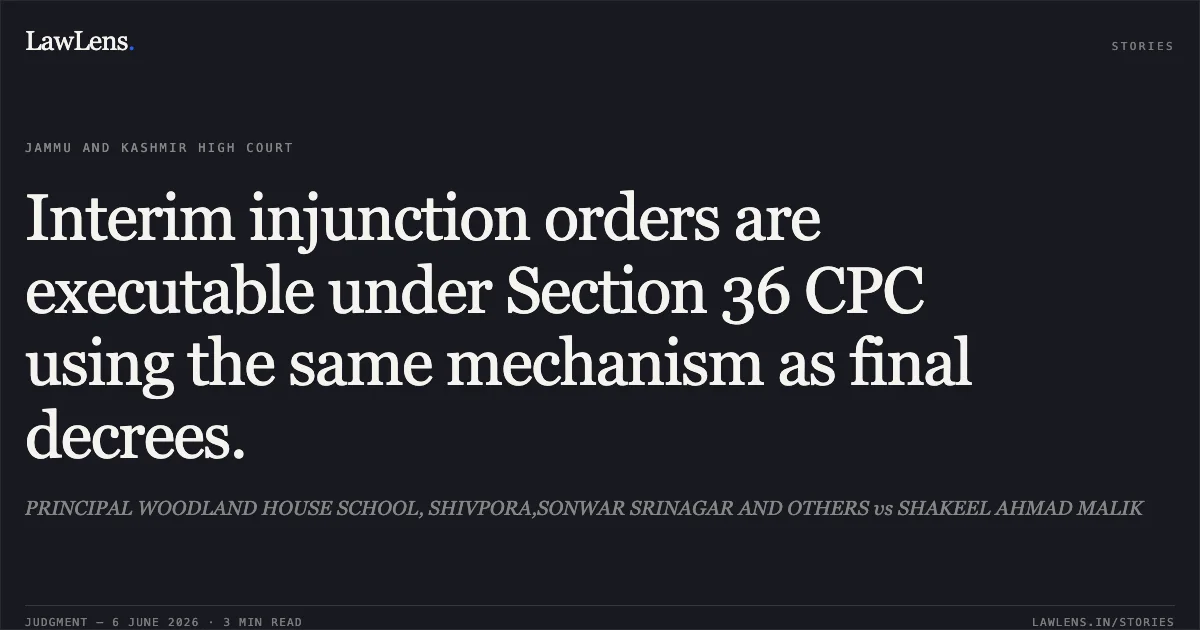
1. Whether an interlocutory/interim order passed under Order XXXIX Rules 1 and 2 of the CPC is executable under Section 36 of the CPC.
Source reference: p.10, para 312. Whether the pendency of a Review Petition against a previous High Court order operates as an automatic stay on the execution of the Trial Court’s interim directions.
Source reference: p.11, para 16; p.15, para 433. Whether the Trial Court exceeded its jurisdiction by adopting coercive execution measures instead of proceeding solely under Order XXXIX Rule 2-A of the CPC.
Source reference: p.4, para 11Law Applied
The Court primarily applied Section 36 of the Code of Civil Procedure (CPC), which mandates that provisions relating to the execution of decrees shall apply to the execution of orders.
Source reference: p.11, para 32The Court relied on the Supreme Court precedent in Sheela Jerald & Ors. v. Pushpadasan (2018), which held that interim injunctions are executable via Section 36 and that Order XXXIX Rule 2-A is a supplemental, not exclusive, remedy.
Source reference: p.11-12, paras 34-35The Court further referenced Venkat Niloba Kabade v. Kishan Dadarao Dhuma (1983) to affirm that execution machinery for decrees under Order XXI is available for interlocutory orders.
Source reference: p.13, para 37Principles regarding the misuse of judicial process and the imposition of costs were drawn from Subrata Roy Sahara v. Union of India (2014) and Pandurang Vithal Kevne v. BSNL (2024).
Source reference: p.19-20, paras 60-62Reasoning
The Court rejected the Petitioners' argument that interim orders are inexecutable, noting that Section 36 CPC does not distinguish between final and interlocutory orders, thereby making the execution mechanism of Order XXI fully available.
Source reference: p.11, para 33The Court reasoned that the Petitioners' conduct displayed a "continuous pattern of litigation" intended to frustrate a judicial mandate affirmed by three forums.
Source reference: p.9, para 26-28Regarding the Review Petition, the Court clarified that mere filing does not constitute a stay; thus, the order remained binding.
Source reference: p.15, para 44-45The Court found that the Trial Court acted within the liberty granted by the High Court in previous proceedings to adopt "any mode available in law" for enforcement.
Source reference: p.9, para 28The Court observed with concern that the Trial Court had relied on incorrect or non-existent judicial citations, possibly due to unverified AI tools, emphasizing that while technological aids are useful, judicial officers bear the ultimate responsibility for the accuracy of precedents.
Source reference: p.22-24, paras 70-73Holding
The Court answered that interim orders are fully executable under Section 36 CPC and the remedy under Order XXXIX Rule 2-A is not exhaustive.
The High Court dismissed the petition, upheld the impugned order dated 15.10.2025, and directed the Petitioners to comply with the original salary payment order. Due to the vexatious nature of the litigation, the Court imposed costs of Rs. 25,000 on the Petitioners. Detailed guidelines were issued to all judicial officers in the Union Territory to independently verify any legal citations or AI-generated content before incorporation into judicial orders.
Source reference: p.21-25, paras 64, 66-67, 75Acts & Sections Cited
2 provisions across 1 statute referred to in this judgment. Each provision opens on LawLens.
Code of Civil Procedure, 19082
Original Court PDF
PRINCIPAL WOODLAND HOUSE SCHOOL, SHIVPORA,SONWAR SRINAGAR AND OTHERSvsSHAKEEL AHMAD MALIK
Click to open original judgment
Original judgment, available to read, download and summarize on LawLens.in


![Subsequent exoneration does not retrospectively invalidate a finalized promotion select list.. UNNIKRISHNAN M vs M/o Environment And Forests. CAT - ['Ernakulam']. LawLens](/stories/thumbnails/subsequent-exoneration-does-not-retrospectively-invalidate-a-finalized-promotion-select-li-ce80a0e84f2f4887857271e8b4341c42.webp)